

From Survival to Sovereignty: AU and WHO Deepen Alliance for Africa’s Health Future
Written By Maxine Ansah
|
Getting your Trinity Audio player ready...
|
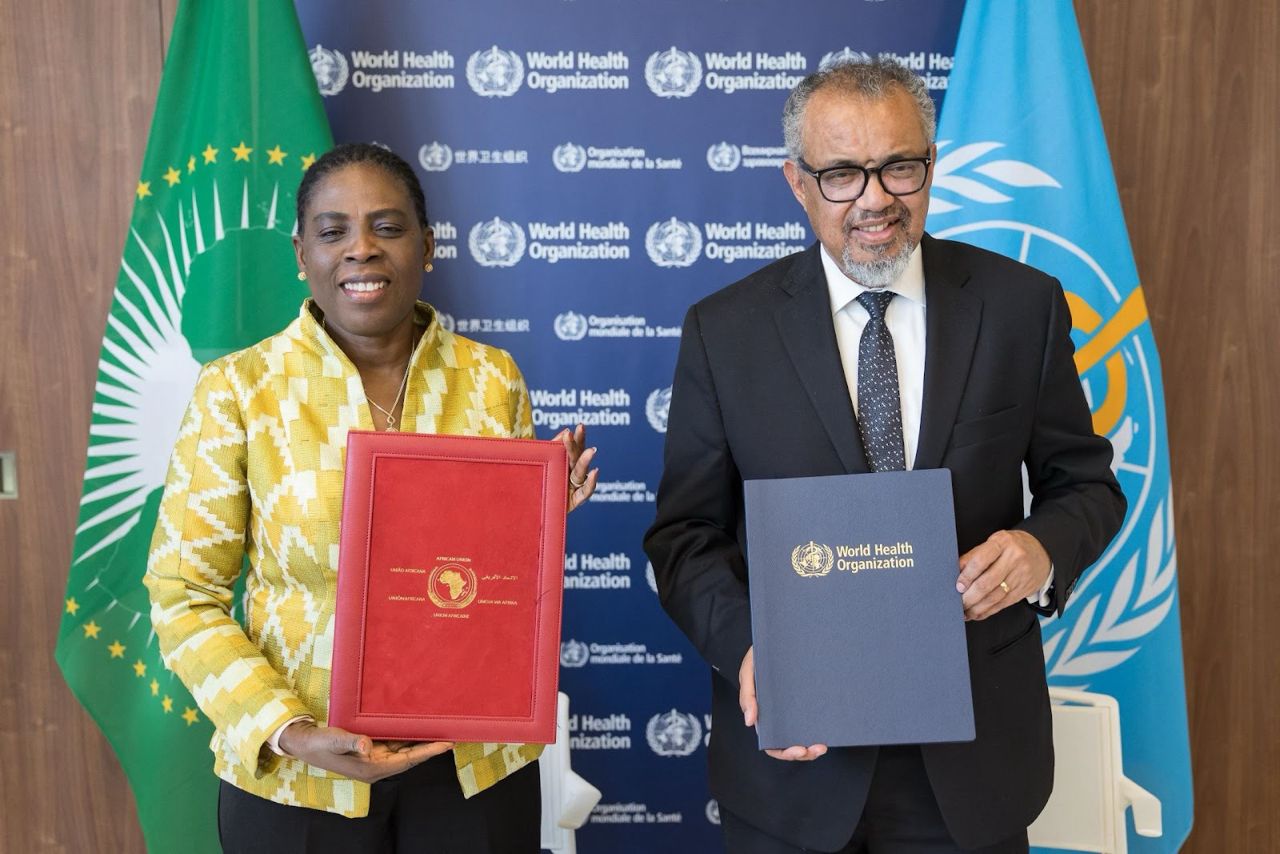
In a renewed display of unity and purpose, the African Union (AU) Commission and the World Health Organization (WHO) have signed an updated Memorandum of Understanding (MoU) to strengthen Africa’s health systems and accelerate progress towards universal health coverage. The agreement was signed on 24 May 2025 on the margins of the 78th World Health Assembly in Geneva.
The updated MoU builds upon the 2019 agreement and represents a significant leap forward in aligning the strategic priorities of both institutions. It arrives at a critical time: the global health landscape is facing financial strain and bilateral aid is increasingly uncertain. In this context, the AU and WHO have chosen collaboration over fragmentation and resilience over dependency.
The agreement was signed by Her Excellency Ambassador Amma Adomaa Twum-Amoah, Commissioner for Health, Humanitarian Affairs and Social Development, on behalf of His Excellency Mahmoud Ali Youssouf, the Chairperson of the African Union Commission, as well as by Dr Tedros Adhanom Ghebreyesus, the Director-General of the WHO. Their signatures not only symbolised commitment but also reinvigorated efforts to drive sustainable health solutions for the African continent.
“This Agreement marks a new chapter in AU–WHO cooperation,” said Commissioner Twum-Amoah. “By working together more closely, we can better respond to the health needs of our populations and ensure that no one is left behind. We need to move from budgeting for survival to planning for health sovereignty.”
The renewed partnership reaffirms WHO’s role as the lead technical authority in global and regional health. It positions the AU Commission’s Department of Health, Humanitarian Affairs and Social Development as a central force in implementing Africa’s health policies. With Africa now a member of the G20, the continent’s voice in global health governance has never been more influential.
Dr Tedros echoed the urgency and significance of this development. “This renewed agreement comes at a critical time, as cuts to bilateral aid imperil the health of millions in Africa,” he said. “It reflects our determination to translate our partnership into tangible results and support countries to transition to sustainable self-reliance. We are proud to stand with the African Union in driving forward the health priorities of the continent.”
The MoU identifies five priority areas for collaboration:
1. Health systems strengthening: Including support for local pharmaceutical manufacturing; regulatory harmonisation; promotion of traditional medicine; domestic health financing; digital health innovation; and workforce development.
2. Reproductive, maternal, neonatal, child, and adolescent health (RMNCAH): Continued commitment to the Campaign on Accelerated Reduction of Maternal Mortality in Africa (CARMMA Plus 2021–2030) and support for the reviewed Addis Ababa Declaration on Immunisation (ADi).
3. Disease prevention and control: Implementation of AU frameworks targeting communicable and noncommunicable diseases; intensified efforts to end AIDS, tuberculosis and malaria; elimination of neglected tropical diseases (NTDs); and addressing viral hepatitis in line with WHO strategies.
4. Nutrition and food security: Strengthening the implementation of the Africa Nutrition Strategy 2015–2025 and associated WHO strategies related to nutrition efforts.
5. Health in emergency settings: Enhancing joint responses to humanitarian crises, conflicts and climate-related emergencies.
The renewed MoU reflects not only a pragmatic response to existing challenges but also a vision for Africa’s health sovereignty. The AU has consistently championed regional resilience and inclusive partnerships. By renewing its strategic alliance with WHO, it is positioning itself to deliver meaningful, long-term health outcomes.
As the world grapples with rising costs and shifting priorities in global health, Africa is choosing to invest in coordination, collaboration and capacity. The continent is not merely reacting to change; it is actively shaping its future. The WHO–AU partnership stands as a model for multilateral cooperation that is both visionary and grounded in action.