

Counting More Than Numbers: The Unsung Work of Migration Enumerators in Djibouti
Written By Maxine Ansah

|
Getting your Trinity Audio player ready...
|
Obock, Djibouti – At first glance, migration data might look like nothing more than numbers on a page: graphs showing tens of thousands on the move, percentages of unaccompanied minors or pregnant women, and flows that rise or fall with the seasons. Yet behind every data point along the Eastern Route, one of the world’s busiest and most dangerous migration corridors, lies a deeply human story. And it is the work of dedicated enumerators in Djibouti that ensures these stories are not lost.
The Eastern Route cuts across the Horn of Africa through Ethiopia, Somalia and Djibouti, carrying countless migrants with hopes pinned on reaching Saudi Arabia. In 2024 alone, nearly half a million movements were recorded on this route: over 430,000 outbound journeys and close to 16,000 return trips. Beyond these striking figures are the people who gather and interpret them, often meeting migrants at their most vulnerable.
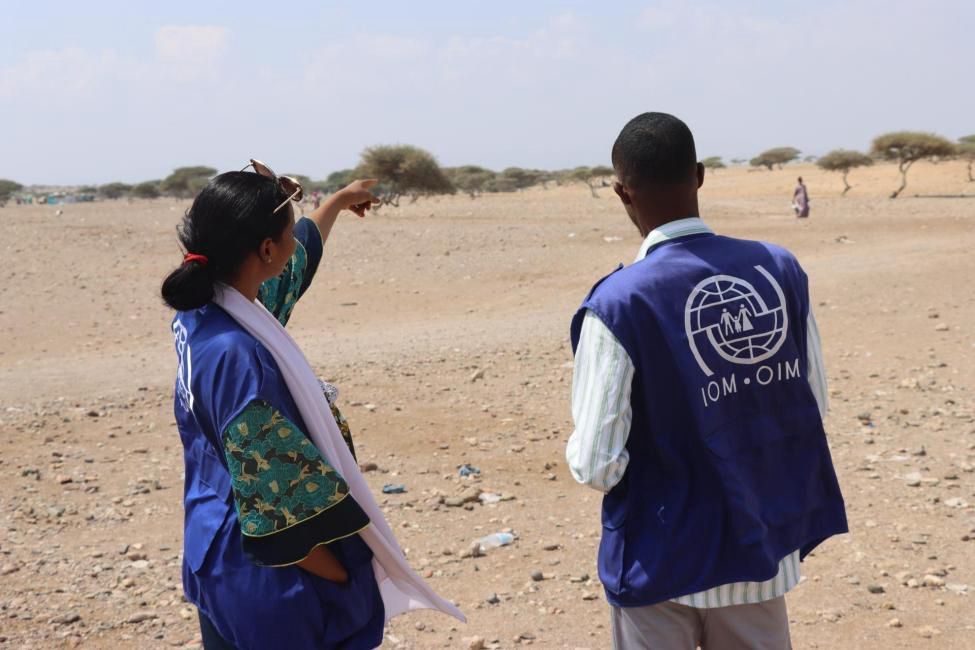
IOM’s Displacement Tracking Matrix (DTM) employs more than a dozen enumerators across nine flow monitoring points dotted across Djibouti’s rugged landscape. From Ali Sabieh in the south to Obock in the north, these enumerators collect critical data to inform humanitarian responses and, in many cases, provide the first line of support to migrants in distress.
One such enumerator is Hemeda Amin, who has worked with IOM since 2023. A native of Tadjourah, she has seen how the migration patterns have changed.
“In the past, it was mostly Ethiopians who crossed the Eastern Route,” Hemeda says. “Now we also see Sudanese.”
According to IOM data, 2024 marked the first year that Sudanese nationals were officially recorded on this route, along with smaller groups from Chad, Kenya and the Central African Republic. The route, once predictable, is becoming more complex.
Children remain among the most vulnerable travellers. Last year, over 43,000 minors were counted on the Eastern Route, representing about 10 per cent of all recorded movements. Nearly a quarter of these children were travelling alone. Hemeda has seen the reality behind these figures.
“Unaccompanied children are among the most vulnerable we encounter,” she notes. “We also registered over 500 pregnant and lactating women, and even seven elderly persons on the route last year.”
When migrants need immediate help, IOM’s Transit Centre in Tadjourah provides shelter, food, mental health support and assistance for voluntary return. Enumerators like Hemeda play a crucial role by referring those in need to this lifesaving help.
Further north, Ahmed Mohamed joined the DTM team in Obock in mid-2024, working at a key transit hub where migrants often disembark from boats or return from Yemen, many bearing physical and emotional scars.
“We see between 200 and 500 migrants a day,” Ahmed explains. “The flow can change with the month, but they keep coming.”
Temperatures in this part of Djibouti can rise between 45 and 52 degrees Celsius, making the work even more challenging.
Smugglers adapt to the heat, moving migrants at night to avoid detection. To keep pace, Ahmed coordinates with colleagues like Fatouma in Khor Angar near the Gulf of Aden to ensure no one slips through unnoticed. This work, supported by funding from EU Humanitarian Aid (ECHO), is vital to protect migrants and capture accurate data that guides aid efforts.
These efforts are part of the broader Migrant Response Plan (MRP) for the Horn of Africa to Yemen and Southern Africa, coordinated by IOM. Through the plan, over one million migrants and members of host communities in Djibouti receive humanitarian support ranging from medical care to shelter.
In a field often reduced to figures, the daily dedication of enumerators like Hemeda and Ahmed serves as a reminder that migration is not only about numbers, but about people. Their quiet commitment ensures that every statistic reflects a human life, a hope and a story worth telling.