

Madagascar coup leader Randrianirina sworn in as president
Source: Associated Press

|
Getting your Trinity Audio player ready...
|
ANTANANARIVO, Madagascar — Just three days after announcing that the military was taking control, Colonel Michael Randrianirina—commander of Madagascar’s elite CAPSAT unit—has been sworn in as president, completing one of the fastest coups in the country’s history. The ousted president, Andry Rajoelina, fled Madagascar claiming threats to his life and was later impeached in absentia.
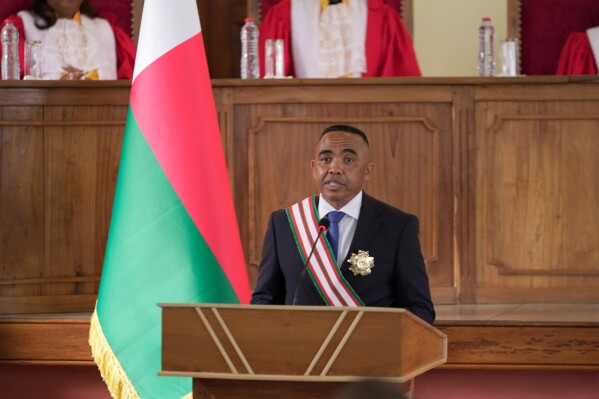
The swearing-in at the High Constitutional Court saw Randrianirina, 50, exchange his camouflage for a dark suit and blue tie as he promised to “break away from the harmful practices of the past.” It was a familiar scene for a country where democracy has struggled to stay upright—ceremonial swords raised, trumpets sounding, and the world once again issuing statements of “deep concern.”
The United Nations and African Union both condemned the power grab as an “unconstitutional change of government.” The European Union called for the “restoration of democratic values.” But for most international observers, it’s déjà vu: Madagascar has seen multiple coups since independence in 1960, including the one that ironically first brought Rajoelina to power in 2009. The country remains suspended from the African Union.
Behind the palace drama lies a much larger story — three weeks of youth-led protests fueled by anger over blackouts, water shortages, corruption, and unemployment. At least 22 people were killed during the demonstrations, according to the U.N. Frustration among Gen Z citizens ignited the unrest, but it was the military that seized the moment. As one protester, Emmanuel Rabemanantsoa, put it, “The previous president failed to listen to the youth — and this is the result.”
Randrianirina, once jailed for an attempted mutiny, now says the country will be ruled by a military council for up to two years before elections are held. Analysts warn that the young people who sparked the movement for change may now have to wait even longer to see it. Still, in the capital Antananarivo, soldiers have been cheered in the streets, seen by some as rescuers of a “dying country.”
Meanwhile, Madagascar’s famous exports — vanilla and lemurs — remain more stable than its politics. Nearly 75% of the population lives in poverty, according to the World Bank, and yet the island’s greatest export may be its ability to repeat history.
For Africa, Madagascar’s crisis is both a cautionary tale and a mirror: when citizens cry for reform, and soldiers answer first, democracy risks being the casualty. The continent’s youth are demanding change — not coups. What happens next will test whether Madagascar’s new leadership can turn rebellion into renewal, or if it’s just another rerun of the old script.