


|
Getting your Trinity Audio player ready...
|
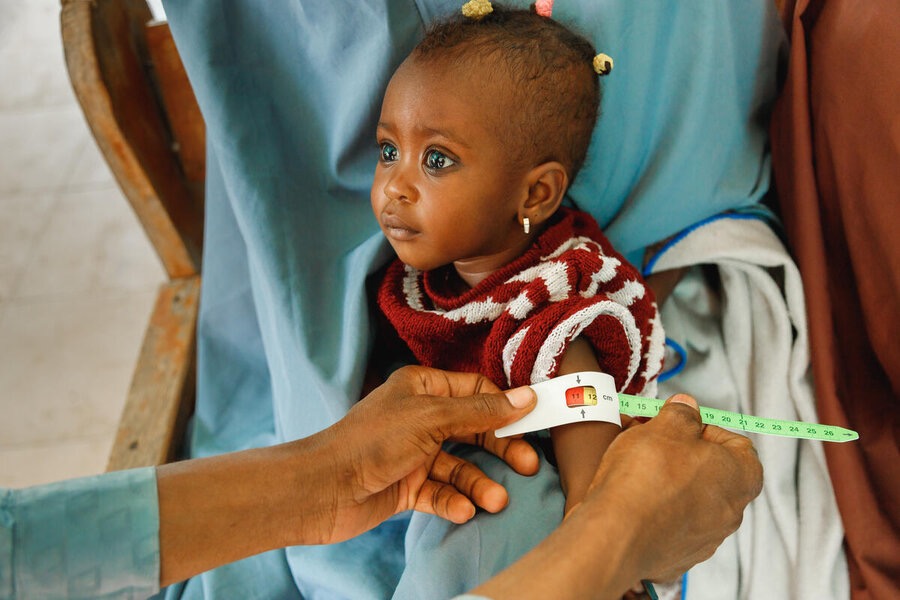
Outside a health centre in the northeastern Nigerian town of Dikwa, women and children sit on wooden benches waiting for treatment. A health worker wraps a mid upper arm circumference band around the tiny arm of one year old Zara. The band slips into the red zone. She is severely malnourished.
“Even when we get food, it is always the same thing,” says her mother Maryam, 20, describing a daily diet of maize and sorghum. “That is why there is no improvement to her health.”
At the clinic, supported by the World Food Programme, Zara receives specialised nutrient rich food designed to restore her strength. Yet that support may not last. Hunger and malnutrition are worsening across Nigeria, even as humanitarian agencies face shrinking resources.
Nearly 35 million people are projected to face severe food insecurity during the June to August lean season next year, according to recent findings from the Cadre Harmonise. This is the highest hunger level ever recorded for Nigeria and the highest on the African continent.
Rising violence, particularly in north central Nigeria, is driving the surge. At the same time, funding cuts threaten to leave the World Food Programme and other humanitarian agencies unable to provide assistance at scale.
In northern Nigeria, six million people are expected to experience acute or worse food insecurity in 2026. In Borno State, where conflict and kidnappings persist, 15,000 people are at risk of catastrophic food insecurity next year, the most severe classification under global food security standards.
Despite the scale of need, WFP is currently able to support 900,000 people with food and nutrition assistance in northeastern Nigeria. By the end of December, that number is expected to fall by half. Without new funding, millions could be left without aid in 2026.
“Communities are under severe pressure from repeated attacks and economic stress,” says David Stevenson, WFP Country Director in Nigeria. “If we cannot keep families fed and food insecurity at bay, growing desperation could fuel increased instability, with insurgent groups exploiting hunger to expand their influence.”
Maryam’s family lives in a displacement camp in Dikwa, sheltering in a small tent made of straw, sticks and tarpaulin. She sews clothes to help buy food, while her husband tries to farm borrowed land. The risks are constant. If armed groups attack, the family could lose their harvest or their lives.
“We live in fear,” she says.
In July, WFP was forced to scale down nutrition programmes due to funding shortfalls, closing dozens of clinics across northeastern Nigeria. As a result, the health of around 300,000 young children has been placed at risk.
“Hunger is now reaching levels we have not seen in years,” says Emmanuel Bigenimana, head of WFP’s area office in the northeast. “This toxic mix of food insecurity, fear and desperation creates conditions that armed groups can exploit, increasing risks for the wider region.”
Near the Borno State capital of Maiduguri, two year old Modu Modu is receiving treatment for malnutrition at another WFP supported clinic. His mother, Bintu, says the family was forced to flee their village of Isanari after bandits attacked.
“We had nothing. We had to start all over again,” she says. With few ways to earn income, “we just eat small amounts.”
In Dikwa, 30 year old Hadiza recounts being kidnapped by an armed group and held for eight years in a forest camp. Released four years ago, she now supports her family of five by selling fried yams, potatoes and soybean cakes, alongside WFP food assistance.
“Honestly, we would like to see peace return to our lives, with everyone going back to their farms,” she says.
That hope is echoed by Fatima, 20, who also lives in the Dikwa displacement camp. Her family now relies on WFP electronic transfers worth about 31 US dollars per person each month.
The money allows them to buy maize, rice, vegetable oil and spaghetti. At the start of the month, they eat three meals a day. By the end, food runs low.
“We are living on food assistance alone,” Fatima says. “It is everything to us.”
WFP’s operations in Nigeria are supported by the African Development Bank Group, Canada, the European Commission, France, Germany, the Republic of Korea, Saudi Arabia, Sweden, the United Kingdom, the United States, UNCERF and private donors.
To maintain assistance for 900,000 people, WFP requires 116 million US dollars in funding through May 2026.
Across Africa, Nigeria’s crisis reflects a broader challenge facing young nations grappling with conflict, climate shocks and economic strain at the same time. Sustained investment in peace, food systems and humanitarian response remains critical, not only to save lives today, but to stabilise communities and protect the region’s future.
Northern Nigeria hunger, Nigeria food insecurity, WFP Nigeria crisis, Borno State hunger, northeast Nigeria conflict, Nigeria malnutrition children, Cadre Harmonise Nigeria, West Africa food crisis, humanitarian funding cuts Africa, Nigeria displacement camps, Boko Haram hunger impact, Nigeria acute food insecurity, WFP nutrition programmes Nigeria, African hunger hotspots, Nigeria lean season hunger, food insecurity West Africa, conflict and hunger Nigeria, humanitarian aid Nigeria shortfall, child malnutrition Borno, WFP funding appeal Nigeria, African development crisis, Nigeria IDP camps food aid, instability West Africa hunger, UN WFP Nigeria warning, Africa food security outlook, Nigeria violence and hunger link, humanitarian assistance Africa, Nigeria famine risk, Borno State malnutrition clinics, food aid cuts Nigeria, Africa humanitarian funding gap, Nigeria conflict displacement, hunger driving instability Africa, WFP electronic transfers Nigeria, food assistance IDPs Nigeria, Africa crisis response, Nigeria nutrition emergency, African security spillover risks, food insecurity and extremism Africa, WFP Nigeria appeal 2026, hunger and conflict nexus Africa, Nigeria rural livelihoods crisis, displaced families Nigeria hunger, Africa humanitarian needs growth, Nigeria malnutrition rates, Borno IDP food access, West Africa stability risks, UN food security Africa, Nigeria hunger emergency