

Saudi Crown Prince and Sudan’s Transitional Leader Hold Strategic Talks in Riyadh Amid Search for Stability

|
Getting your Trinity Audio player ready...
|
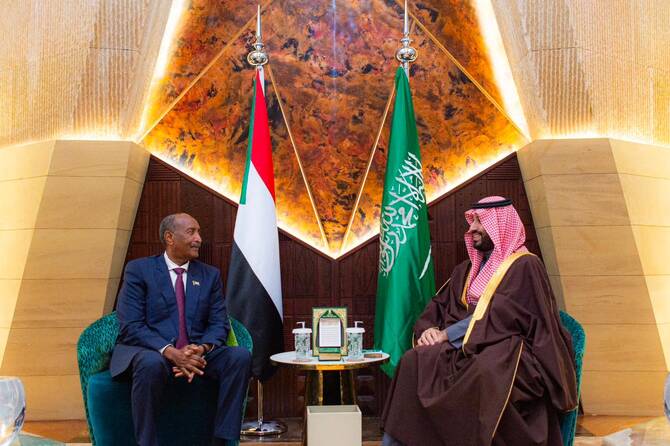
Saudi Arabia intensified its diplomatic engagement on Tuesday as Crown Prince Mohammed bin Salman met Gen. Abdel Fattah Al‑Burhan, head of Sudan’s Transitional Sovereignty Council, to review the escalating conflict in Sudan and explore pathways toward restoring security and political stability.
The talks, held at Al‑Yamamah Palace in Riyadh, come at a moment when Sudan faces one of the world’s most severe humanitarian crises, with millions displaced and regional tensions rising. Saudi Arabia has been a central actor in efforts to mediate between Sudan’s warring parties, co‑chairing the earlier Jeddah peace talks and consistently calling for humanitarian access and a durable ceasefire.
Strategic Dialogue Focused on Security and Regional Stability
According to Saudi officials, discussions centered on:
-
The security trajectory of Sudan’s conflict
-
Regional spillover risks across the Red Sea and the Horn of Africa
-
Humanitarian access and cross‑border delivery systems
-
Opportunities for coordinated international pressure on armed groups
-
Long‑term frameworks for political transition and institution‑building
Saudi ministers in defense, foreign affairs, finance and national security were present in the meeting, underlining the strategic weight Riyadh attaches to Sudan’s future.
A Critical Moment for Sudan — and for Regional Diplomacy
Diplomats familiar with the process say that Riyadh’s engagement has grown increasingly urgent as instability threatens key maritime corridors, commercial routes and investment zones tied to Vision 2030 and wider Gulf‑African cooperation.
For Sudan, the meeting represents one of the most high‑profile regional dialogues since the eruption of conflict, offering signals that:
-
Saudi Arabia remains willing to act as a stabilizing partner
-
Sudan’s interim leadership is seeking broader international legitimacy
-
A renewed diplomatic track may be possible heading into 2026
Why This Meeting Matters to Africa’s Political Landscape
TVOA analysts note that the Saudi–Sudanese relationship has implications far beyond bilateral ties:
-
Economic stakes: Sudan’s agricultural and mining potential remains vital to Gulf‑Africa trade corridors.
-
Security stakes: Instability threatens the Red Sea security architecture—an area of shared interest for Riyadh and African Union partners.
-
Humanitarian stakes: Over 20 million Sudanese require aid, making regional coordination essential.
-
Geopolitical stakes: With shifting power blocs in Africa, major diplomatic players—Saudi Arabia among them—are repositioning to shape long‑term influence.
TVOA Insight
The Riyadh meeting showcases the emerging role of Gulf–Africa diplomacy, where economic partnerships, logistics networks, investment flows and political mediation increasingly intersect.
This reflects a broader trend: African stability is now seen as integral to global markets, supply chains and security frameworks.