

Violence in Jonglei pushes hundreds of thousands of children towards hunger crisis
By Maxine Ansah
|
Getting your Trinity Audio player ready...
|
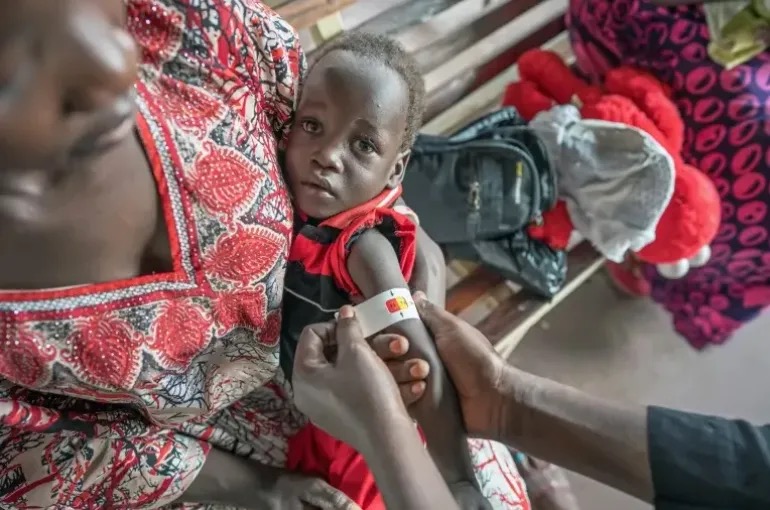
An escalation of violence in Jonglei state is placing the lives of more than 450,000 children at risk of acute malnutrition, as mass displacement and insecurity disrupt access to food, health care and essential nutrition services, according to UNICEF in South Sudan.
Clashes that have intensified since the start of 2026 have reportedly displaced at least 250,000 people, particularly across the northern and central areas of Jonglei State. Many families have fled with little more than what they could carry, leaving children exposed to hunger, disease and worsening malnutrition in a region already facing some of the highest child malnutrition rates in the country.
“We are extremely concerned for women and children impacted by these violent clashes,” said Noala Skinner, UNICEF’s Country Representative in South Sudan. She warned that a malnourished child without treatment is twelve times more likely to die and urged all parties to the conflict to cease hostilities and allow rapid, safe and unhindered access for humanitarian workers to reach displaced and vulnerable communities.
Humanitarian access has been severely constrained by insecurity and restrictions on movement by river, road and air. These limitations are preventing life saving assistance from reaching those most in need. Six counties in Jonglei state already have, or are close to having, stock outs of therapeutic foods, a critical treatment for children suffering from severe acute malnutrition.
The impact of the violence is also being felt across the health system. UNICEF reports that 17 health facilities nationwide have closed due to conflict, resulting in the suspension of associated nutrition services. In addition, ten incidents of looting of health and nutrition supplies have been recorded, with five occurring in Jonglei alone, further weakening an already fragile system.
Despite the access challenges, UNICEF says it is continuing to respond where possible. Water purification equipment, buckets and soap have been dispatched to Duk County amid concerns over a potential cholera outbreak. Supplies have also been sent to Akobo in Jonglei state, including malaria treatments, therapeutic food for malnourished children and emergency health kits sufficient to support more than 10,000 people.
The situation in Jonglei reflects a wider pattern across South Sudan, where cycles of violence, displacement and under investment in basic services continue to place children at the centre of a deepening humanitarian crisis. For a country still in its early years of nationhood, the strain on institutions and communities remains immense. Yet across Africa, these crises also highlight the importance of sustained international attention, local resilience and long term investment in peace and child centred development. Protecting children today is not only a humanitarian imperative, but a foundation for a more stable and hopeful future for the continent.
Editor’s note: Figures relating to displacement remain provisional and are yet to be formally confirmed by the United Nations in South Sudan. Current estimates are based on information from the Relief and Rehabilitation Commission and the Government of South Sudan.
South Sudan crisis, Jonglei violence, malnourished children Africa, UNICEF South Sudan, child hunger South Sudan, acute malnutrition Africa, humanitarian access South Sudan, displaced children Jonglei, conflict and hunger Africa, health facilities South Sudan, therapeutic food shortage, cholera risk South Sudan, Akobo humanitarian aid, Duk County displacement, child mortality malnutrition, African humanitarian crises, UN aid South Sudan, women and children conflict zones, East Africa insecurity, fragile health systems Africa, child nutrition emergencies, displacement in Africa, Jonglei humanitarian situation, South Sudan children at risk, violence and displacement Africa, UN children protection, food insecurity South Sudan, conflict affected children, African child health, humanitarian workers access, civil unrest South Sudan, nutrition services disruption, emergency health kits Africa, malaria treatment South Sudan, water sanitation aid Africa, early warning hunger Africa, African conflict reporting, UN humanitarian briefing, South Sudan development challenges, young African states conflict, Africa peace and stability, child survival Africa, humanitarian law access, African displacement trends, Jonglei state insecurity, South Sudan aid funding, children in war zones Africa, Africa humanitarian response, UN agencies Africa, malnutrition mortality risk, South Sudan nutrition crisis, African children rights, conflict driven hunger, Africa development reporting, humanitarian corridors Africa, UN appeals South Sudan, child focused aid Africa, violence impact on health, Africa emergency response, South Sudan humanitarian update, Jonglei displacement figures, African post conflict states, protecting children Africa, Africa humanitarian journalism