

UNFPA backs UN80 reforms as merger talks with UN Women enter assessment phase
By Maxine Ansah

|
Getting your Trinity Audio player ready...
|
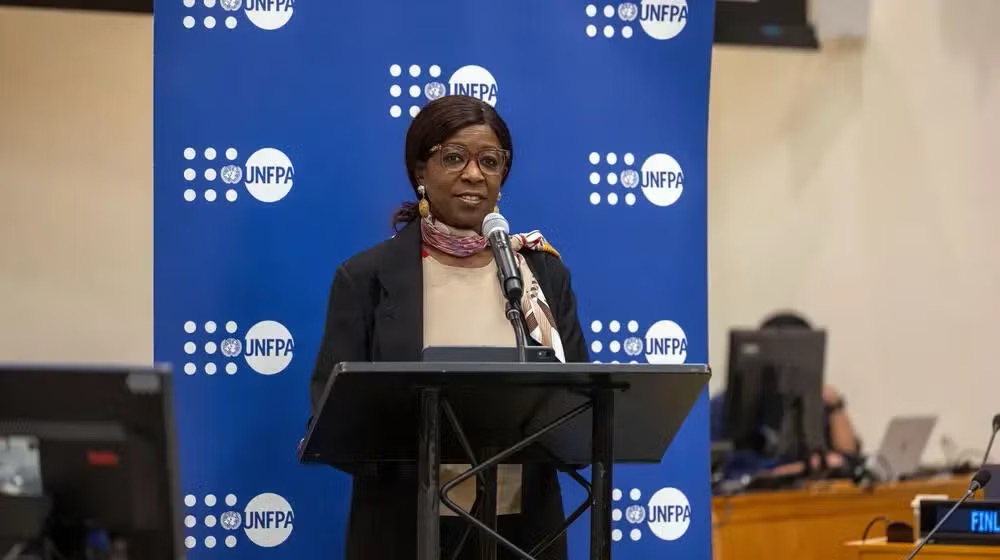
At the First Regular Session of the Executive Board, Ms Diene Keita, Executive Director of United Nations Population Fund, outlined UNFPA’s position on the UN80 reform agenda, signalling firm support for the Secretary-General’s vision of a more agile, integrated and effective United Nations.
Addressing the joint segment on UN80, Ms Keita said UNFPA is already implementing reforms aligned with the initiative’s priorities, including workstreams on human rights, supply chains, efficiencies, funding, knowledge hubs, regional and country configurations, and the planned sunsetting of UNAIDS. She stressed that the organisation’s technical, programmatic and normative work remains central, particularly as demographic shifts, overlapping crises and rising humanitarian needs increase demand for UNFPA’s services.
Ms Keita underscored UNFPA’s delivery record, pointing to Multilateral Organisation Performance Assessment Network and Joint Inspection Unit assessments that confirm the strength of its systems and processes. In humanitarian settings, she reaffirmed UNFPA’s role in ensuring women’s and girls’ needs remain central to response efforts, including its mandate as provider of last resort on gender-based violence.
Turning to institutional reform, Ms Keita confirmed UNFPA’s readiness to assess the benefits and risks of a possible merger with UN Women, following a request from the Secretary-General. She emphasised that the exercise is exploratory and evidence-based, focusing on a baseline assessment, feasibility, potential benefits, principal risks, credible merger pathways and conditions for success. Work on the risk matrix and cost-benefit analysis is ongoing.
The assessment, she said, deliberately examines only a merger scenario and tests whether deeper institutional integration could strengthen coherence, accountability and political resilience without compromising operational delivery. A shared vision statement presented to Member States envisages a world where gender equality is lived reality, with women and girls exercising full rights, bodily autonomy, economic power and choice.
Potential benefits identified include a stronger unified global voice on gender equality and sexual and reproductive health and rights, improved end-to-end value creation from global standards to community-level delivery, and enhanced coordination in humanitarian and crisis contexts. At the same time, Ms Keita highlighted key risks, including political backlash, the dilution of sensitive mandates, transition complexity that could disrupt life-saving services, funding uncertainty, and legal and operational challenges. She also warned of the risks of inaction amid mounting pushback and declining resources.
Throughout her statement, Ms Keita stressed that UN80 is not about protecting institutions but about protecting rights and delivering better outcomes for those furthest behind. She reaffirmed that sexual and reproductive health and rights, gender equality, demographic data and youth engagement are intrinsically linked, as reflected in UNFPA’s Strategic Plan endorsed by Member States in August.
Closing her remarks, Ms Keita reiterated UNFPA’s core principles, including that women’s rights are human rights and that sexual and reproductive health and rights are for everyone. She affirmed that any decisions on the way forward rest with Member States and committed UNFPA to continued consultations with the Executive Board, civil society and partners as the UN80 process unfolds.
For Africa, where demographic change, humanitarian crises and gender inequality intersect sharply, the stakes of UN reform are particularly high. As African countries continue to build institutions and systems often less than a century old, the need for a responsive, rights-centred UN architecture is not abstract. It is practical and urgent. How UNFPA and its partners adapt under UN80 will shape whether African women and girls are protected, counted and empowered in the decades to come.
UNFPA, UN80, UN reform, UNFPA Executive Board, Diene Keita, UN Women merger, gender equality UN, sexual and reproductive health rights, SRHR, women’s rights UN, humanitarian response women, gender based violence UN, provider of last resort GBV, UN humanitarian reset, Agenda 2030, Sustainable Development Goals, ICPD Programme of Action, Beijing Platform for Action, UN governance reform, UN institutional reform, Africa gender equality, African women rights, reproductive health Africa, UNFPA Africa, UN Women Africa, demographic change Africa, youth peace and security, UNFPA funding, voluntary funding UN, MOPAN assessment UN, Joint Inspection Unit UN, UN supply chains, UN efficiencies, UN knowledge hubs, regional UN reform, country level UN reform, humanitarian crisis response, women and girls in crises, UN political backlash gender, funding uncertainty UN, legal complexity UN merger, operational feasibility UN, sexual health commodities, reproductive health supplies, population data census, gender data UN, Africa humanitarian needs, women’s health Africa, girls’ rights Africa, UN development system reform, UN Secretary-General reforms, multilateral reform Africa, global governance gender, African perspectives UN, UNFPA mandate, UN Women mandate, rights based development Africa, future of UN gender architecture, Africa SDGs gender, women girls youth UN, dignity rights opportunity Africa