

Addis Ababa Talks: AU and UN Close Ranks on Reform, Industrialisation and Global Equity
By Maxine Ansah

|
Getting your Trinity Audio player ready...
|
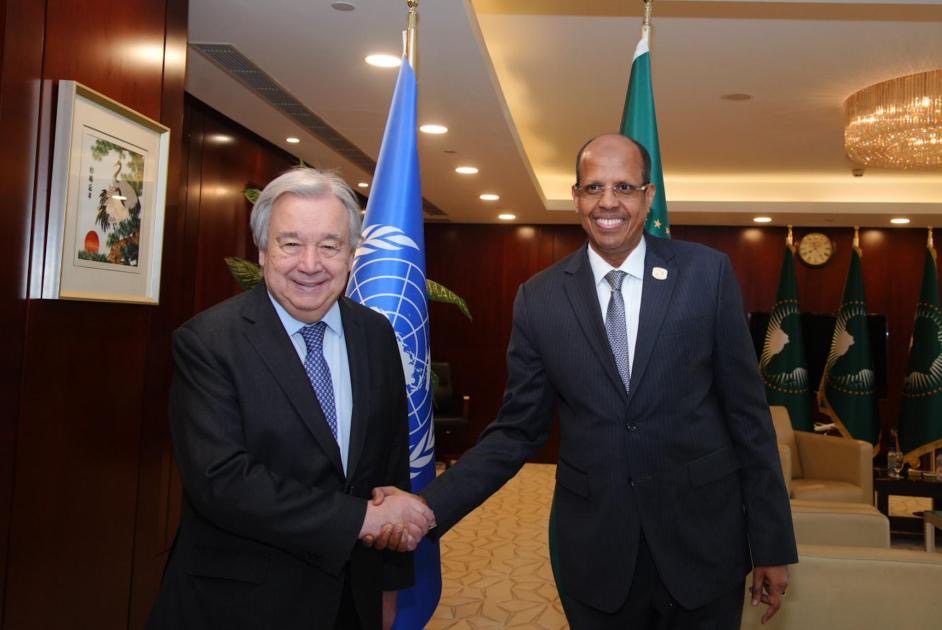
On the margins of the 39th Ordinary Session of the Assembly of Heads of State and Government of the African Union, the Chairperson of the African Union Commission, Mahmoud Ali Youssouf, received the Secretary-General of the United Nations, António Guterres, at the AU Headquarters in Addis Ababa.
The Chairperson welcomed the Secretary-General and expressed appreciation for his steadfast commitment to Africa and to strengthening multilateralism at a time of heightened global uncertainty. He underscored that the AU–UN partnership remains a cornerstone of effective global governance and a vital instrument for advancing peace, security and sustainable development.
Both leaders reaffirmed their shared resolve to deepen strategic cooperation in line with Africa’s continental priorities as articulated in Agenda 2063 and the purposes and principles of the UN Charter.
Discussions centred on regional peace and security, sustainable development and inclusive economic transformation. The two leaders stressed that Africa’s industrialisation is indispensable to achieving the continent’s growth trajectory, generating dignified employment for its youthful population and consolidating long-term stability. They reaffirmed their commitment to advancing structural transformation, value addition and resilient economies consistent with the aspirations of Agenda 2063.
Secretary-General Guterres commended the Chairperson’s leadership in elevating the African Union’s voice and agency within global diplomacy. He recognised Africa’s constructive and influential role in advancing multilateral reform efforts, including in the context of the Pact for the Future, where the continent has demonstrated principled and forward-looking leadership.
He reaffirmed that the AU stands as the UN’s most strategic multilateral partner, noting its increasingly central role in shaping the global peace and security architecture, conflict prevention and mediation efforts, and development cooperation.
On reform of the UN Security Council, both leaders were unequivocal. They emphasised that reform remains an urgent and historic imperative. In the interest of equity, justice and enhanced legitimacy of the multilateral system, Africa must be accorded permanent representation on the Security Council, consistent with the Common African Position.
The Secretary-General further highlighted the risks posed by the concentration of capital flows in emerging economies at the expense of developing countries, including in Africa. In response, both sides agreed to intensify joint advocacy with International Financial Institutions and global financial actors to ensure that Africa’s development financing needs are adequately addressed. This includes fairer access to capital, debt sustainability measures and reforms of the international financial architecture.
The meeting reaffirmed the enduring commitment of the African Union and the United Nations to principled multilateralism, collective leadership and strengthened cooperation in pursuit of peace, prosperity and sustainable development for Africa and the world.
For Africa, these conversations are not abstract diplomatic exchanges. They speak to representation, economic sovereignty and the right to shape global rules that affect 1.4 billion people. As one of the youngest regions in the multilateral system, the continent continues to push for reforms that reflect present realities, not post-war arrangements. The partnership between the AU and the UN, when anchored in equity and mutual respect, remains one of the most important levers for ensuring that Africa’s voice is not only heard, but acted upon.