


|
Getting your Trinity Audio player ready...
|
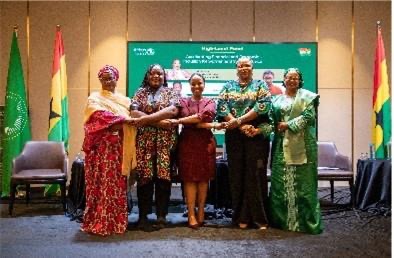
The African Union has renewed its commitment to financing gender equality, with a strong political call for action at a High-Level Breakfast Meeting convened on the margins of the 39th Ordinary Session of the Assembly of the African Union in Addis Ababa.
The meeting was organised by the Women, Gender and Youth Directorate of the African Union Commission in collaboration with the Republic of Ghana. It was led by H.E. John Dramani Mahama, President of Ghana and AU Champion for Gender and Development Issues. Heads of State and Government, policymakers, development partners, financial institutions, private sector actors and civil society representatives gathered to revitalise the AU Gender Champion’s Agenda and mobilise political and financial backing for the Women and Youth Financial and Economic Inclusion 2030 initiative.
President Mahama set out a renewed strategy anchored on five pillars: political leadership, resource mobilisation, policy coherence, accountability and strategic partnerships. He acknowledged progress but warned that the current pace of change is insufficient to meet continental and global targets.
“Advancing gender equality is not merely a moral obligation; it is a strategic imperative for Africa’s sustainable development and inclusive growth,” he said.
He stressed the need to move beyond declarations and ensure that commitments are reflected in concrete budget allocations, measurable targets and transparent accountability mechanisms. According to him, gender equality must be treated not as a peripheral social issue but as central to economic transformation and long-term stability across the continent.
The meeting reaffirmed that Africa’s ambitions under Agenda 2063 are closely linked to unlocking the economic potential of women and youth. Participants recognised that despite strong continental frameworks, implementation gaps remain. These include the Protocol to the African Charter on Human and Peoples’ Rights on the Rights of Women in Africa, commonly known as the Maputo Protocol, the AU Convention on Ending Violence Against Women and Girls, and the African Women’s Decade on Financial and Economic Inclusion 2020 to 2030.
Delegates highlighted persistent structural barriers that continue to limit women’s and young people’s full participation in economic life. Limited access to credit, land, markets and digital innovation remains a significant constraint. Recent economic shocks and climate-related crises have further slowed, and in some regions reversed, gains in gender equality.
Discussions centred on securing renewed political leadership for gender equality and women’s empowerment in line with Agenda 2063; increasing targeted financing to close gender gaps in financial and economic inclusion; strengthening the AU Gender Champion’s Agenda as a continental accountability mechanism; and deepening partnerships with the private sector, financial institutions and civil society under the Women and Youth Financial and Economic Inclusion 2030 initiative.
The meeting concluded with a strategic panel discussion aimed at strengthening collaboration across stakeholders to translate commitments into tangible and scalable outcomes under the WYFEI 2030 Initiative.
The AU Champion’s Agenda for Gender remains a high-level advocacy platform bringing together African Heads of State and Government to lead by example and accelerate the implementation of gender equality commitments.
For Africa, the conversation on gender equality is no longer about recognition but execution. The continent is young, its institutions still evolving, its economies still consolidating. Financing women and youth is not charity. It is statecraft. If political will now aligns with public budgets, the promise of inclusion can move from conference rooms into markets, farms, boardrooms and digital spaces across Africa.