

Libya Signals New Energy Push as Prime Minister Dbeibeh Encourages Shell’s Return

|
Getting your Trinity Audio player ready...
|
Tripoli, Libya — Libya is once again positioning itself as a major player in global energy markets, as Prime Minister Abdul Hamid Dbeibeh reaffirmed his government’s support for the return of major international energy companies to the country’s oil and gas sector.
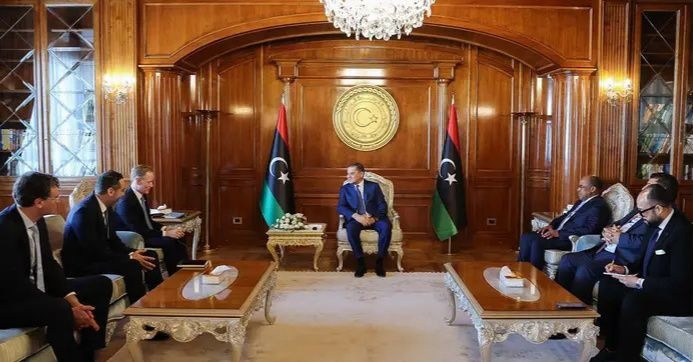
During a meeting in Tripoli with a high‑level delegation from Shell, the Libyan government signaled its readiness to facilitate foreign investment and accelerate energy exploration projects aimed at boosting national production.
The talks centered on implementing a memorandum of understanding signed earlier this year between Libya’s National Oil Corporation (NOC) and Shell, with both sides exploring practical steps to restart the company’s operations in Libya.
Energy Diplomacy Returns to Tripoli
The Shell delegation included Richard Howe, Executive Vice President for Conventional Oil and Gas, Fakher Bader, Vice President and Head of UAE and Iraq, and Martin Garvelink, General Manager for New Business Development.
According to government officials, discussions focused on:
-
Expanding exploration programs
-
Developing Libya’s existing oil and gas fields
-
Improving operational efficiency across energy infrastructure
-
Strengthening long‑term partnerships between Libya and international energy firms
For Libya, the return of major oil companies is more than a technical issue — it is central to restoring global investor confidence after years of political instability and conflict.
Restoring Libya’s Energy Position
Prime Minister Dbeibeh emphasized that the government is working under a clear strategy to increase oil and gas production, with partnerships from global energy companies playing a critical role in achieving those targets.
“Partnerships with major international companies represent a fundamental pillar for achieving technical and financial stability in Libya’s oil and gas sector,” the prime minister said.
Libya holds Africa’s largest proven oil reserves, but production has fluctuated sharply in recent years due to political divisions, security challenges and infrastructure disruptions.
The government now hopes renewed partnerships with international firms such as Shell will help modernize the sector and stabilize output.
Investor Confidence and Energy Security
Officials say facilitating the return of global companies is part of a broader strategy to create a competitive and secure investment environment in Libya’s energy sector.
Improved cooperation with international energy firms could help Libya:
-
Expand production capacity
-
Upgrade aging oil infrastructure
-
Attract foreign capital and technical expertise
-
Strengthen its role as a reliable energy supplier to global markets
For international energy companies, Libya remains an attractive — if complex — investment opportunity due to its vast reserves and strategic location in the Mediterranean energy corridor.
Whether these new commitments translate into sustained investment will depend heavily on Libya’s political stability and long‑term security guarantees.
For now, however, Tripoli is making it clear: the door to global energy companies is open again.