

Republic of Congo’s Denis Sassou N’Guesso Secures Fifth Term as Youth Pressures Mount

|
Getting your Trinity Audio player ready...
|
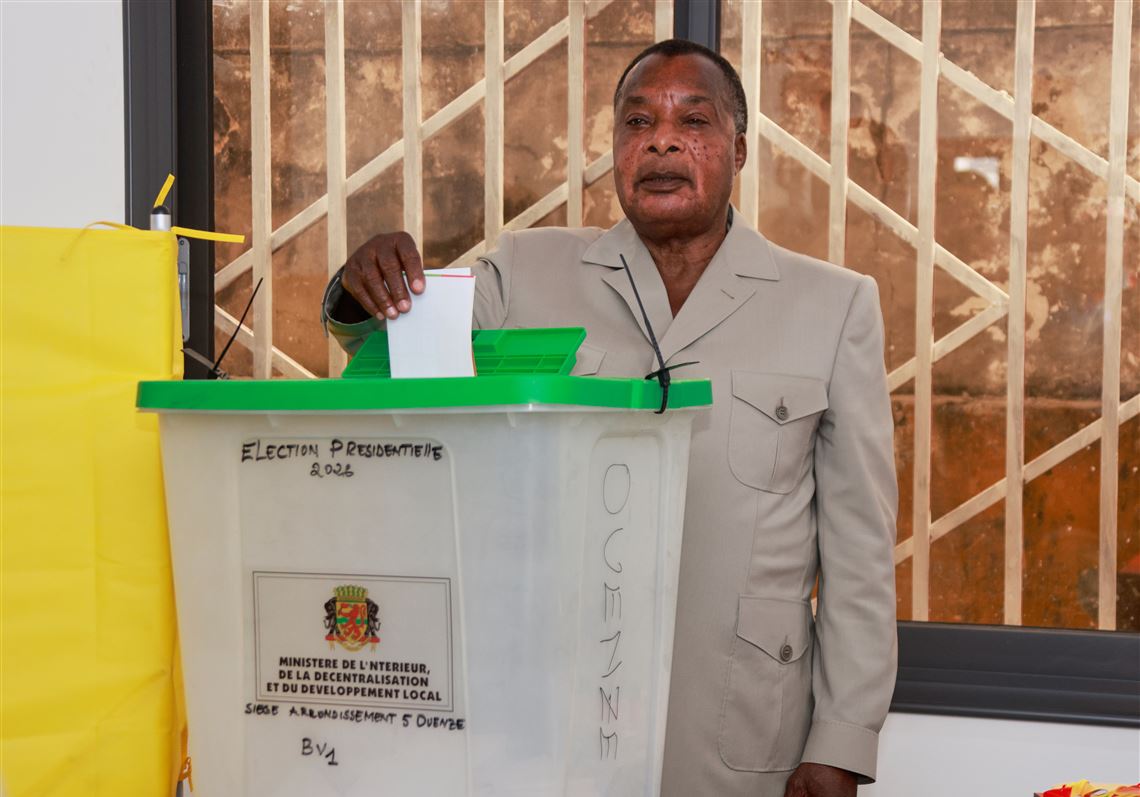
The Republic of Congo’s long-serving president, Denis Sassou N’Guesso, has been declared the winner of the country’s latest presidential election, securing a fifth consecutive term with 94.82% of the vote, according to provisional results announced by authorities.
The outcome extends Sassou N’Guesso’s rule to more than four decades, reinforcing his position as one of Africa’s longest-serving leaders at a time when the continent’s political and economic landscape is rapidly evolving.
An Election Without Uncertainty
Interior Minister Raymond Zéphirin Mboulou confirmed that approximately 2.6 million ballots were cast, with turnout reported at 84.65%.
However, the election unfolded in a controlled environment:
-
Internet access was shut down nationwide
-
Movement across the capital, Brazzaville, was restricted
-
Major opposition parties boycotted the process
Despite official turnout figures, reports from polling stations in the capital indicated low voter presence, with many citizens expressing skepticism about the possibility of political change.
A Leader Defined by Longevity
Sassou N’Guesso’s political career spans generations.
He first came to power in 1979, ruled until 1992, and returned in 1997 following a civil war. Since then, he has remained at the helm of the oil-rich Central African nation.
A 2015 constitutional referendum removed presidential age and term limits, enabling him to extend his tenure indefinitely.
Today, at 82, he stands among the longest-serving leaders on the continent — alongside figures such as Paul Biya and Teodoro Obiang Nguema Mbasogo.
An Economy Under Pressure
The election comes at a critical moment for the Republic of Congo.
Despite significant oil reserves, the country faces mounting economic challenges:
-
Public debt estimated at 94.5% of GDP
-
High unemployment levels
-
More than half the population living in poverty
These pressures are compounded by structural dependence on oil revenues and limited diversification.
Africa Is Young — and Watching
What makes this moment particularly significant is not only the election outcome, but the demographic reality behind it.
Nearly half of the country’s population is under the age of 18.
This reflects a broader continental trend: Africa is the youngest region in the world, with a generation coming of age that is increasingly connected, informed, and economically aware.
The contrast is clear:
-
Aging political leadership
-
Rapidly expanding youth populations
-
Rising expectations around governance, opportunity, and inclusion
This tension is becoming one of the defining forces shaping Africa’s political future.
A Broader Continental Pattern
Sassou N’Guesso’s reelection fits into a wider pattern across parts of the continent, where entrenched leadership structures continue to coexist with shifting economic realities and demographic change.
At the same time, Africa is undergoing transformation:
-
Urbanization is accelerating
-
Digital connectivity is expanding
-
Youth-led entrepreneurship is rising
-
Political awareness is increasing
These forces are gradually reshaping how power, legitimacy, and development are understood.
The Bigger Picture
The Republic of Congo’s election is not just a national event.
It is part of a larger conversation about:
-
Governance and continuity
-
Economic reform and diversification
-
The role of youth in shaping Africa’s future
Africa is young.
And while leadership cycles may remain slow in some regions, the pace of change across society is accelerating.
The question is no longer whether transformation will happen.
It is how — and how quickly — institutions evolve to meet it.