
Aunties, Midwives & Mental Health: Rethinking Traditional Support Systems
Written By Irene Afua Quarshie
|
Getting your Trinity Audio player ready...
|
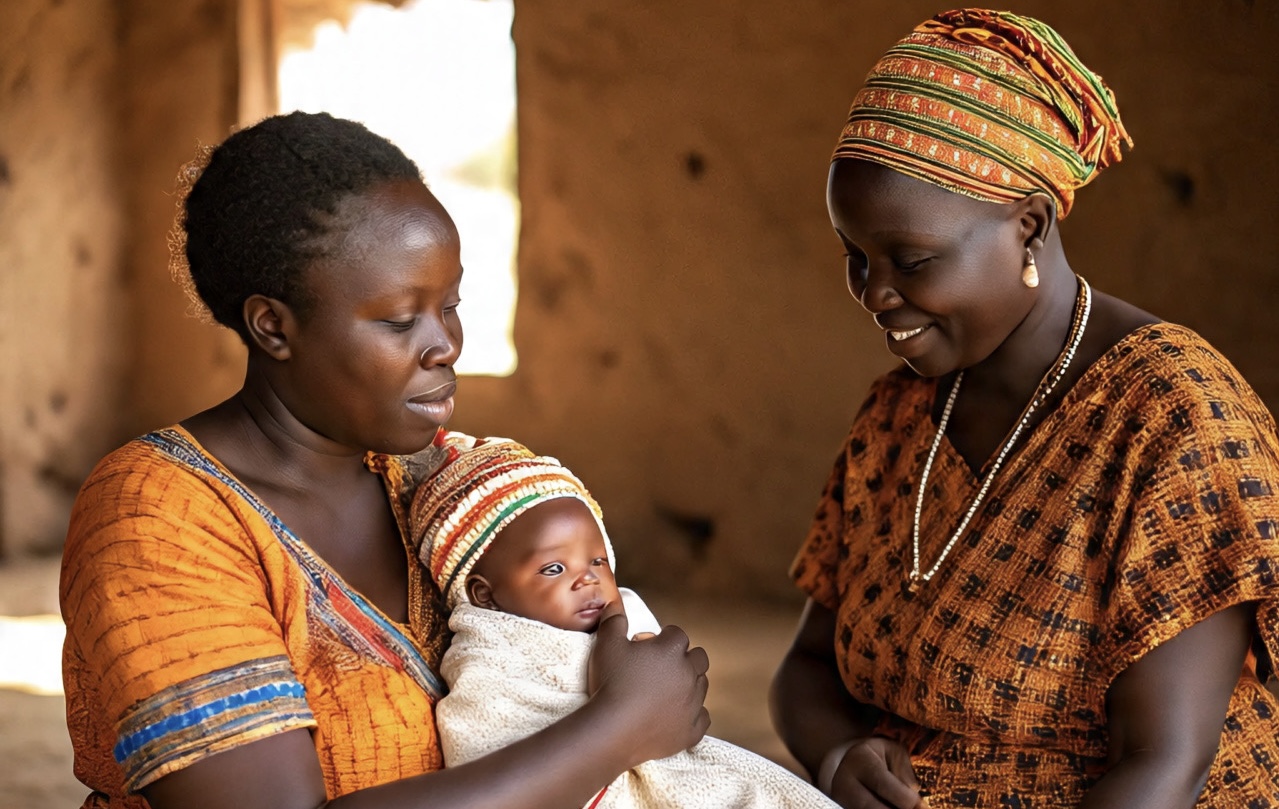
In many African cultures, there has always been a form of support during pregnancy and postpartum. It existed through rituals, postpartum seclusion, massages, herbs, songs, or simply presence. They spoke to something we often forget in modern maternal care: that wellbeing is as communal as it is personal.
Traditional African societies understood what research now confirms: maternal mental health thrives in community. In many East and West African communities, the seclusion period wasn’tjust isolation – it was intensive care, where new mothers were surrounded by experienced women who guided them through the emotional landscape of early motherhood. Across the continent, there are many names for these practices; to name a few- Olojojo omo amongst the Yorubas, Omugwo amongst the Igbo, Botsetsi in Botswana.
When it comes to maternal mental health, many of our traditional support systems are underutilized but not obsolete. And that’s where the opportunity lies.
At the same time urbanization, migration and modernizationhave reshaped much of the communal life that characterizes many African societies. Migration has sent daughters far from their mothers, and young mothers into cities where nobody knows their name.
In some families, intergenerational knowledge has skipped a beat – where new mothers are left trying to Google what grandmothers used to speak over steaming pots of soup.
A 2018 study in urban Kenya found that 73% of new mothers had moved away from their natal communities, losing access to traditional support networks.
The Double-Edged Sword of Strength
Ironically, whilst many cultures made space for the physical healing of the mother, many African cultures also place immense premium on women being perceived as strong. Many women fear being labeled “unfit” or “weak” because culturally, women are often expected to be enduring of experiences surrounding childbirth and mothering. In these matters, pain is seen as dignity, and struggle as a rite of passage.
Research from Nigeria reveals this tension starkly: while 89% of women surveyed acknowledged traditional postpartum support practices, 67% reported feeling unable to express emotional distress for fear of being seen as ungrateful or weak.
And so, the woman who has just given birth may be lying in her bed with a brand-new baby, unsure of whether what she’s feeling is normal, or something deeper. She may be bleeding in ways the hospital didn’t warn her about. She may be afraid of the dark thoughts creeping in. She may not have the language to explain what’s happening – and no one around her to ask the second question after “How’s the baby?”
Modernizing, Not Mourning
What if we didn’t just mourn the loss of the old ways but modernized them?
What if religious leaders and aunties and community health workers, to whom many seek early forms of support, were trained to become mental health advocates. What if the woman who comes to give you a sponge bath after birth also knows how to ask, gently, if your heart is feeling heavy?
The Promise of Blended Care
I believe deeply that the future of maternal mental health in Africa won’t be built by clinical models alone. It will be shaped by blended care – where community wisdom meets evidence-based tools. Where your grandmother’s remedies coexist with screening checklists. Where digital platforms extend access, but human beings still carry the weight of care.
We’ve seen glimmers of this working. In Zimbabwe, the Friendship Bench program trains community grandmothers to deliver basic psychosocial support, achieving remarkable results in treating depression. In Ghana, traditional birth attendants are being integrated into referral systems for maternal care, creating powerful bridges between traditional and modern approaches.
These aren’t small interventions – they’re powerful bridges.
We can start by inviting more mothers to whisper their truths. By reminding ourselves that mental health is not a luxury– it is a foundation.
And maternal mental health? That’s public health, family health, and community healing rolled into one.
The silence after birth doesn’t have to be permanent. We can build language. We can build systems. We can build softness.
The Mental Health Worker in Disguise
So, as we rethink maternal mental health in African contexts, my invitation is to lean into the village. Train it. Trust it. And extend access to limited professionals using tech-enabled tools.
Between tech tools, and traditional support systems, we may just be on the verge of redefining mental healthcare for many of our communities’ lifelines: the mothers.