

Ghana Charts Course for Safe Labour Migration to Drive Development
Written By Maxine Ansah

|
Getting your Trinity Audio player ready...
|
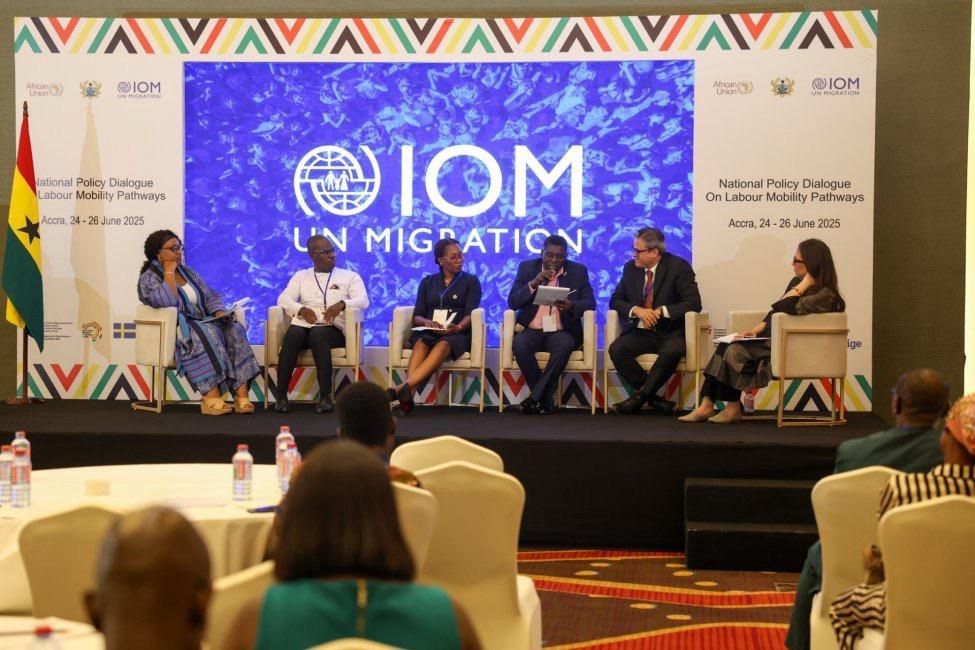
In a region where young people are increasingly seeking opportunities beyond their borders, Ghana is taking bold steps to make labour migration safer, more ethical, and more beneficial for both migrants and the country. The Government of Ghana, in partnership with the International Organization for Migration (IOM) and the African Union Commission (AUC), recently convened a high-level National Policy Dialogue in Accra to explore new pathways for regular labour mobility and turn migration into a tool for sustainable development.
Held from 25 to 27 June 2025, the three-day dialogue brought together a diverse group of stakeholders. These included senior policymakers, the World Bank, diaspora leaders, private sector representatives, civil society actors, international organisations, and diplomatic missions from key destination countries for Ghanaian migrants. The objective was to co-create a shared vision for safe, regular, and dignified labour mobility that benefits not just Ghana but the wider West and Central African region.
“The National Policy Dialogue on Labour Mobility Pathways marks a historic milestone in our collective pursuit for safe, orderly, and regular migration pathways,” said Dr Abdul Rashid Hassan Pelpuo, Ghana’s Minister for Labour, Jobs and Employment. “This initiative will undoubtedly contribute to empowering people, bolstering economies, and advancing sustainable development aspirations,” he added.
Ghana’s strategic position in the region makes it an important actor in the conversation on migration. In 2019, over 970,000 Ghanaians were living abroad, contributing to the local economy by sending remittances, sharing skills, and investing in their home communities. At the same time, Ghana hosted more than 466,000 international migrants, many of them from neighbouring countries in the Economic Community of West African States (ECOWAS). This dynamic reflects the strong regional labour links and Ghana’s dual role as both a country of origin and destination.
“This dialogue comes at a critical time for Ghana and the region,” said Fatou Diallo Ndiaye, IOM Ghana Chief of Mission. “At a time when irregular migration continues to expose migrants to risks of exploitation and abuse, expanding regular migration pathways is both a humanitarian necessity and a development opportunity,” she stated.
As a Champion Country in the implementation of the Global Compact for Migration, Ghana has continued to lead in migration governance. The country has adopted key legal and policy frameworks aligned with continental and global instruments, including the AU Agenda 2063, the AU Migration Policy for Africa, the National Labour Migration Policy, the Human Trafficking Act, the Immigration Act, the National Migration Policy, and the Diaspora Engagement Policy.
Ghana is also strengthening its international partnerships. Through the development of Bilateral Labour Migration Agreements (BLMAs) and Skills Mobility Partnerships, and with technical assistance from the AU-IOM-ILO Joint Labour Migration Programme (JLMP), the country is reinforcing its commitment to safe and mutually beneficial migration. These agreements aim to match skills with demand in destination countries while protecting migrant workers’ rights.
Discussions during the National Policy Dialogue highlighted several key priorities. These included improved coordination among government agencies and partners, stronger data systems for evidence-based decision-making, and the adoption of innovative labour mobility models such as skills partnerships and education-work pathways.
Migration governance is becoming increasingly important as labour markets shift, and demographic pressures rise. IOM reaffirmed its role as a convener and technical partner, committed to working with governments and communities to ensure that migration is well-managed and contributes to development.
The National Policy Dialogue was implemented with support from the JLMP and funded by the Swiss Agency for Development Cooperation and the Swedish International Development Cooperation Agency.
As Ghana moves forward, the outcomes of this dialogue are expected to inform national and regional strategies, ensuring that the aspirations of migrant workers are met with policies that promote fairness, protection, and opportunity.