

The New Africa: Why This Generation Will Finish What Our Fathers Began
From Kenya to Madagascar, Africa’s youth are rising to demand accountability, opportunity, and a future built on their own terms. By Kadmiel Van Der Puije CEO, The Voice of Africa

|
Getting your Trinity Audio player ready...
|
Something powerful is moving across Africa. It is not just protest. It is a generational awakening — a new wave of courage sweeping from North to South, East to West, shaking institutions and forcing the world to reckon with a truth long ignored: Africa’s youth are no longer the audience. We are the authors.
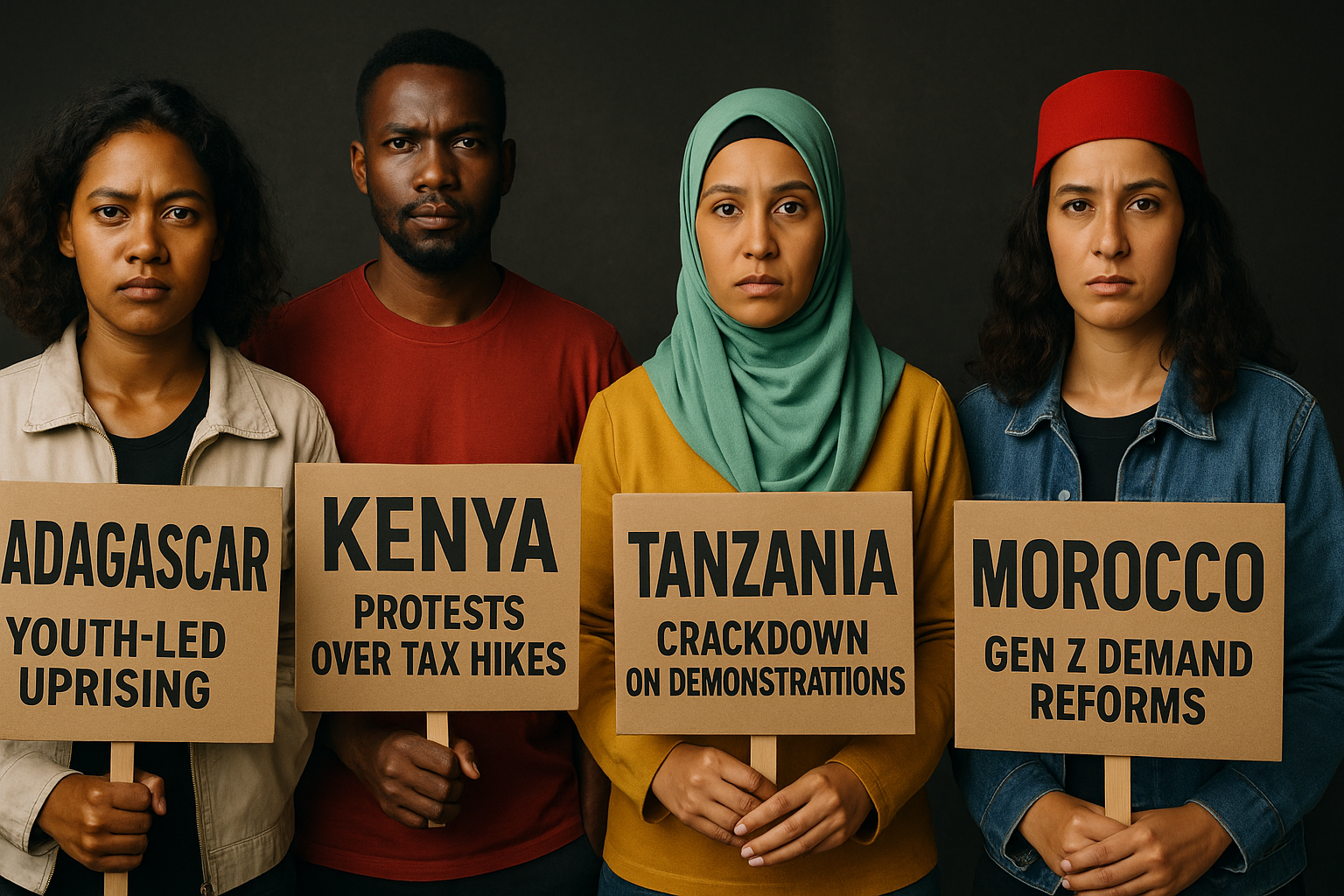
Across eight nations — Kenya, Madagascar, Morocco, Cameroon, Tanzania, Ethiopia, the Democratic Republic of Congo, and Sudan — young Africans are rewriting the social contract in real time. What began as isolated outbursts of frustration has evolved into a continental consciousness: a declaration that Africa’s next chapter will be written by its people, not prescribed by its past.
Kenya: When the youth refused silence
In Kenya, young people took to the streets this year to challenge the government’s controversial finance bill — a policy that would have raised taxes amid a cost-of-living crisis. What began as a fiscal protest became a national referendum on leadership, inequality, and youth inclusion. Students, creators, and entrepreneurs marched side by side, united by one message: governance must serve the governed.
Police fired tear gas, arrests were made, and lives were lost. But something else was born — a political awareness in a generation once dismissed as disengaged. The same energy that drove the protests has now turned digital, fueling civic education networks and voter registration drives ahead of Kenya’s 2027 elections.
Madagascar: The youth who toppled a president
In Madagascar, frustration erupted after long-standing shortages of electricity and water collided with rising unemployment. When the government’s response failed, the youth — led largely by Generation Z — flooded the streets of Antananarivo. Within days, President Andry Rajoelina, who once rose to power through a youth-driven coup in 2009, fled.
The irony was poetic. The same youthful force that made him a symbol of change ultimately unseated him when he became the symbol of stagnation. The army stepped in, and a military transition was declared — but what truly changed was consciousness. A new generation discovered its power.
Morocco: Digital dissent goes offline
In Morocco, the “Gen Z 212” movement turned online frustration into organized action. Sparked by anger over healthcare and education cuts, and the state’s heavy investment in sports projects, young Moroccans began coordinated demonstrations through Discord and Telegram.
For days, thousands filled the streets of Casablanca, Rabat, and Tangier, demanding justice for the poor and accountability for corruption. The government’s crackdown was swift — hundreds were arrested and two people were killed — but the message could not be contained.
The youth of Morocco proved that digital dissent is no longer just noise; it is strategy.
Cameroon: An old guard under pressure
In Cameroon, where President Paul Biya has ruled since 1982, protests broke out ahead of the October elections, with opposition supporters rejecting what they called “a prewritten script.” Four people were killed as clashes erupted between protesters and security forces.
For over four decades, Cameroon’s youth have known only one president. Now, they are demanding more than stability; they are demanding transition. Whether through ballots or pressure, the call for renewal is growing louder — and irreversible.
Tanzania: The crackdown and the courage
In Tanzania, newly re-elected President Samia Suluhu Hassan faces the most significant protests in the country’s modern history. After opposition leaders were arrested and internet access restricted, Tanzanians poured into the streets. The protests, unprecedented since independence, revealed deep frustration over inequality, youth unemployment, and political repression.
This is a country once known for its calm. But calm has given way to courage. Citizens are now demanding constitutional reform and an independent electoral body.
Ethiopia and the DRC: Tensions within transition
In Ethiopia, peace remains fragile after years of conflict in Tigray. While the guns have quieted, political mistrust between regions persists. The youth, many of whom were born after the fall of the Derg regime, are demanding jobs and inclusion in a political system dominated by ethnic elites.
Meanwhile, in the Democratic Republic of Congo (DRC), protests continue over corruption, insecurity, and election integrity. The eastern provinces remain unstable, with clashes between the Congolese army and M23 rebels displacing thousands. Yet amidst the chaos, young Congolese entrepreneurs and creatives are reclaiming national pride — building startups, organizing civic movements, and reshaping what leadership looks like.
Sudan: A nation divided, a generation defiant
In Sudan, the conflict between the army and the Rapid Support Forces (RSF) has turned once-vibrant cities into war zones. Millions have been displaced, and humanitarian crises grow daily. Yet even here, a generation raised on revolution refuses to surrender. Youth-led volunteer networks continue to deliver food, shelter, and education in the midst of war — proof that leadership is not always a title, but often a will.
A shared story of frustration and faith
Across these nations, the story is the same: young Africans are demanding governance that matches their potential. They are rejecting decades of corruption, economic inequality, and the quiet choke of neo-colonialism that still defines how African economies engage with global systems.
This is not just political unrest; it is the final stage of Africa’s unfinished liberation. Our forefathers won political freedom. Now, their children are fighting for economic, institutional, and narrative freedom — the right to define who we are, how we live, and how we lead.
The Voice of Africa: More Than Media — A Movement
At The Voice of Africa (TVOA), we are not spectators of this transformation. We are part of it.
We built TVOA to be more than a news outlet. It is Africa’s microphone, amplifying the voices of young people, reformers, entrepreneurs, and visionaries across the continent and diaspora. Through our subsidiaries — TVOA Media, TVOA Sports, Experience Africa, Experience Africa Tours, The TVOA Trade & Investment Forum, and Ambassador of Africa — we are connecting the dots between information, opportunity, and global visibility.
We believe Africa’s stories are not just headlines; they are blueprints for global leadership. Our journalists, creators, and partners document not only what Africa endures, but what it invents, builds, and transforms.
TVOA Sports celebrates Africa’s athletic power as more than entertainment — as industry, identity, and inspiration.
Experience Africa connects the diaspora to the homeland.
The Trade & Investment Forum bridges investors to African innovation.
And Ambassador of Africa prepares the next generation of diplomats, creators, and thinkers who will define the new era of leadership.
The Voice of Africa is not asking for inclusion in the world’s systems. We are building Africa’s own.
What Comes Next
Africa’s youth are already reshaping our politics and economies. The next stage is ownership — of capital, content, culture, and conversation.
We are entering the decade when African nations must trade more with each other than with the world. When African universities must become engines of invention. When our media must reflect not only our pain, but our power.
Africa is the youngest continent in the world and the newest in independence. We are still becoming, and that is our greatest strength. Nations in Europe took centuries to mature. We have had barely six decades — and yet we are standing tall.
So, to the world: Africa is not waiting.
To our youth: your time is not coming — it is here.
And to every African leader reading this: listen to your people, or prepare to be replaced by them.
This is the new Africa.
It does not whisper. It speaks.
And through The Voice of Africa, it will never again be silenced.