

Meriam Mravili: From International Law to Development Practice at the United Nations
By Maxine Ansah

|
Getting your Trinity Audio player ready...
|
“If others can do it, why can’t you?” For Meriam Mravili, that question has never been rhetorical. It is a quiet but persistent reminder of possibility, resilience, and purpose. Instilled in her by her parents, it has carried her through lecture halls, law firm offices, United Nations negotiation rooms, and now into development work on the African continent. A North and East African legal professional of Comorian and Tunisian heritage, Meriam stands at the intersection of international law, policy, and lived experience, steadily shaping a career rooted in service and impact.
Meriam describes herself as a citizen of the world. Raised across several African countries, with a father in diplomacy and a mixed cultural heritage, she grew up navigating different societies, languages, and political contexts from an early age. These experiences shaped her understanding of justice and identity long before she formally studied law. Having lived, studied, and worked in the United States, the United Kingdom, and within the United Nations system, she developed a global lens that continues to inform her work. Each environment, she reflects, gave her a new way of understanding how law operates within social, economic, and political realities. That upbringing instilled in her both empathy and adaptability, qualities she sees as essential when working on complex issues that affect diverse communities.
Although her academic journey began with a degree in sociology, law was always the intended destination. Studying in the United States meant that law school was a postgraduate path, a structure that ultimately worked in her favour. Sociology gave her the tools to understand power, inequality, and how systems shape people’s lives. When she later pursued legal training in the United Kingdom, she carried that perspective with her, particularly into areas such as human rights and public law. For Meriam, legal analysis is never abstract. Whether she is drafting, researching, or advising, she remains focused on the people behind policies and decisions. She believes her legal work is stronger precisely because it is grounded in human context.
Her professional experience reflects this multidimensional approach. Meriam has worked across law firms, civil society, and international organisations, including Amnesty International UK, DLA Piper, and the International Organization for Migration. One of the most formative experiences of her career came during her time with IOM in Cameroon, where she worked on cases involving returning migrants who had fled violence and instability. Reviewing their stories forced her to confront the contrast between their journeys and her own freedom of movement. While she crossed borders with choice and security, many of the people she worked with did so out of survival. That realisation deepened her commitment to international law and strengthened her desire to use legal tools to amplify voices that are often overlooked.
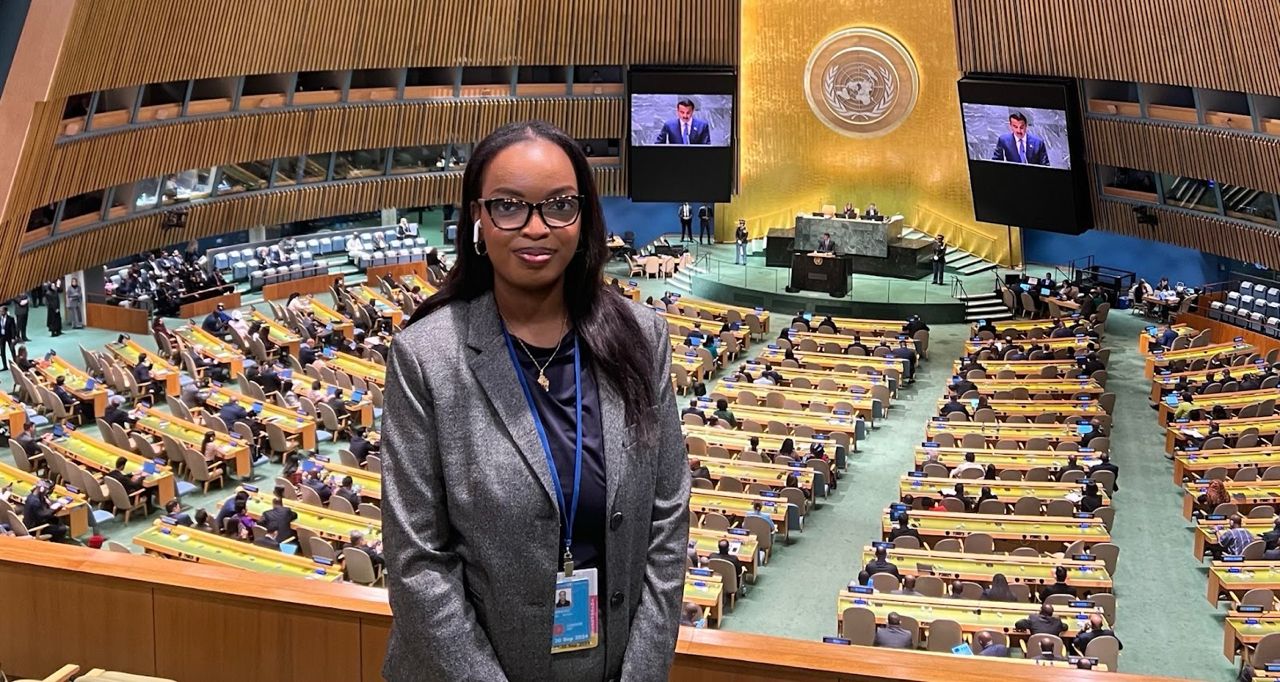
Another pivotal chapter came when she served as Legal Advisor to the Permanent Mission of the Union of the Comoros to the United Nations. Working within the Third Committee of the General Assembly, which addresses human rights and humanitarian affairs, Meriam was responsible for analysing treaties, attending negotiations, and drafting and negotiating resolutions on sensitive global issues. Representing a small island state required nuance and strategic thinking. Comoros sits at the intersection of several political groupings, including African, Arab, Francophone, and small island developing states, each with distinct priorities. As a young African woman in the General Assembly, the pressure was significant. Yet the experience proved deeply formative. Supported by a collaborative team, she sharpened her understanding of diplomacy, multilateral negotiation, and the responsibility that comes with speaking on behalf of a nation.
She later trained at the United Nations Office of Legal Affairs, within the General Legal Division, where she supported legal counsel across multiple areas of work. During that period, she assisted with research for cases before the UN Appeals Tribunal, reviewed agreements submitted by Member States, and contributed to the drafting of commercial and administrative contracts. The role exposed her to the inner workings of the UN legal system and reinforced her belief that law, diplomacy, administration, and public international law are deeply interconnected.
Today, Meriam’s career has taken her from headquarters to the field. She currently works as a Policy Expert and Analyst at the UNDP Sierra Leone Country Office through the African Young Women Leaders Programme, a joint initiative of the United Nations Development Programme and the African Union. She was selected as part of the programme’s fourth cohort following a rigorous six-month application and assessment process, chosen from more than ten thousand applicants across the continent. For Meriam, the appointment represents far more than a professional milestone. It is a responsibility she carries with purpose and a deep sense of commitment to Africa.
In Sierra Leone, she works within UNDP’s Strategic Advisory Unit, supporting the implementation of the UN Sustainable Development Cooperation Framework and the Government of Sierra Leone’s Medium Term National Development Plan. Her work focuses on policy and legal analysis, programme support, and strategic research aimed at strengthening inclusive governance, enhancing community resilience, and promoting sustainable and equitable economic transformation. The analytical and drafting skills she developed during her time at the UN Headquarters remain central to her work, from translating complex research into clear policy outputs to monitoring data and regional trends. Her sociology background has found renewed relevance as she analyses social data and contributes to innovative, data driven approaches to understanding poverty and climate vulnerability, ensuring that policy recommendations remain grounded in local realities.
Her decision to join UNDP was deliberate. She was drawn to the organisation’s multidimensional approach to development, one that connects governance, poverty reduction, climate justice, gender equality, and economic transformation. For Meriam, development work offers a way to use legal training for systemic impact. Having grown up across the African continent, she has always believed that the knowledge gained abroad must be brought back home. Africa’s development challenges, she insists, cannot and should not be addressed from outside the continent alone.
Beyond her professional role, Meriam continues to engage publicly through her writing on Substack, The Diplomatic Edit. The platform reflects her commitment to accessibility, offering reflections on diplomacy, international affairs, and early career realities. While she no longer hosts a podcast, her writing continues the same mission she began as a law student: demystifying global institutions and offering honest insight for those trying to find their way into international spaces.
She is candid about the challenges of navigating elite institutions as an African woman. One of the most difficult aspects of her journey has been the lack of representation in decision making spaces. While diversity is often discussed at the institutional level, she has observed that African women remain underrepresented in positions of influence. Still, she remains grounded. She sees her presence as part of something larger, carrying with her the experiences of communities often excluded from global tables and using that awareness as motivation to keep going.
For Meriam, meaningful inclusion goes beyond numbers or symbolism. It requires structural change, mentorship, access to education, and real opportunities to influence outcomes. Representation, in her view, is not just about being seen but about having the power to shape decisions.
As she looks ahead, Meriam resists defining success in fixed terms. Her ambitions continue to evolve, but her guiding principle remains clear. She wants to build a legacy that tells others, especially young Africans and women, that they belong in these spaces too.
Today, working on the ground in Sierra Leone, she is constantly reminded that her work is bigger than her. It is about people, communities, and futures shaped by the policies and decisions she helps inform. And for those just starting out, her message remains simple and steady. Stay informed. Stay curious. Believe in your capacity to shape the world. Do not wait for permission. Create your own opportunities.
The views expressed in this article are Meriam Mravili’s own and do not represent those of the United Nations or any other institution.