
A Thousand Days Too Late: Sudan’s Children Trapped in a War the World Failed to Stop
By Maxine Ansah

|
Getting your Trinity Audio player ready...
|
For Sudan’s children, the world has arrived far too late. After 1,000 days of relentless conflict, their lives have been shaped not by classrooms, playgrounds or safety, but by violence, hunger and displacement. What began in April 2023 has grown into one of the largest and most devastating humanitarian crises in the world, with children paying the highest price.
According to a statement by UNICEF Regional Director for the Middle East and North Africa, Edouard Beigbeder, Sudan is facing a profound child protection crisis marked by widespread violations of international law by parties to the conflict. Each passing day has deepened children’s exposure to killing, injury, sexual violence and forced displacement, while humanitarian access remains severely restricted across large parts of the country.
The scale of need is staggering. In 2026, an estimated 33.7 million people, nearly two-thirds of Sudan’s population, are expected to require urgent humanitarian assistance. Half of them are children. Access to life-saving aid remains dangerously constrained, compounding already extreme levels of vulnerability and suffering.
Children continue to be directly targeted by violence. This week alone, eight children were reportedly killed in an attack in Al Obeid, North Kordofan. Such incidents are not isolated. More than five million children have been forced from their homes since the conflict began, the equivalent of 5,000 children displaced every day. Many have been uprooted repeatedly, with violence often following them as they move in search of safety.
Sexual violence has become a defining and brutal feature of the conflict. Millions of children are at risk of rape and other forms of sexual abuse, which is being used as a tactic of war. Reports indicate that even children as young as one year old have been among survivors, underscoring the extreme nature of the protection crisis.
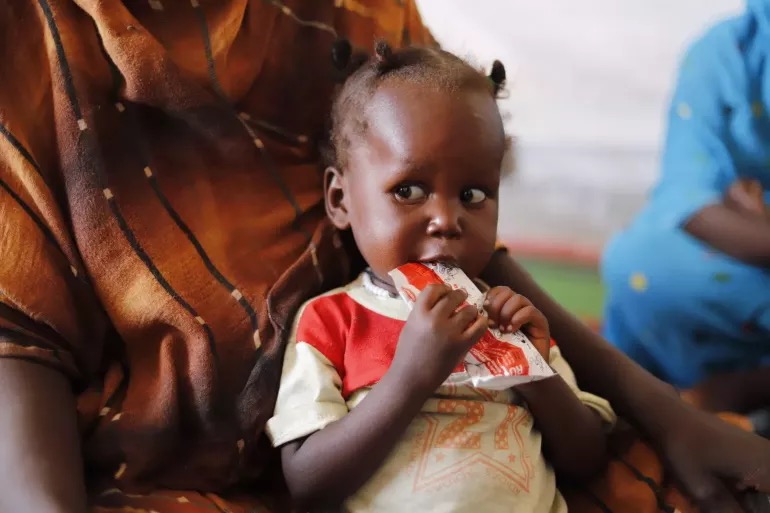
Hunger is now pushing children to the brink of survival. An estimated 21 million people are expected to face acute food insecurity in 2026. Famine has already been confirmed in Al Fasher and Kadugli, with a further 20 areas across Greater Darfur and Greater Kordofan at risk. In North Darfur alone, the epicentre of Sudan’s malnutrition emergency, nearly 85,000 children with severe acute malnutrition were treated between January and November 2025, roughly one child every six minutes.
The collapse of health systems, critical water shortages and the breakdown of basic services are worsening the crisis. Deadly disease outbreaks are spreading, placing an estimated 3.4 million children under five at heightened risk. Behind these figures are lives defined by fear, loss and deprivation, with childhood itself being steadily erased by war.
Despite extraordinary insecurity and access constraints, life-saving assistance is still reaching children where possible. UNICEF and its partners continue to treat severe malnutrition, vaccinate against deadly diseases, provide safe drinking water, and deliver protection and psychosocial support to children affected by violence and displacement. These interventions are keeping children alive under the most difficult conditions, but they are far from sufficient.
Humanitarian action, Beigbeder stressed, cannot replace what only peace can provide. Without sustained access, adequate funding and a meaningful reduction in hostilities, the suffering of Sudan’s children will continue. UNICEF is calling for an immediate end to the conflict and for all parties to uphold their obligations under international humanitarian law by protecting civilians, stopping attacks on infrastructure and allowing safe, sustained and unimpeded humanitarian access across Sudan.
Children in Sudan are not statistics. They are frightened, displaced and hungry, yet they remain determined, resourceful and resilient. Even after 1,000 days of agony, they continue to learn, to play where they can, and to hope for a future beyond war. For Africa, where so many nations are still young and navigating the scars of conflict and underdevelopment, Sudan’s children are a stark reminder of both vulnerability and strength. Ending this war is not only urgent, it is a moral necessity, and the continent, and the world, cannot afford to wait any longer.