
Fleeing Without Care: Sudanese Women and Midwives Recall the Fall of El Fasher
By Maxine Ansah

|
Getting your Trinity Audio player ready...
|
NORTH DARFUR STATE, Sudan – For women trapped inside El Fasher during its 18-month siege, pregnancy became a daily gamble with death. Health facilities vanished, medicines ran out and the sound of shelling replaced access to even the most basic care.
“In El Fasher, I couldn’t have any health check-ups because there were no hospitals left near us,” said Zainab, 26, who was pregnant during the siege of the capital of North Darfur State. Her account mirrors the experience of countless women who endured relentless bombardment, rising sexual violence and a total cut-off from humanitarian aid.
The crisis reached a breaking point in October 2025 when El Fasher fell to the Rapid Support Forces. By then, women were delivering babies without skilled assistance and survivors of rape were left without medical care as health facilities came under repeated attack.
“We dug trenches to hide and sheltered inside them,” said Rania, 22, who was also pregnant at the time. “There was shelling every day.”
More than 107,000 people, most of them women and children, fled El Fasher by foot and by chance, often without food, transport or money. Rania and Zainab were among thousands who reached Al Affad, an overcrowded displacement site where healthcare and protection remain fragile.
The journey itself proved deadly. Rania collapsed from exhaustion and saw women giving birth on the roadside. “It was heartbreaking and frightening,” she said. When she finally reached Al Affad, she was rushed to Al Dabbah Maternity Hospital and delivered her baby by Caesarean section.
Zainab’s arrival was no less abrupt. “I was waiting to receive a tent, but I gave birth beforehand,” she told UNFPA, the UN agency responsible for sexual and reproductive health.
Health workers who remained inside El Fasher during the siege described conditions that pushed medicine beyond its limits. Midwife Madina Bashir spent nearly a year confined inside a mosque with 65 women. Food and water ran out, forcing them to drink rainwater and eat plants growing in the courtyard.
“When the mosque was stormed, they took all the men away and forced the women out barefoot,” she said. Some of the women were pregnant, and one gave birth on the road because care was unreachable.
Ikhlas Ahmed Abdallah Adam, an obstetrician and mother of three, continued working throughout the blockade despite constant danger. “Between my house and the Saudi Maternity Hospital there were more than 100 bombs a day,” she said. “Many of my colleagues were killed that way.”
With supplies exhausted, doctors improvised. “We worked using cut-up bedsheets and mosquito nets. We were performing procedures like amputations outside the operating room,” Dr. Ikhlas said. Even then, staff donated their own blood after attacks, sometimes while the hospital itself was being hit.
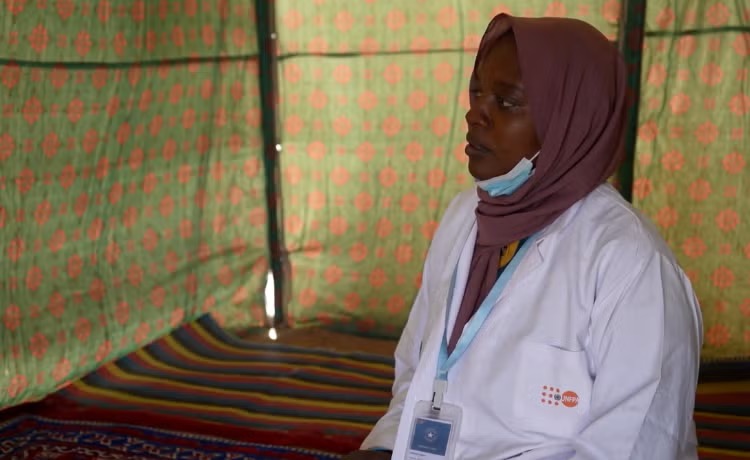
Today, both Ms. Bashir and Dr. Ikhlas are displaced, but they continue to work in Al Affad with UNFPA-supported medical teams. Their presence has become a lifeline for women arriving after days of walking under extreme conditions.
Farha Ahmed met Dr. Ikhlas after fleeing El Fasher for a week on foot while pregnant and carrying her three-year-old daughter. Her husband, father and brothers had all been killed. “I arrived exhausted, sitting in the heat without supplies or food,” she said. Dr. Ikhlas took her to Al Dabbah Maternity Hospital, where she stayed for 11 days and gave birth safely.
“She brought me everything I needed,” Ms. Ahmed said. “She stayed with me throughout, and even after I was discharged she continued to follow up with me.”
UNFPA continues to support emergency obstetric care at Al Dabbah Maternity Hospital and operates a reproductive health clinic inside Al Affad. Roving midwife teams are being deployed, and training is provided for health workers on the clinical management of rape.
Despite these efforts, the scale of need continues to outpace resources. After 1,000 days of war, nearly two thirds of Sudan’s population requires humanitarian assistance. UNFPA is appealing for $4.8 million to sustain reproductive health and protection services in response to the El Fasher crisis, but as of the end of November, the appeal is only just over a quarter funded.
For Sudanese women, survival has depended on courage, improvisation and the refusal of health workers to stop caring, even after losing everything themselves. Across Africa, conflicts continue to expose how fragile health systems are when war strikes. Yet the resolve of displaced midwives and doctors in northern Sudan also reflects a deeper truth about the continent: even in its youngest and most wounded nations, hope often survives in the hands of those who choose to keep others alive.