
Nigeria Secures First‑Ever Formal Labour Recruitment Deal With Saudi Arabia

|
Getting your Trinity Audio player ready...
|
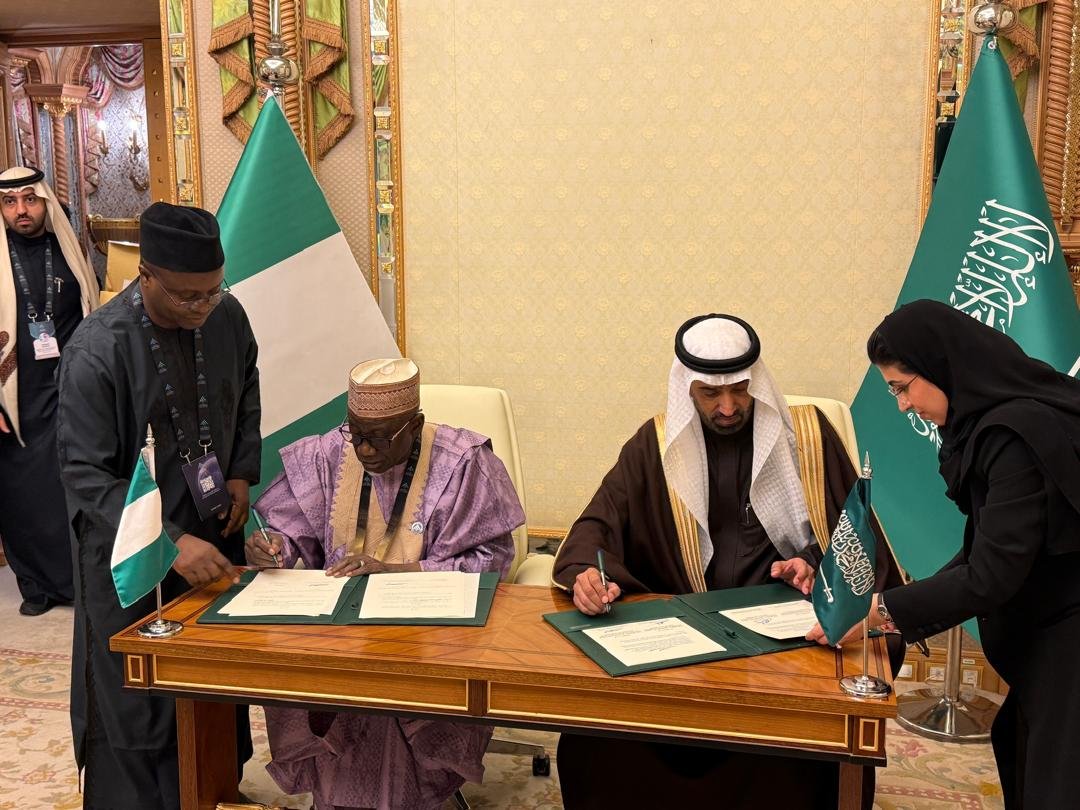
Riyadh / Abuja — Nigeria and Saudi Arabia have signed their first‑ever bilateral labour recruitment agreement, creating a regulated and government‑backed employment corridor between Africa’s largest economy and the Middle East’s biggest labour market.
The agreement, signed on the sidelines of the Global Labour Market Conference in Riyadh, represents a strategic shift away from informal migration channels toward a structured framework governing recruitment, placement, and worker protection. It positions Nigeria as a priority labour partner for Saudi Arabia at a time when the Kingdom is rapidly expanding its workforce under Vision 2030.
A State‑Backed Labour Corridor
The pact was signed by Saudi Arabia’s Minister of Human Resources and Social Development, Eng. Ahmed bin Sulaiman Al‑Rajhi, and Nigeria’s Minister of Labour and Employment, Dr. Muhammad Maigari Dingyadi. Officials involved in the negotiations describe the agreement as a foundational framework designed to govern labour mobility at scale, with oversight from both governments.
At its core, the deal establishes a regulated recruitment system that channels Nigerian workers into Saudi Arabia exclusively through licensed and authorised agencies. By removing informal middlemen, the framework aims to significantly reduce exploitation risks while ensuring transparent, enforceable contracts.
What Changes for Nigerian Workers
Under the new system, employment conditions—including wages, working hours, accommodation, and welfare—will be defined by mutually agreed standards and jointly monitored. This represents a material upgrade from informal migration routes, where protections have historically been inconsistent.
For Nigerian workers, the agreement offers clearer rights, stronger legal backing, and improved welfare safeguards. For the Nigerian government, it provides a mechanism to better track overseas employment flows while maximising the economic value of labour exports.
Why Saudi Arabia Is Turning to Nigeria
Saudi Arabia’s demand for foreign labour is accelerating as mega‑projects linked to Vision 2030 scale up across construction, logistics, healthcare, hospitality, and services. While Asian labour has traditionally dominated the Saudi workforce, African countries—particularly Nigeria—are emerging as key sources of young, adaptable talent.
With its large, youthful population and growing skills base, Nigeria fits squarely into Saudi Arabia’s workforce diversification strategy, which seeks not only scale but also improved labour governance and compliance.
Strategic Importance for Nigeria
For Nigeria, the timing is critical. Youth unemployment remains elevated, while remittances from Nigerians working abroad continue to be a vital source of foreign exchange. Formalising labour migration to Saudi Arabia offers structured employment opportunities at scale while strengthening protections for citizens overseas.
The agreement also aligns with Nigeria’s broader efforts to convert labour mobility into a more predictable economic lever—one that supports household incomes, stabilises remittance flows, and reduces the risks associated with irregular migration.
A Template for Africa–Gulf Labour Partnerships
Beyond the bilateral relationship, the deal is being closely watched as a potential model for other African countries seeking formal labour arrangements with Gulf economies. Saudi Arabia has increasingly framed labour reform as central to its global competitiveness, responding to past international scrutiny by tightening standards and oversight.
If effectively implemented, the Nigeria–Saudi labour corridor could serve as a test case for how Africa–Gulf labour partnerships evolve—from informal dependency to structured, rules‑based cooperation.