
|
Getting your Trinity Audio player ready...
|
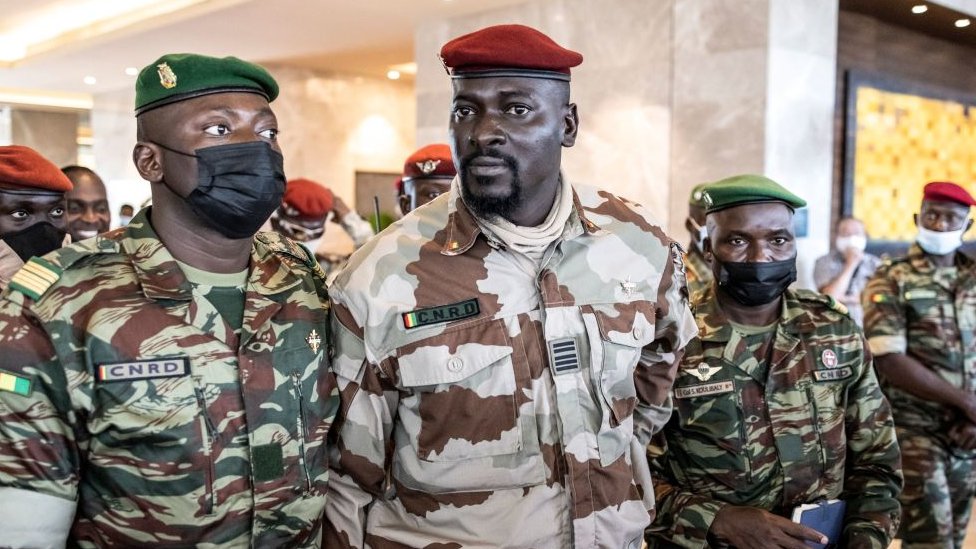
Conakry, Guinea — Guinea’s military government has dissolved 40 political parties, including the country’s three main opposition groups, in a late‑night decree that critics say deepens authoritarian rule under President Mamady Doumbouya.
The decision was announced by the Ministry of Territorial Administration and Decentralisation, which said the parties were dissolved for “failure to fulfil their obligations.” The order immediately stripped the groups of their legal status and banned all political activities associated with them.
Among the parties affected are the Union of Democratic Forces of Guinea (UFDG) led by exiled opposition leader Cellou Dalein Diallo, the Rally of the Guinean People (RPG) linked to former president Alpha Condé, and the Union of Republican Forces (UFR).
Authorities also ordered the confiscation of party assets, placing them under state supervision.
Opposition Condemns Move
Opposition leaders and civil society organizations strongly criticized the decree, describing it as an attempt to eliminate political competition.
Souleymane de Souza Konaté, communications coordinator for the UFDG, said the government had crossed “all red lines,” calling the move “the final act of a political farce aimed at establishing a single‑party state.”
Pro‑democracy activist Ibrahima Diallo of the National Front for the Defence of the Constitution (FNDC) said the decision formalized what he described as a dictatorship.
“The country is sinking into profound uncertainty,” he said.
Human rights groups have previously raised concerns about restrictions on civil liberties in Guinea since the military takeover.
Background: From Coup to Presidency
Doumbouya seized power in September 2021, overthrowing President Alpha Condé in a military coup.
In December 2025, he was elected president in a controversial vote in which several opposition leaders were barred from participating.
A new constitution approved by referendum last year allows members of the military junta to run for office and extends presidential terms from five years to seven years, renewable once.
Doumbouya was sworn in as president on January 17, 2026.
Growing Concerns Over Political Freedoms
Since the coup, critics say Guinea has seen a steady erosion of political freedoms.
Authorities have banned protests and detained opposition activists. Several prominent critics of the government have gone into exile.
Two FNDC activists, Oumar Sylla, also known as Foniké Mengué, and Mamadou Billo Bah, have been missing since July 2024.
In recent months, relatives of opposition figures and journalists have also reportedly been abducted.
The junta has defended its actions as necessary to stabilize the country and reform political institutions.
Political Uncertainty Ahead
The dissolution of major political parties raises questions about the future of Guinea’s political system.
Analysts warn the move could deepen political tensions in a country already grappling with economic challenges and governance concerns.
Guinea is one of the world’s largest producers of bauxite, a key mineral used to manufacture aluminum, making political stability a critical issue for international investors and global commodity markets.