
Macron to Host AU Peace Fund Talks in Paris as Africa Seeks Financial Independence

|
Getting your Trinity Audio player ready...
|
Emmanuel Macron has announced that African Union peace efforts will once again take center stage — this time in Paris.
Because when it comes to solving Africa’s security challenges, nothing says progress quite like another high-level conference… in Europe.
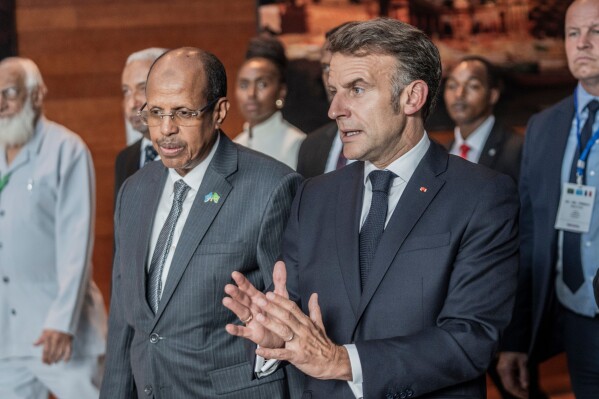
Speaking during a visit to Ethiopia, Macron confirmed that France will host an international conference later this year aimed at mobilizing funding for the AU Peace Fund. The initiative, he said, will bring together public and private partners to strengthen Africa’s capacity for peacekeeping and mediation.
The fund itself, originally established in 1993, has had a complicated history — including a two-decade period where progress was, generously speaking, slow. It wasn’t until recent years that contributions began to gain traction, with roughly $400 million raised in 2024.
Global Support, Familiar Structure
Macron also emphasized the need to implement United Nations Resolution 2719, which would require UN member states to contribute to AU-led peace operations.
He framed the Paris conference as part of a broader effort to give the African Union “more capacity” — a statement that lands somewhere between support and subtle acknowledgment that capacity still depends heavily on external backing.
During the same visit, Macron held discussions with AU Commission Chair Mahmoud Ali Youssouf and UN Secretary-General Antonio Guterres, reinforcing the familiar triangle of African priorities, European platforms, and global institutions.
Africa’s Problems, Africa’s Solutions… Hosted in Paris
In what might be the week’s most consistent messaging contradiction, Macron reiterated that “African problems must be solved by Africa” — while simultaneously announcing that the funding conversation will take place in France.
To be fair, the logic is not entirely new. Africa’s peace operations have long depended on a mix of internal coordination and external financing. What is new, however, is the growing expectation that the continent should take greater ownership of both.
That expectation becomes harder to meet when the financial architecture still relies on donor conferences, international pledges, and geopolitical alignment.
The Bigger Picture
Macron’s proposal comes at a time when global instability — including tensions affecting key trade routes such as the Strait of Hormuz — is placing additional economic pressure on African states.
The French president also indicated that the conference would explore broader support mechanisms, including mediation efforts in conflict zones like eastern Democratic Republic of Congo.
At the same time, Kenya’s President William Ruto has been invited to represent Africa at the upcoming G7 summit, signaling continued efforts to integrate African leadership into global decision-making forums — even if those forums are still largely shaped outside the continent.
Between Support and Dependence
The Paris conference may well unlock new funding streams and partnerships. But it also highlights a persistent tension: Africa’s push for self-reliance in peace and security versus a system that still leans heavily on external convening power.
For now, the continent’s peace agenda continues to move forward — one conference, one commitment, and one carefully worded declaration at a time.
Macron Africa, AU peace fund, African Union funding, France Africa relations, AU peace operations, UN resolution 2719, Africa security funding, peacekeeping Africa, AU Paris conference, Macron Ethiopia visit, Africa diplomacy, global funding Africa, AU partnerships, Africa peacekeeping finance, UN Africa operations, AU independence, Africa geopolitical strategy, France AU relations, Africa security challenges, DRC conflict mediation, AU funding gap, Africa global partnerships, G7 Africa representation, William Ruto G7, Africa economic pressure, Strait of Hormuz Africa, global instability Africa, AU peacekeeping budget, Africa defense funding, AU reforms, Africa governance security, international aid Africa, Africa donor dependence, AU capacity building, Africa policy leadership, Africa UN collaboration, peace fund Africa, AU strategy, Africa political economy, African diplomacy, global conferences Africa, Africa development policy, AU initiatives, Africa external funding, Africa sovereignty debate, AU institutional growth, Africa international relations, Africa peace strategy