
|
Getting your Trinity Audio player ready...
|
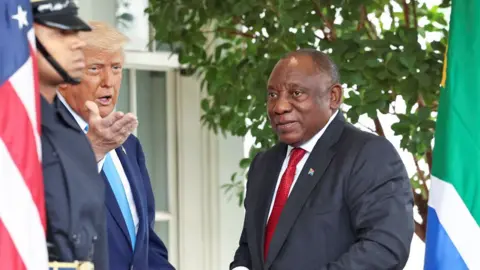
As South Africa prepares to host the G20 Leaders’ Summit in Johannesburg, U.S. President Donald Trump has stirred controversy by declaring that South Africa “should not be part of the G20 anymore.” The remarks — made at a Miami conference — have drawn swift, measured responses from African and international observers, many of whom see the statement as another example of Washington’s inconsistent posture toward Africa’s rising global influence.
South African presidential spokesperson Vincent Magwenya reaffirmed the nation’s confidence in its leadership role, stating that the upcoming summit will be “one of the most successful in G20 history.”
“Drawing on our journey from racial and ethnic division to democracy, South Africa is uniquely positioned to champion a future of genuine solidarity,” added Chrispin Phiri, spokesperson for the foreign ministry.
A Shift in Global Power Narratives
The G20, representing 85% of the world’s GDP, has long served as a forum for major economies to coordinate on growth, trade, and climate stability. But this year’s gathering carries deeper symbolism: it marks the first time the African Union joins as a permanent member, and South Africa’s presidency has placed “solidarity, equality, and sustainability” at the center of its agenda.
Trump’s assertion that South Africa “shouldn’t even be in the Gs anymore” — citing discredited claims about discrimination against white minorities — has been widely dismissed by experts as politically motivated rhetoric rather than policy.
Analysts from Chatham House and the Foreign Policy Centre note that no formal mechanism exists for removing a member from the G20, which functions on consensus rather than treaty.
“Even if one leader wanted to exclude another nation, it would require full agreement from all members,” said Dr. Andrew Gawthorpe of the UK-based Foreign Policy Centre. “That is not going to happen — especially given Africa’s growing strategic relevance.”
Africa Responds with Composure
South Africa’s measured response reflects the confidence of a nation aware of its expanding global footprint.
Under President Cyril Ramaphosa, the country has used its G20 presidency to spotlight African issues — from energy transition to equitable trade reform.
Regional blocs, including the African Union and SADC, have rallied around Pretoria’s leadership, emphasizing that Africa is no longer a guest in global governance — it is a stakeholder.
Meanwhile, major partners such as the European Union and China have reiterated support for South Africa’s role, calling the G20 an opportunity to reshape global economic dialogue through an African lens.
The Voice of Africa Says
Donald Trump’s remarks may have made headlines — but the real story is Africa’s endurance and evolution on the world stage.
South Africa’s G20 presidency is not a privilege granted; it is a position earned through decades of struggle, diplomacy, and leadership.
As the world’s economies meet in Johannesburg, one truth remains: you cannot discuss global growth without Africa at the table.