
Senegal Signals a New Development Era as 2026 Investments Target Education, Health and Water

|
Getting your Trinity Audio player ready...
|
Senegal is positioning 2026 as a year of structural investment, with President Bassirou Diomaye Faye announcing increased public spending focused on education, healthcare, and access to water.
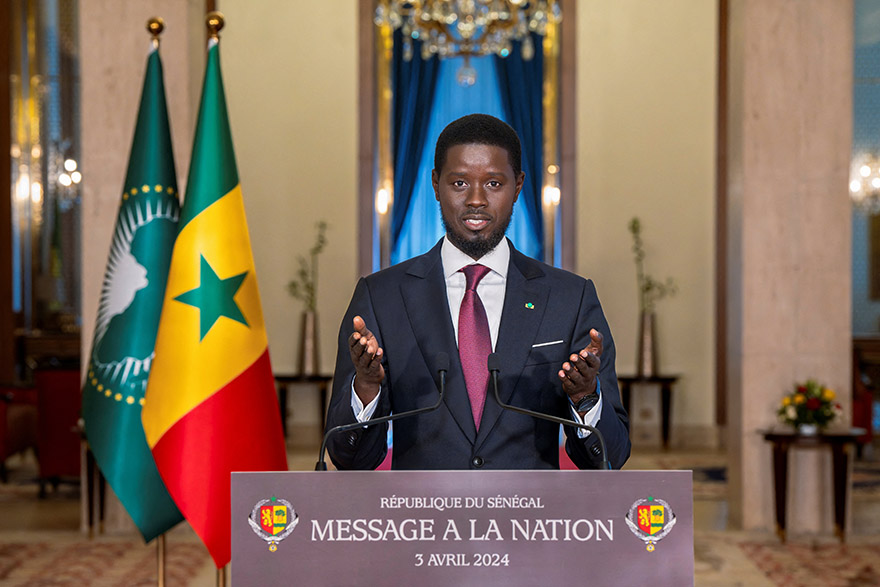
In his New Year’s Eve address to the nation, Faye outlined a budget strategy aimed at reinforcing essential services while sustaining economic stability after what he described as a demanding year marked by discipline and resilience.
Education sits at the center of the plan. The government will allocate 62.8 billion CFA francs toward new educational infrastructure, including the construction of 2,500 classrooms nationwide. The move is intended to ease overcrowding, expand access, and strengthen long-term human capital development.
Healthcare investment will also see a significant increase. The 2026 budget includes 91 billion CFA francs dedicated to building 35 high-standard community health centers, completing the Diamniadio Oncology Hospital, and reinforcing medical facilities across the country. The funding targets both access and capacity, particularly outside major urban centers.
Water security has been elevated to what the president called a strategic priority. Senegal will launch the Grand Water Transfer Project, designed to mobilize 1.8 million cubic meters of water per day to sustainably supply the Dakar–Mbour–Thiès urban corridor and the city of Touba. The initiative responds to rapid urban growth and long-term climate pressures.
Looking back at 2025, Faye acknowledged economic strain but emphasized measurable progress. Government measures to reduce the cost of essential goods generated 342.5 billion CFA francs in household savings, according to official figures, with similar interventions planned for 2026.
Agriculture and industry also featured prominently in the address. Cereal production surpassed 2.5 million tonnes, while the groundnut sector rebounded. In industry, the relaunch of SONACOS, Senegal’s leading agri-food company, led to the creation of more than 2,300 direct jobs after two years of inactivity.
Taken together, the announcements reflect a policy direction focused on foundational systems rather than short-term gains. Education, health, water, food security, and industrial revival form the backbone of a development model that prioritizes stability and inclusion.
Senegal’s approach enters 2026 with cautious confidence. The investments signal intent, but their impact will depend on execution, transparency, and sustained public trust. What remains clear is that the country is choosing to invest in its people and its future at a moment when many nations are navigating uncertainty.
And while Senegal’s modern republic is still young by global standards, its direction shows a country learning, adjusting, and building forward. Africa’s story is not one of instant comparison, but of steady construction—and in that patience lies long-term promise, shaped by a generation that understands growth is built, not borrowed.
Senegal economy, Senegal 2026 budget, Bassirou Diomaye Faye, Senegal education investment, Senegal health sector, Senegal water project, Grand Water Transfer Project, Senegal infrastructure, Africa development news, West Africa economy, Senegal public investment, Dakar water supply, Touba water access, Senegal healthcare expansion, Diamniadio Oncology Hospital, Senegal classrooms, education funding Africa, African public spending, Senegal agriculture output, groundnut sector Senegal, cereal production Africa, SONACOS Senegal, Senegal industrial jobs, African economic policy, Senegal cost of living, CFA franc budget, African infrastructure investment, Africa water security, Africa education policy, Africa healthcare funding, Senegal resilience, Senegal development strategy, West Africa infrastructure, African leadership economy, Senegal public services, Africa growth outlook, African policy reform, Senegal government spending, Africa investment priorities, Senegal national development, Africa youth future, African economies 2026, Africa long-term growth, Senegal stability, African state capacity, Africa public sector, Senegal reforms, Africa infrastructure planning, Africa water access, African development models, Senegal social investment, Africa economic resilience, Senegal food security, African agriculture growth, Africa industrial revival, Senegal jobs creation, Africa climate adaptation, Africa sustainable development, Senegal public policy, Africa governance, Senegal national priorities, Africa rising economies, Africa development path, Senegal leadership vision, Africa future growth, African nations investment, Africa economic transformation, Senegal planning, Africa infrastructure funding, Africa human capital, Senegal education reform, Africa healthcare systems, Africa water infrastructure, Senegal economic outlook