
Angola’s Foreign Minister Opens AU Executive Council Session With Reform, Finance, and Peace Security on the Table

|
Getting your Trinity Audio player ready...
|
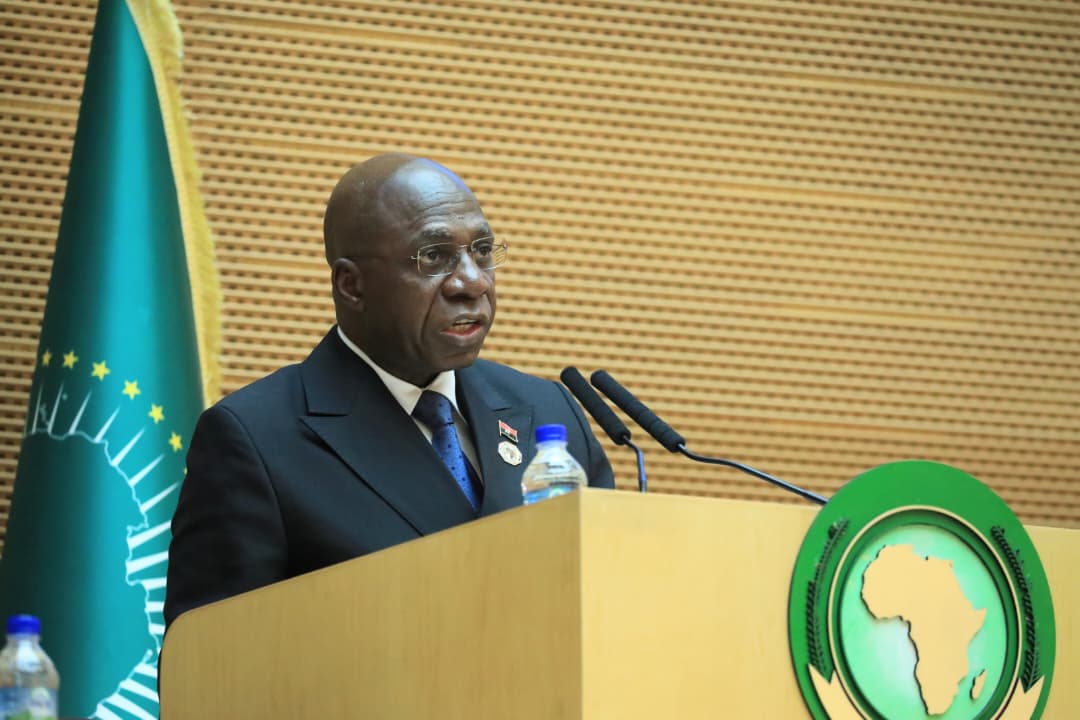
At the African Union Headquarters in Addis Ababa, Angola’s Minister of Foreign Affairs Amb. Téte António, speaking as Chair of the Executive Council, officially opened the 48th Ordinary Session of the AU Executive Council with a message focused on institutional continuity, reform delivery, and the Union’s ability to finance its priorities.
In his opening statement, Amb. António began by acknowledging first time participating ministers and welcoming member states, institutional partners, and invited guests. He also expressed condolences to the governments and peoples of Morocco and Mozambique following recent catastrophic floods and extended solidarity to affected communities.
The Chair framed the 48th Session as a key statutory moment in the AU calendar, noting it also marks the end of Angola’s mandate in the rotating presidency of the African Union. Within that context, he presented the Executive Council as a central engine of the Union’s policy architecture, responsible for harmonising common positions, ensuring coherence of continental policies, and preparing matters for consideration by the Assembly of Heads of State and Government in line with Agenda 2063.
What Angola says it prioritised during its mandate
Amb. António described Angola’s approach as pragmatic, inclusive, and results oriented. He referenced the successful completion of the 47th Ordinary Session and said the 48th Session is convened to conclude pending dossiers responsibly while laying foundations for subsequent work.
On AU reform, he pointed to progress he said was recorded, including the conclusion of leadership selection processes, the beginning of implementation of the SACA process, and efforts to revitalise working methods of AU organs to improve efficiency and predictability and align with Agenda 2063.
On multilateral engagement, he said Angola promoted active diplomacy and referenced political conditions created for TICAD 9 in Yokohama and the 7th AU EU Summit hosted in Luanda, describing these as milestones that strengthened Africa’s voice and reinforced strategic partnerships grounded in mutual respect and shared interests.
Peace and security focus and named roles
On peace and security, the Chair said Angola contributed at technical, diplomatic, and political levels during its two year mandate on the Peace and Security Council. He referenced support for the designation of Burundi’s President Évariste Ndayishimiye as Facilitator for the Sahel Region and the designation of Togo’s President of the Council of Ministers Faure Gnassingbé as AU Mediator in the conflict between the Democratic Republic of the Congo and the Republic of Rwanda. He also referenced support for initiatives aimed at peace, stability, and reconciliation in contexts including the Central African Republic, Somalia, Sudan, and South Sudan, describing these efforts as undertaken in collaboration with member states, the AU Commission, regional economic communities and mechanisms, and partners.
The agenda items he said the Executive Council will consider
Amb. António highlighted several items for deliberation across the two day session. These include:
Report of the 51st Ordinary Session of the Permanent Representatives Committee
AU participation in the G20 and Africa’s positioning in global governance
Elections and appointments to AU organs and institutions
Review of the implementation of decisions linked to the SACA process
Consideration of draft legal instruments and institutional governance matters
Reports of specialised ministerial committees including matters linked to Agenda 2063
Financing, contributions, and the scale of assessment
A major part of the statement focused on AU financing. Amb. António emphasised the importance of member states supporting the Union through the implementation of Assembly Decision AU Dec.938(XXXVIII) of February 2025, which mandated the Commission to formulate a new Scale of Assessment for consideration and adoption by the Assembly in February 2026.
He described the current Scale of Assessment as outdated and argued that a new scale based on solidarity, equity, and capacity to pay is necessary. He referenced options proposed by F15 technical experts, specifically options 3 and 4, saying they allow a more balanced distribution of contributions, strengthen financial resilience, and support Johannesburg self financing targets. He also stated that Angola’s decision to remain in Tier 1 for the 2027 to 2029 cycle facilitates consensus, while underlining the need to harmonise the options presented.
Closing message and call to member states
As the statement concluded, the Chair called for active engagement, constructive collaboration, and responsibility from member states to ensure smooth work. He appealed for flexibility, dialogue, and mutual understanding on sensitive dossiers that could have lasting impacts. He urged that Pan African values and AU founding principles guide decision making, and then declared the 48th Ordinary Session officially open.
In a year where the continent is juggling institutional reform, conflict pressures, and financing realities, the message from the opening was straightforward: the AU’s ambitions require decisions that are both politically cohesive and financially sustainable. And while Africa’s states are still building modern institutions at scale, the direction is clear: the continent is organising itself to act with more unity, more discipline, and more control over its future narrative.
Africa’s story is still being written in real time and the point is not perfection overnight, it is steady forward motion with courage and clarity.