
Senegal’s Bilingual Education Breakthrough: How the Gates Foundation-Backed Model Is Transforming Classrooms
By Maxine Ansah

|
Getting your Trinity Audio player ready...
|
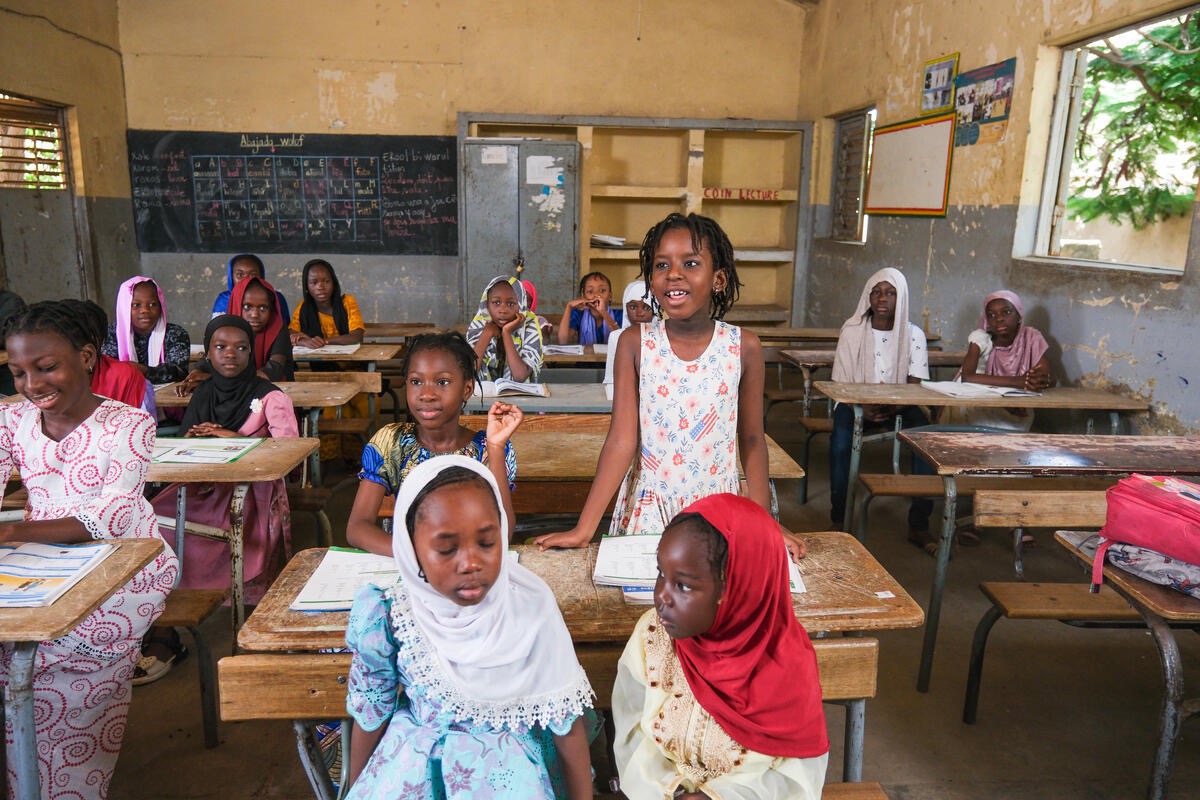
In classrooms across Senegal, a quiet but decisive shift is underway. A national bilingual education model is changing how children learn, how teachers teach, and how families engage with education itself. At the centre of this transformation is a simple but powerful idea: children learn best in a language they understand.
For decades, Senegal’s education system relied almost entirely on French, despite the fact that fewer than 1 percent of the population speaks it at home. For most children, school began in a language unfamiliar to their daily lives. The consequences were predictable. According to education research cited by the Gates Foundation, more than 70 percent of children struggled to read even a simple sentence before reforms began.
The introduction of bilingual education is beginning to reverse that trend.
Launched in 2015 by Senegal’s Ministry of Education in partnership with Associates in Research and Education for Development (ARED) , a nonprofit organisation supported by the Gates Foundation, the programme integrates national languages such as Wolof alongside French in early learning. The model, formally known as the Modèle Harmonisé d’Enseignement Bilingue au Sénégal, which translates in English to mean Unified Framework for Bilingual Education in Senegal, has expanded steadily and is now active in 13 of the country’s 16 education regions.
The results are measurable and significant. One assessment found a 29 percentage point increase in the number of students meeting oral reading and comprehension benchmarks compared to those taught exclusively in French. Beyond literacy, the model is linked to stronger classroom participation, improved retention, and long-term prospects for higher earnings.
The shift from pilot to policy did not happen overnight. For years, bilingual education efforts in Senegal struggled to gain traction due to the absence of a unified national strategy. That changed when pilot programmes demonstrated clear gains. Afternoon literacy sessions delivered in national languages showed improvements not only in reading ability but also in behaviour and engagement during regular school hours. These outcomes convinced both parents and policymakers to integrate the approach into the formal education system.
For educators, the reform has been transformative. Teachers who were once constrained by rigid language rules now have the flexibility to communicate in languages their students understand. This has reduced barriers in the classroom and improved the pace at which foundational skills are acquired. Early results show children recognising letters, forming syllables, and participating more actively within weeks of exposure to bilingual instruction.
The model’s success has also drawn international recognition. In 2025, ARED was awarded the Yidan Prize, one of the world’s most prestigious education honours, for advancing instruction in national languages and demonstrating scalable impact.
Yet the programme’s expansion presents new challenges. Scaling bilingual education nationwide requires significant investment in teaching materials, curriculum development, and teacher training across multiple languages. Senegal’s Ministry of Education acknowledges that developing sufficient learning resources remains a key constraint as the model continues to grow.
The implications extend beyond Senegal. UNESCO estimates that 40 percent of the global population still lacks access to education in a language they understand. Countries including Ghana, Kenya, Djibouti, Guinea, Haiti, and Gabon are now exploring or expanding similar approaches, positioning Senegal’s model as a reference point in global education reform.
At its core, the reform is not only about language. It is about equity, access, and unlocking human potential. By aligning education with the linguistic realities of its population, Senegal is investing directly in its long-term development agenda. The government has linked the initiative to its Agenda 2050 vision, recognising that human capital development begins with foundational learning.
Inside homes, the impact is already visible. Children who once struggled to follow lessons are now teaching their parents how to read and write in national languages. Education is no longer confined to the classroom; it is becoming a shared family experience.
For a continent where education systems still carry the imprint of colonial language structures, Senegal’s approach signals a broader shift. It suggests that Africa’s development trajectory may depend not only on expanding access to education, but on redefining how that education is delivered.
In that sense, Senegal’s bilingual model is more than a policy reform. It is a recalibration of what effective learning looks like in African contexts. As more countries begin to rethink language in education, the lessons emerging from Senegal’s classrooms may shape the future of learning far beyond its borders.
Africa’s systems are still evolving, still defining themselves on their own terms. When language, identity, and education align, the result is not just better classrooms, but stronger societies. Senegal’s experience shows that progress does not always require new inventions. Sometimes, it begins with recognising what has always been there.
Senegal education reform, bilingual education Senegal, Gates Foundation education Africa, Wolof language learning, MOHEBS Senegal, African language education, literacy Africa, Senegal schools reform, education policy Senegal, bilingual learning benefits, ARED Senegal, Yidan Prize education, UNESCO language education, mother tongue instruction, early literacy Africa, education inequality Africa, French language Senegal schools, national languages education, education innovation Africa, Senegal Agenda 2050, human capital Africa, primary education Africa, African classrooms reform, literacy rates Senegal, education development Africa, multilingual education Africa, teaching in local languages, African education systems, school participation Africa, reading comprehension Africa, Senegal Ministry of Education, education access Africa, language policy education, African youth education, sustainable education Africa, community learning Africa, education transformation Africa, policy reform education Africa, inclusive education Africa, language barriers education, learning outcomes Africa, education equity Senegal, African education strategy, global education reform, education innovation Senegal, African development education, education systems Africa, local language literacy, child education Africa, African schools progress, education success Africa, bilingual classrooms Africa, education investment Africa, language and learning Africa, African policy innovation, student retention Africa, reading skills Africa, foundational learning Africa, African education models, Senegal literacy improvement, education access Senegal, teaching methods Africa, classroom transformation Africa, Africa youth development, education impact Africa, development policy Africa, school performance Africa, education strategy Senegal, bilingual policy Africa, global south education, education evidence Africa, learning outcomes Senegal, African education research, child literacy programmes, national language policy, education scalability Africa, African schools reform, early education Senegal, student engagement Africa, education systems reform Africa, bilingual teaching Africa, African learning innovation, education policy Africa, literacy programmes Senegal, language inclusion education, Africa education future, Senegal development strategy, education access global south, foundational education Africa, multilingual classrooms Africa, education success stories Africa