
World Bank Youth Summit 2026 Calls for Education Reform and Human-Centered Skills to Prepare Youth for an AI-Driven Future
Speakers at the World Bank Youth Summit 2026 said play-based early learning, adaptive education systems, and human-centered skills such as resilience, relationships, and critical thinking are essential to closing learning gaps and preparing young people for the changing world of work.

|
Getting your Trinity Audio player ready...
|
The World Bank Youth Summit 2026 highlighted the urgent need to rethink how children and young people are taught, with speakers arguing that education systems must evolve beyond traditional academic models to prepare learners for an economy increasingly shaped by artificial intelligence (AI), technological change, and evolving labor markets.
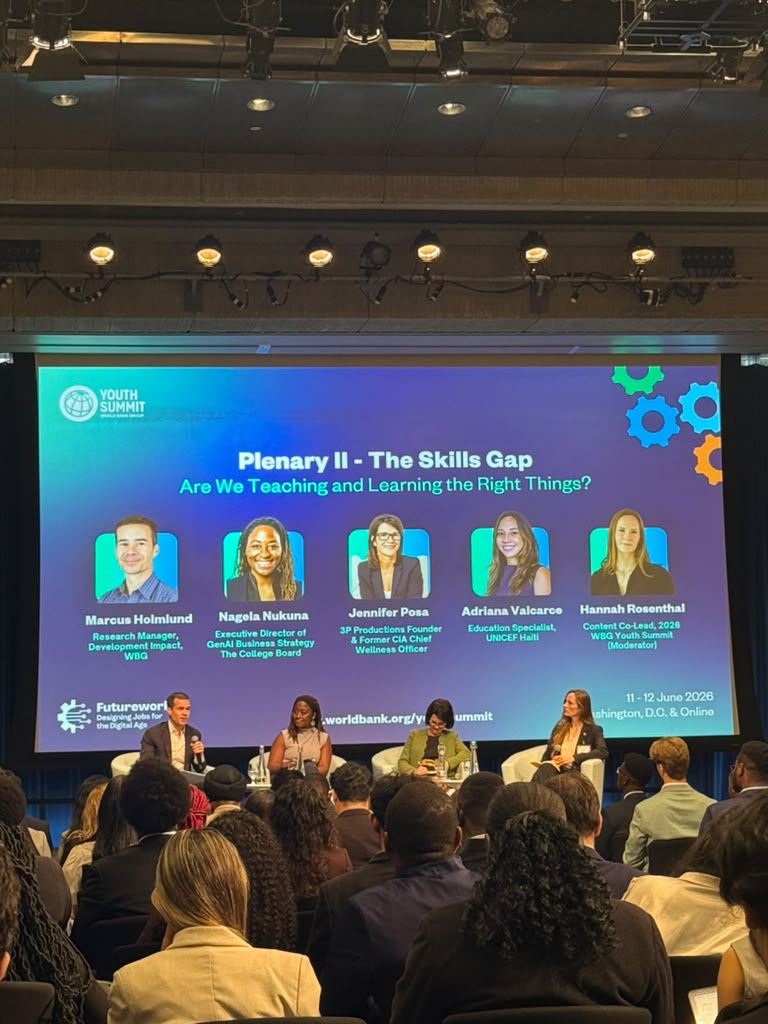
During discussions on “The Skills Gap: Are We Teaching and Learning the Right Things?”, panelists emphasized that developing technical skills alone will not be sufficient. Instead, they called for greater investment in early childhood development, play-based learning, adaptive education systems, and the human skills that enable people to thrive throughout their careers.
The conversation presented education as a lifelong process beginning well before formal schooling and extending into continuous learning and adaptation in the workplace. Speakers argued that governments, educators, businesses, and development institutions all have a role in ensuring young people are prepared for future opportunities.
Education Systems Must Keep Pace with Change
A central message of the discussion was that existing education systems are struggling to match the speed of technological transformation.
Jennifer Posa noted that learners operate within broader institutional systems that influence how they acquire and apply knowledge.
“You are working within systems right now that are impacting the way that you learn, and how it is that you operationalize your job.”
She also argued that personal motivation remains essential in navigating change.
“Purpose is incredibly important, for your own resilience within your work.”
The discussion suggested that preparing students for future careers requires not only curriculum reform but also institutional changes that support continuous learning and adaptability.
Human Skills Remain Critical in the AI Era
While AI continues to reshape workplaces, speakers stressed that uniquely human capabilities will remain indispensable.
Jennifer Posa observed:
“AI will and is asking us to redesign.”
Rather than replacing human abilities, participants argued that AI increases the importance of skills such as communication, critical thinking, collaboration, emotional regulation, trust-building, and conflict resolution.
The panel identified four particularly important competencies:
-
Adaptive resilience
-
Relational intelligence
-
Building and maintaining relationships
-
Trust, communication, and conflict resolution skills
Jennifer Posa emphasized that:
“Relationships are critically important.”
Speakers suggested that these abilities will increasingly differentiate successful workers in environments where technology can automate routine tasks but cannot replace human judgment and interpersonal skills.
Early Childhood Development Shapes Future Success
The discussion extended beyond higher education and workforce preparation to emphasize the importance of early childhood development.
Panelists argued that caregiver interactions—including play, communication, and responsive caregiving—are as essential to long-term development as nutrition and healthcare.
According to the discussion, early neural development depends on both genetics and environmental experiences, making supportive relationships critical before formal schooling begins.
An example cited during the session referenced a longitudinal study in Jamaica in which children receiving both nutrition and psychosocial stimulation reportedly demonstrated stronger cognition, improved mental health, and earnings exceeding those of children receiving nutrition interventions alone by more than 40% at age 31.
Speakers used the example to illustrate how investments in early childhood can produce long-term educational and economic benefits.
Play-Based Learning Rather Than Early Academic Pressure
Participants argued that preschool should not simply replicate primary school by emphasizing reading and mathematics drills.
Instead, they advocated play-based learning that develops working memory, task-switching, sharing, spatial awareness, fine motor skills, and other foundational competencies.
The discussion also highlighted disparities in preschool access, noting that coverage in Western and Central Africa was described as approximately 25–30%, compared with around 80% across Latin America and the Caribbean.
Speakers acknowledged that integrated early childhood programs combining education, nutrition, parenting support, and cash transfers can produce strong outcomes but also involve significant financial trade-offs between universal and targeted approaches.
Learning Poverty Requires Adaptive Systems
Another major theme was learning poverty and the need for education systems that respond to students’ actual learning levels.
Participants discussed an adaptive framework summarized as:
Assess → Teach → Reassess → Adapt
Rather than following rigid curricula, speakers argued that teaching should respond to where learners are academically and adjust accordingly.
The discussion promoted the LEADS approach—Learn, Adapt, Scale—encouraging evidence-based experimentation before expanding successful interventions.
Panelists warned that investments in infrastructure alone, such as buildings or laptops, are unlikely to improve learning outcomes without effective pedagogy and teacher support.
Technology Should Support Teachers, Not Replace Them
The panel described educational technology as an important tool but cautioned against viewing it as a substitute for educators.
Speakers argued that edtech should augment teacher productivity while fitting local contexts and available resources.
Examples discussed included low-cost offline smartphone applications, SMS, and messaging platforms that can function effectively where connectivity is limited.
AI was described as having significant potential for personalization and assessment but also carrying risks such as inaccurate outputs and misuse if implemented without appropriate safeguards and human oversight.
Participants therefore recommended integrating AI cautiously while ensuring learners develop the ability to interpret, evaluate, and challenge AI-generated information.
Purpose, Security, and Community Support Resilience
Jennifer Posa’s workplace readiness framework emphasized four pillars:
-
Purpose
-
Security
-
Strength through resilience
-
Relational intelligence
Speakers encouraged young people to understand their purpose, build resilience, and choose communities that provide opportunities and agency to thrive.
The discussion also included broader advice to remain skeptical, continuously test ideas, and welcome constructive criticism rather than assuming expertise alone guarantees correct answers.
Marcus summarized this perspective by encouraging participants to:
“Be humble in your own thinking, make sure we are subjecting our ideas to criticism.”
Why the Discussion Matters
The conversation has implications for policymakers, educational institutions, businesses, and development organizations seeking to prepare future generations for technological change.
For governments, it highlights the need to invest in early childhood development, adaptive education systems, and evidence-based reforms. For schools and universities, it underscores the importance of combining technical instruction with human-centered skills. For employers, it reinforces that communication, judgment, resilience, and collaboration remain valuable alongside AI literacy.
For young people, the discussion suggests that lifelong learning, adaptability, and strong relationships will become increasingly important in navigating changing careers.
Conclusion
The World Bank Youth Summit 2026 discussion argued that preparing youth for an AI-shaped future begins long before entering the workforce. From nurturing early childhood development and expanding play-based preschool to redesigning education systems and strengthening human-centered skills, speakers emphasized that successful adaptation will require coordinated action across families, schools, governments, businesses, and development institutions. As AI continues to transform learning and work, the challenge will be ensuring that education systems evolve to equip young people not only with knowledge, but with the resilience and judgment needed to apply it.
World Bank Youth Summit 2026, World Bank Youth Summit, skills gap, education reform, future of work, artificial intelligence, AI education, AI literacy, youth development, early childhood development, play-based learning, preschool education, education policy, workforce readiness, workforce development, human capital, learning poverty, adaptive learning, LEADS approach, Learn Adapt Scale, education technology, edtech, teacher training, lifelong learning, resilience, adaptive resilience, relational intelligence, communication skills, critical thinking, collaboration, emotional regulation, trust building, conflict resolution, purpose, career resilience, youth skills, skills development, education systems, learning outcomes, cognition, socio-emotional development, caregiver support, responsive caregiving, brain development, innovation, technology, global development, economic growth, youth employment, future skills, AI and education, education innovation, policy, governance, institutions, schools, universities, curriculum, assessment, personalized learning, digital learning, offline learning, teacher support, workforce skills, productivity, sustainable development, youth empowerment, talent development, education investment, learning systems, evidence-based policy, development policy, Sub-Saharan Africa education, Latin America education, preschool access, educational inequality, inclusive education, skills economy, human skills, problem solving, creativity, judgment, adaptability, education strategy, World Bank event, AI era, future careers, learning transformation, workforce transformation, child development, educational leadership, policy reform, technology in education, educational resilience, learning assessment, developmental outcomes, educational innovation, skills agenda, global education, youth policy, economic inclusion, lifelong skills.