
World Bank Youth Summit 2026 Calls for Skills-First Economy and Inclusive AI Policies to Prepare Young People for the Future of Work
Speakers at the World Bank Youth Summit 2026 said the future of work will depend on skills, adaptability, and effective AI adoption, while urging governments, employers, and institutions to work with young people to build more and better jobs.

|
Getting your Trinity Audio player ready...
|
The World Bank Youth Summit 2026 highlighted the growing importance of a skills-first economy, with speakers arguing that governments, employers, educational institutions, and young people must work together to ensure artificial intelligence (AI) expands opportunities rather than deepens inequality in the global labor market.
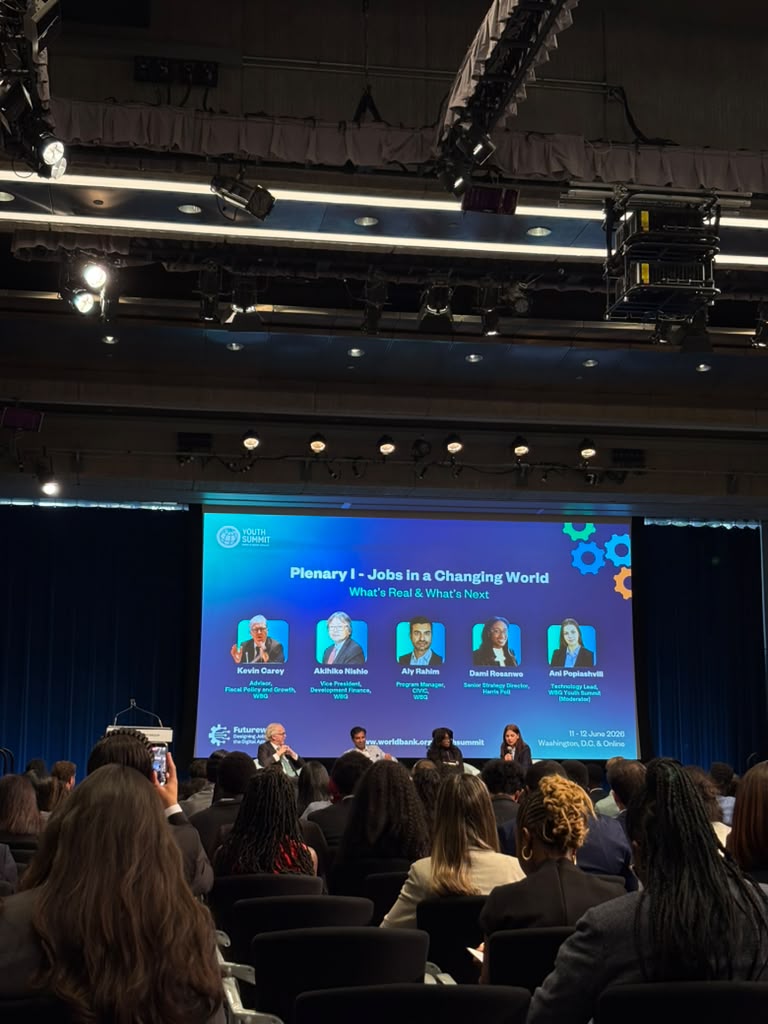
During the panel “Jobs in a Changing World,” participants emphasized that technological change is reshaping employment faster than many education systems can adapt. They argued that future success will increasingly depend on demonstrated skills, lifelong learning, and supportive policies that allow workers to transition into new opportunities.
The discussion comes as speakers noted that 1.2 billion young people are expected to enter the global workforce in the coming years, while 800 million of the world’s three billion workers remain poor, illustrating the scale of the employment challenge facing policymakers and development institutions.
A Skills-First Economy Is Emerging
A recurring theme throughout the discussion was the shift from credential-based hiring to a skills-first economy, where employers place greater value on evidence of what individuals can do rather than on traditional degrees alone.
Panelists noted that research discussed during the session found 85% of workers believe proof of credentials is essential, yet only 45% have access to institutions or technologies that enable them to demonstrate those skills.
Speakers argued that education systems are struggling to keep pace with rapid technological change, leaving many graduates without the competencies employers increasingly demand.
According to the discussion, AI creates new opportunities for learning and demonstrating skills, but those opportunities can only be realized if trustworthy credentialing and assessment systems are widely accessible.
AI Is an Opportunity—but Systems Matter
Rather than portraying AI as a threat that will eliminate work, participants described it primarily as an augmentation tool capable of increasing productivity by removing repetitive tasks and allowing workers to focus on judgment, creativity, and problem-solving.
Dami Rosanwo observed that young people recognize both the promise and the risks associated with AI.
“Young people understand the benefits AI brings but they also understand there are a lot of tradeoffs and drawbacks.”
He also noted that career advancement is increasingly based on demonstrated capability rather than formal qualifications.
“Career advancement is moving more towards proof of what people can do; we are moving into a skills-based economy…education is not keeping pace with technology.”
Speakers emphasized that the challenge is not AI itself but the institutional environment surrounding it. They argued that governments and organizations should help people learn how to navigate and use AI effectively rather than focusing solely on the technology.
The discussion repeatedly characterized the issue as a systems, policy, and institutional support challenge, requiring coordinated action beyond individual effort.
Creating More and Better Jobs
The panel linked skills development directly to economic growth and employment creation.
Kevin Carey summarized the objective simply as “More and better jobs.”
Participants explained that much of this job creation will need to come from the private sector, making predictable and business-friendly environments increasingly important.
The discussion highlighted the role of the World Bank Group in investing in foundations such as human capital, skills development, and infrastructure that improve productivity while fostering conditions that encourage private-sector growth.
Speakers suggested that economic development depends not only on education but also on policies that allow businesses to invest and expand.
Labor Mobility Will Determine AI’s Impact
Another major focus was labor mobility.
Panelists argued that AI affects industries unevenly, making it essential for workers to move between sectors and occupations as economies evolve.
An example discussed during the session referenced economic modeling for Poland, indicating that full labor mobility could offset net job losses associated with AI adoption, while barriers to mobility could result in a net loss of approximately 330,000 jobs.
The implication, according to the discussion, is that retraining programs, incentives, and supportive institutions will determine whether AI produces overall employment gains.
Speakers stressed that adaptability alone is insufficient if systems prevent workers from translating newly acquired skills into employment opportunities.
Youth Should Help Shape Policy
The discussion repeatedly emphasized the importance of involving young people in policymaking rather than designing policies on their behalf.
Aly Rahim stated:
“Young people really need to be brought into policy dialogue.”
He also described the current period as “a civilizational transition,” reflecting the scale of technological and economic change underway.
Rahim further argued:
“Listening to young people at scale is a project we need to build.”
Participants suggested that local realities should shape solutions, noting that skills strategies should reflect the specific needs of communities rather than relying on one-size-fits-all global approaches.
Human Skills Remain Critical
Despite advances in AI, speakers stressed that foundational human capabilities remain indispensable.
Employers reportedly continue to prioritize creativity, judgment, communication, adaptability, and learning-to-learn alongside technical competencies.
The discussion also highlighted an AI literacy gap, with hiring managers identifying the ability to evaluate and appropriately use AI-generated outputs as a significant need.
According to participants, adaptability only translates into career advancement when hiring systems, workplace practices, and credentialing mechanisms recognize and reward those skills.
Why the Discussion Matters
The conversation has implications beyond individual career development. For policymakers, it highlights the need for investments in education, credentialing systems, workforce mobility, and institutional reform. For businesses, it underscores the importance of building environments that value demonstrated skills and continuous learning. For educational institutions, it points to the challenge of aligning curricula with rapidly evolving labor market demands.
For young people, the message was that resilience, adaptability, and practical skills will increasingly define career success in an AI-enabled economy.
Conclusion
The World Bank Youth Summit 2026 discussion suggested that the future of work will not be determined by technology alone but by how governments, employers, educational institutions, and international organizations respond to technological change. Speakers argued that creating inclusive growth requires stronger skills systems, accessible credentialing, supportive labor policies, and meaningful youth participation. As AI continues to reshape economies, the success of the transition will depend on whether institutions can convert innovation into more—and better—employment opportunities.
World Bank Youth Summit 2026, World Bank Youth Summit, Jobs in a Changing World, future of work, AI, artificial intelligence, youth employment, youth development, skills-first economy, skills-based hiring, workforce development, employment, jobs, global development, economic growth, innovation, entrepreneurship, education, skills development, AI literacy, digital skills, human capital, labor market, credentialing, credentials, workforce mobility, labor mobility, policy, public policy, governance, institutions, employers, businesses, private sector, productivity, technology, technology policy, youth policy, career development, career skills, adaptability, resilience, creativity, communication, critical thinking, lifelong learning, upskilling, reskilling, training, assessment, certification, education reform, economic opportunity, inclusive growth, development policy, global economy, workforce skills, future careers, youth leadership, international development, World Bank Group, innovation policy, digital economy, employment policy, job creation, sustainable development, AI adoption, AI and jobs, future skills, labor force, workforce transformation, education technology, learning, human skills, youth participation, policymaking, institutional support, business environment, economic resilience, talent development, professional development, opportunity, emerging economies, development stakeholders, job market, employment trends, digital transformation, skills gap, technology adoption, career readiness, workforce readiness, economic inclusion, AI governance, productivity growth, youth innovation, education systems, labor economics, skills agenda, future workforce.