
Guinea-Bissau Referendum Backs Stronger Presidency Ahead of December Election

|
Getting your Trinity Audio player ready...
|
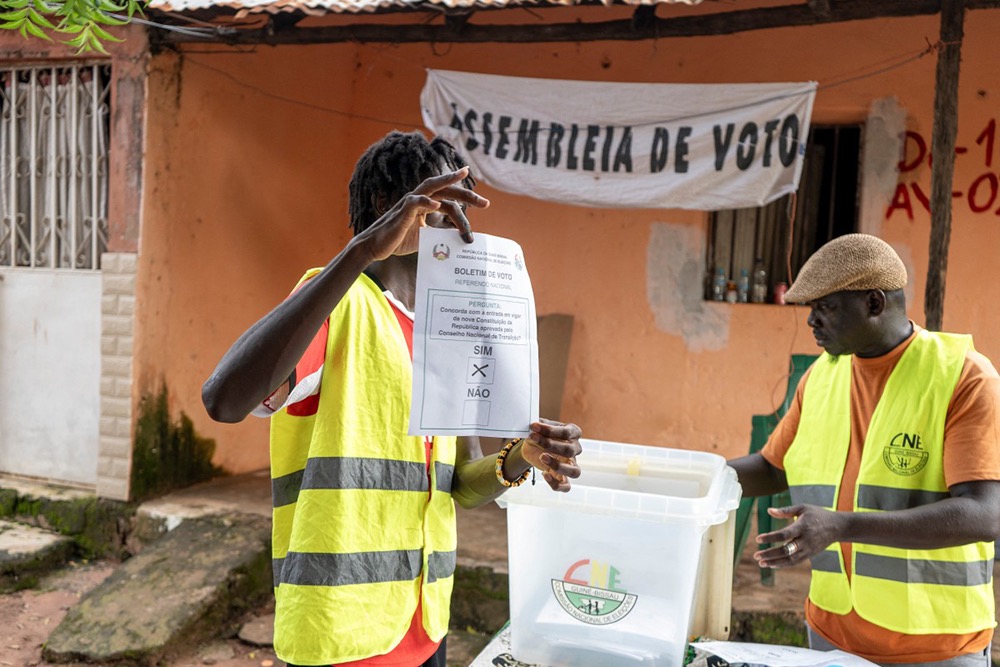
Guinea-Bissau voters have backed a new constitution that significantly strengthens presidential authority, according to provisional results from a referendum held as the country prepares to return to elected civilian government.
The National Electoral Commission said 70 per cent of votes supported the constitutional changes while 30 per cent opposed them. The new text changes the balance of power between the president, prime minister and parliament. The president will be able to appoint and dismiss the prime minister and members of government and dissolve parliament under specified circumstances. The legislature will also shrink from 102 seats to 65.
The changes move Guinea-Bissau further away from the previous arrangement in which executive authority was shared more substantially between the presidency and a prime minister emerging from the parliamentary majority. The military-led transitional authorities argue that repeated disputes between those offices have contributed to political instability.
Opponents see the same reforms very differently.
The African Party for the Independence of Guinea and Cape Verde, PAIGC, urged supporters to boycott the referendum and argued that the process lacked adequate political and institutional safeguards. The disagreement reflects a larger constitutional question. Guinea-Bissau has struggled for decades with military intervention, unstable governments and political confrontation.
A clearer executive structure could potentially reduce some institutional conflict, but concentrating authority also increases the importance of strong legal and parliamentary checks. The referendum took place less than a year after the military seized power following a disputed presidential election in November 2025.
Presidential and legislative elections are planned for December as part of the transition back towards civilian rule. The current result is provisional. The Supreme Court is expected to announce the final outcome in the coming days, and the electoral commission said it had not received legal challenges to the referendum at the time of its latest announcement.
The constitutional changes will therefore become particularly important during the December elections. Whoever eventually occupies the presidency could exercise substantially greater authority than under the previous system. That makes political competition, electoral credibility and institutional oversight even more consequential.
Guinea-Bissau has experienced repeated coups and attempted coups since independence. Political instability has often prevented institutions from acquiring the continuity necessary to build public confidence.
For The Voice of Africa, the referendum should therefore be judged beyond the 70 per cent headline. Africa’s constitutional systems are still relatively young, and many continue to evolve as states search for arrangements capable of combining effective government with democratic restraint. Guinea-Bissau may have chosen a stronger presidency, but the long-term test is whether stronger executive authority exists alongside stronger institutions. Political stability is most durable when citizens know that power is governed by rules regardless of who holds it.