

|
Getting your Trinity Audio player ready...
|
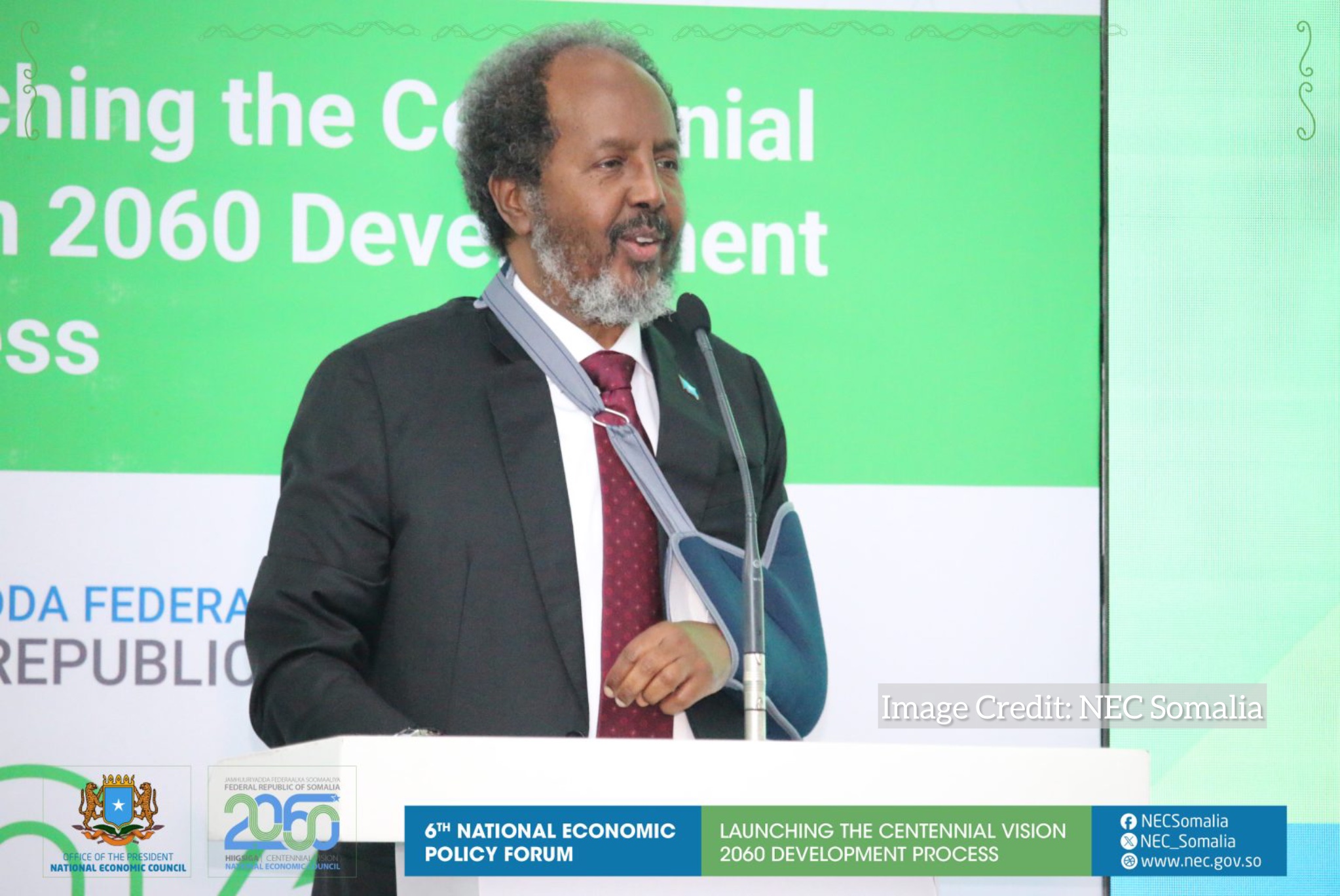
Somalia has launched an ambitious national agenda aimed at transforming the country from a fragile state into a resilient, inclusive, and prosperous middle-income nation by the year 2060. The initiative, known as Centennial Vision 2060 (CV2060), outlines a bold framework for long-term development, rooted in sustainable governance, economic reform, human capital development, and environmental resilience.
Somalia Sets Its Sights on Middle-Income Status
The CV2060 strategy represents a monumental shift in Somalia’s approach to development. Spearheaded by the National Economic Council and supported by President Hassan Sheikh Mohamud and Prime Minister Hamza Abdi Barre, the plan envisions a Somalia that is economically independent, politically stable, and globally competitive by the time it marks its centenary of independence in 2060.
The vision is being implemented through a structured, phased approach. In March 2025, the Somali government unveiled the National Transformation Plan (NTP) 2025–2029, the country’s first integrated development roadmap aligned with CV2060. This four-year plan is designed to serve as the foundation for broader reforms and growth over the next three decades.
National Transformation Plan 2025–2029: A Foundation for Change
The NTP is centered on four strategic pillars: transformational governance, sustainable economic transformation, social and human capital development, and environmental and climate resilience. Each pillar outlines specific objectives, reforms, and measurable targets to be achieved between 2025 and 2029.
In terms of governance, the plan emphasizes rebuilding Somalia’s institutions through public sector reform, anti-corruption strategies, inclusive decision-making, and enhanced rule of law. The government has already launched digital identification programs and begun implementing systems to digitize tax collection and public services.
Economically, the NTP aims to diversify Somalia’s economy by investing in critical infrastructure such as roads, ports, telecom, and energy while promoting public-private partnerships (PPPs). Somali leaders have studied international models, including Turkey’s PPP framework, to design partnerships for toll roads, airports, and hospitals.
Human capital development is also a central focus. The plan prioritizes improvements in education, healthcare, job creation, and social safety nets—especially for youth, women, and marginalized populations. The government intends to scale up technical education and vocational training to align with emerging market needs.
A Greener and More Resilient Somalia
On the environmental front, Vision 2060 and the NTP underscore the importance of climate resilience and sustainable natural resource management. The Ministry of Environment and Climate Change has launched a nationwide
“Green Somalia”
initiative, aiming to plant over one million trees and rehabilitate degraded lands. Somalia is also participating in the African Union’s Great Green Wall initiative and has committed over $10 million toward climate adaptation and reforestation.
The government’s long-term resilience strategy also addresses disaster preparedness, water access, and energy diversification, with a growing emphasis on clean energy solutions such as solar and wind.
Financing Transformation: Mobilizing Domestic and International Support
The estimated cost of implementing the first phase of the NTP is $26 million. The Somali government is working with international partners such as the World Bank, International Monetary Fund (IMF), and East African Community (EAC) to secure funding, technical assistance, and policy support. The World Bank’s new Country Partnership Framework for Somalia (2024–2029) is aligned with the NTP and supports digital infrastructure, climate adaptation, and fiscal reform.
Domestically, the government aims to increase its revenue-to-GDP ratio from its current level of just 2.5% one of the lowest in the world to at least 9% by 2030. Reforms in taxation, customs administration, and intergovernmental revenue sharing are central to this goal.
Building Momentum Amid Ongoing Challenges
Despite significant progress, Somalia’s path to 2060 is not without obstacles. Political instability, insecurity, and limited institutional capacity continue to pose serious challenges. However, Vision 2060 reflects a strong commitment by Somali leaders to break from cycles of fragility and donor dependency by pursuing a nationally owned and accountable development process.
To ensure success, the government has committed to monitoring and evaluation frameworks that will track progress on NTP targets and adapt strategies as needed. Ongoing stakeholder engagement with civil society, academia, the private sector, and regional governments will be crucial.
A Historic Pivot Toward Peace and Prosperity
With the unveiling of Vision 2060 and its first National Transformation Plan, Somalia is signaling its readiness to turn a new page in its national story. If implemented effectively, this vision could redefine the country’s trajectory moving it from decades of conflict and underdevelopment toward a future defined by peace, productivity, and national pride.
For the Somali people, Vision 2060 is more than just a plan it is a promise of what the nation can become: a stable, self-reliant, and rising force on the African and global stage.