
Bringing Gender to the Heart of Climate Policy in East and Southern Africa
Written By Maxine Ansah

|
Getting your Trinity Audio player ready...
|
UN Climate Change News– A transformative two-year initiative by UN Climate Change’s Regional Collaboration Centre for East and Southern Africa (RCC EASA) has strengthened the leadership of women and gender experts in climate negotiations and national policy across the region. Funded by the African Development Bank’s Africa Climate Change Fund, the project marks a significant step towards embedding gender equality into climate action where it matters most: in national climate commitments and long-term strategies.
Launched in February 2023, the project supported 19 countries in East and Southern Africa, focusing on building the capacity of National Gender and Climate Change Focal Points (NGCCFPs) and key negotiators. Central to its success is a newly released technical guide that helps policymakers, national climate teams and gender focal points integrate gender considerations into Nationally Determined Contributions (NDCs) and Long-Term Low-Emission Development Strategies (LT-LEDs).
The guide draws on more than 20 global resources and offers practical steps covering every stage of climate planning, from stakeholder engagement and drafting to implementation and monitoring. Beyond being a procedural document, it promotes what the authors describe as a gender-transformative approach: urging planners to consider not only how women and marginalised groups are affected by climate change, but also how climate policy itself can help redress deep-rooted inequalities and reshape power structures.
In an interview with UN Climate Change News, Jackline Makokha, Director of Gender at Kenya’s State Department for Gender Affairs and Affirmative Action and the country’s UNFCCC National Gender and Climate Change Focal Point, reflected on the project’s impact.
“The technical assistance has been transformative. We are certainly not the same, and we are committed to passing on the knowledge and skills we have gained, in the true spirit of mentorship,” she said. “We look forward to similar initiatives in the future for the good of our region and humanity at large.”
Key milestones of the initiative included four regional dialogues that brought together NGCCFPs, NDC focal points, civil society and experts to jointly develop strategies for mainstreaming gender into climate policies. A month-long online training course also equipped over 60 participants with deeper knowledge of the UNFCCC processes, gender mandates, negotiation tactics and practical skills to integrate gender perspectives into national climate planning. Importantly, the project also facilitated the direct participation of NGCCFPs in global meetings such as the UN Climate Change Conference COP 28, held in Dubai, United Arab Emirates, where their expertise contributed to national delegations.
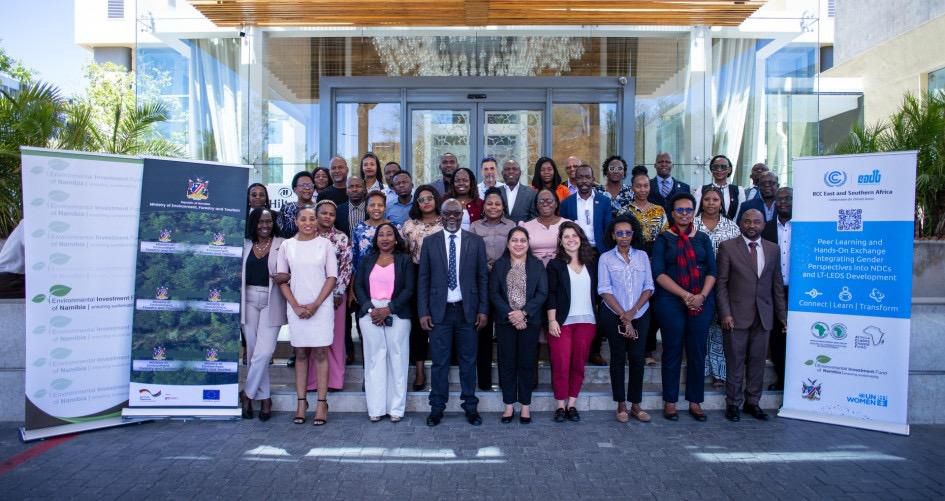
The guide’s development process itself was highly participatory, reflecting the region’s priorities and realities. A high-level capacity-building workshop in Windhoek, Namibia, co-hosted by the Ministry of Environment, Forestry and Tourism, the Environmental Investment Fund and UN Women, helped shape its structure. Feedback from NDC Focal Points, NGCCFPs, sectoral experts and civil society partners ensured that the final document is both practical and regionally relevant.
As countries prepare to submit their next generation of NDCs and LT-LEDs, the guide comes at a critical moment. It reinforces the role of NGCCFPs not only as technical advisers, but as champions of more inclusive and equitable climate action. The initiative, as highlighted by UN Climate Change, shows how gender considerations can be mainstreamed from the ground up rather than added as an afterthought, ensuring that climate action leaves no one behind.
By centring gender in climate policy, East and Southern African countries are taking concrete steps towards climate strategies that are fairer, more inclusive and ultimately more effective in addressing the intertwined challenges of climate change and inequality.