

|
Getting your Trinity Audio player ready...
|
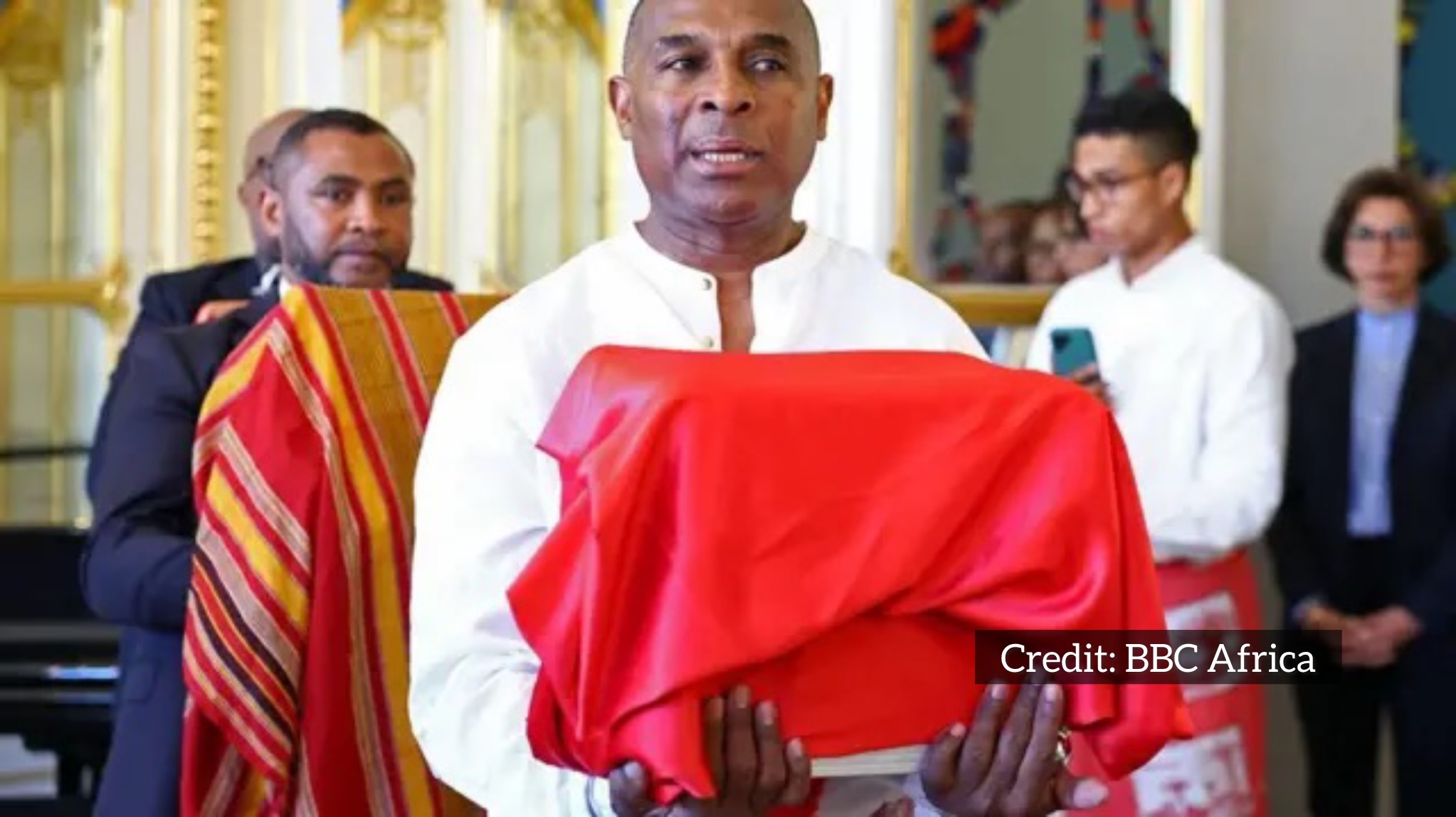
In a historic and symbolic act of reconciliation, France has formally returned the skull of King Toera, a prominent Malagasy ruler killed during a colonial-era conflict, to his homeland, Madagascar. The repatriation also included the remains of two members of his royal court, marking an important milestone in addressing the lingering wounds of colonial history.
The handover ceremony took place at France’s Ministry of Culture in Paris, where the remains had been stored for over a century in the collections of the Museum of Natural History. The return is the first conducted under a new French law designed to accelerate the restitution of human remains taken during colonial times or under ethically questionable circumstances.
A Dark Chapter of Colonial History
King Toera was killed in August 1897 during a French military campaign to exert control over the Menabé kingdom of the Sakalava people in western Madagascar. Following his death, French troops decapitated the king, and his head was transported to Paris. The remains were kept in museum archives for nearly 130 years.
French Culture Minister Rachida Dati, speaking at the ceremony, described the presence of the skulls in national collections as a result of “circumstances that clearly violated human dignity and occurred in the context of colonial violence.”
Recognition of Historical Injustice
The return follows years of pressure from both the Malagasy government and King Toera’s descendants, who campaigned for the repatriation. While DNA tests conducted several years ago could not conclusively confirm the skull’s identity, a traditional Sakalava spirit medium played a crucial role in authenticating it as that of the monarch.
Madagascar’s Culture Minister, Volamiranty Donna Mara, expressed the deep emotional impact of the return, stating:
“Their absence has been, for more than a century, an open wound in the heart of our island. This return is a meaningful gesture towards healing and remembrance.”
A New Era for Restitution
France has in recent years faced increasing calls to return cultural artifacts and human remains acquired during colonial rule. This is not the first instance of restitution, but it is the first carried out under the recent legislation aimed at simplifying the process.
One of the most notable earlier cases was the repatriation of the remains of Sarah Baartman, often referred to by the derogatory nickname “Hottentot Venus,” whose body was returned to South Africa in 2002.
It is estimated that the Museum of Natural History alone holds more than 20,000 human remains collected globally for so-called scientific purposes during the colonial period. The new law is expected to pave the way for similar repatriations in the future, fostering dialogue and cultural reconciliation between France and nations affected by its colonial past.
Source: BBC Africa