
Africa at the UN: Leaders Call for Peace, Justice and Stronger Multilateralism
Written By Maxine Ansah
|
Getting your Trinity Audio player ready...
|
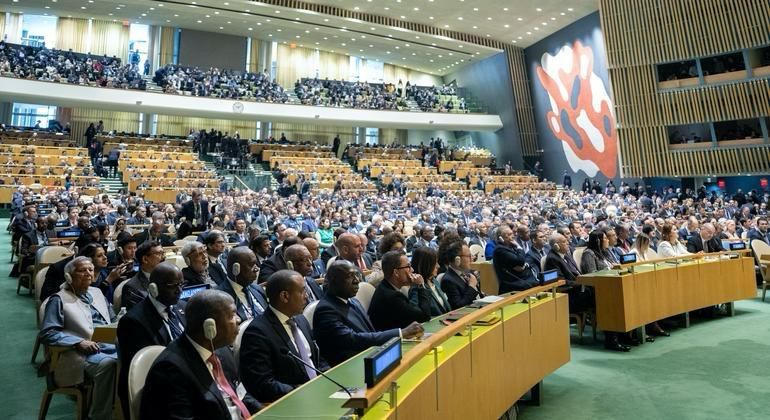
At the 80th session of the United Nations General Assembly in New York, African leaders used the global stage to call for peace, climate justice, fairer representation, and stronger multilateralism. Their speeches reflected both national priorities and a collective African vision for a world order that upholds sovereignty, justice and solidarity.
Morocco: A call for peace in the Middle East and Africa
Morocco’s Prime Minister Aziz Akhannouch urged the world to pursue peaceful solutions to protracted conflicts across the Middle East and Africa. On Western Sahara, he reaffirmed Morocco’s position that its autonomy initiative is the only realistic solution, citing growing international support. Describing the Sahara as a land full of opportunity, he insisted that Morocco’s sovereignty and territorial integrity must be respected.
Turning to the Middle East, Akhannouch called for an immediate ceasefire in Gaza, unrestricted humanitarian access, and renewed negotiations towards a two-State solution. He emphasised the importance of establishing a Palestinian State with East Jerusalem as its capital and Gaza as an integral part of its territory. He also highlighted Morocco’s commitment to protecting holy sites, including the Aqsa Mosque compound, and expressed solidarity with Qatar, Syria and Lebanon. On the wider continent, he urged peaceful resolutions through dialogue in Libya, Yemen, Sudan and Somalia.
Democratic Republic of the Congo: An end to exploitation and war
President Félix Antoine Tshisekedi Tshilombo drew attention to what he described as a silent genocide in his country, fuelled by illegal resource exploitation. He linked this crisis to broader global instability in Gaza, Ukraine, Yemen, Myanmar and Syria. Tshisekedi pressed the international community to support an independent commission of inquiry into atrocities in eastern Congo.
Looking ahead to his country’s term as a non-permanent member of the Security Council in 2026-2027, he promised a constructive and holistic approach focused on peace and security. He called for Africa to be given two permanent and two non-permanent seats on the Council, insisting that the continent can no longer remain on the sidelines. He further urged strict enforcement of the peace agreement between the Democratic Republic of the Congo and Rwanda, warning that failure to do so would cost more innocent lives.
Liberia: Peace, multilateralism and climate justice
President Joseph Nyuma Boakai celebrated Liberia’s election to the Security Council for the 2026-2027 term, its first full tenure. He noted that Liberia’s experience with peacebuilding and governance reforms gives it a moral responsibility to strengthen multilateralism. He expressed support for mediation efforts in both Ukraine and Palestine, calling for global unity to protect civilians and hold perpetrators accountable.
Boakai also raised the urgency of climate change, describing it as a present reality rather than a distant threat. He called for climate justice, stressing that those who contribute the least to the crisis should not bear the greatest burden.
Angola: Condemning aggression and interference
Angolan President João Manuel Gonçalves Lourenço condemned the actions of powerful states that invade, annex or interfere in sovereign countries. Drawing parallels with Europe’s liberation from fascism and Africa’s liberation from apartheid, he argued that current aggression undermines the moral authority of global institutions.
He noted that Angola has worked to resolve conflicts in the Sahel, Sudan and eastern Congo, while stressing that instability hampers development across the continent. He underlined the unique role of the United Nations in holding states accountable when they breach international law.
Mozambique: Democracy and inclusive multilateralism
President Daniel Francisco Chapo of Mozambique used his first address to showcase his country’s democratic progress. He highlighted regular, transparent elections and a new public consultation process designed to ensure that all voices are heard regardless of economic or social standing.
Chapo reaffirmed Mozambique’s commitment to peace, democracy and a stronger African voice on the world stage. He warned against a United Nations that resembles an assembly of shareholders dominated by the richest, urging instead for inclusive multilateralism built on solidarity and fairness.
A united African message
Across these speeches, a shared African narrative emerges: that sovereignty, peace and fairness must be defended in an increasingly unstable world. Calls for climate justice, Security Council reform and respect for international law underscore the desire for a more equitable global order.
As wars, displacement and environmental crises continue to strain societies, African leaders at the 80th General Assembly are making it clear that their voices and experiences cannot be marginalised. Their contributions have so far not only been appeals for peace but also firm reminders that the future of multilateralism depends on inclusivity, justice and solidarity.