

|
Getting your Trinity Audio player ready...
|
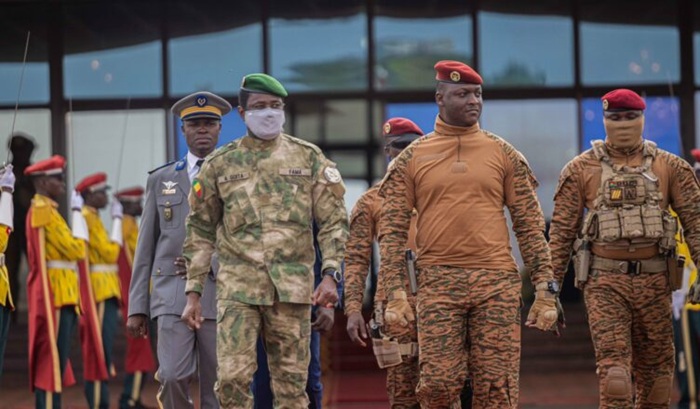
Burkina Faso, Mali and Niger have formally launched a unified regional armed force, marking a new phase in how parts of West Africa are choosing to confront insecurity, sovereignty and external pressure.
The force was inaugurated at an air force base in Bamako under the supervision of Mali’s transitional leader General Assimi Goïta. It brings together troops from the three Sahel states under the framework of the Alliance of Sahel States, with a stated mandate to jointly respond to security threats across their borders.
Niger’s defence minister earlier confirmed the force would number around 5,000 troops and operate collectively against armed groups destabilising the region. Burkinabè General Daouda Traoré has been appointed to lead the force, with a permanent command base established in Niamey.
This development follows the decision by Burkina Faso, Mali and Niger to withdraw from ECOWAS, which the three governments accuse of imposing sanctions that punish citizens more than political actors and of aligning too closely with external interests. The alliance is positioning itself as an alternative model of regional cooperation rooted in shared security priorities rather than diplomatic consensus.
To be clear, this is not a fairy tale. All three countries are led by military governments and remain under pressure from armed insurgencies that have resisted years of foreign backed interventions. The difference now is tone and ownership. Instead of waiting for approval or instruction, these states are choosing to act together, on their own terms, with their own command structure.
Critics will say this is risky. Supporters will argue the old approach was failing anyway. What is undeniable is that the Sahel is experimenting in real time with a new security architecture, one that reflects frustration with existing regional systems and a desire to reclaim agency over national survival.
Whether this force succeeds will depend less on announcements and more on discipline, coordination, civilian protection and economic stability. Guns alone have never solved Sahelian crises. But political unity, however imperfect, changes the equation.
Africa’s story is often judged as if it should already look like Europe or North America. That comparison ignores history, time and context. These are young states operating under extreme pressure, trying to correct paths shaped by decades of external control and internal fragility. Progress here will not be linear, but neither is it absent.
The Sahel’s experiment may stumble or it may evolve into something stronger. Either way, it reflects a continent still writing its future, learning through hard choices, and refusing to stand still. Africa is young, its systems are still forming, and its trajectory cannot be measured by the standards of much older nations. What matters is that even in uncertainty, the direction remains forward, grounded in the belief that tomorrow can be built better than yesterday.