
From the Kitchen to the Frontlines: Christian Abegan’s Recipe for Fighting Hunger
By Maxine Ansah

|
Getting your Trinity Audio player ready...
|
In eastern Cameroon’s Kaigama village, a long trestle table is laid out with maize, groundnuts, powdered fish and fruit. As a large metal pot warms over an open fire, chef Christian Abegan guides a group of women through the steps of preparing Five Star Porridge. The women include local Cameroonians and refugees from the Central African Republic. For Abegan, the dish is more than food. It is a response to rising hunger and malnutrition in the region.
“Now you add water,” he tells them, stressing the need for balance and care. Made entirely from local, affordable ingredients, Five Star Porridge has become a simple but effective nutritional tool promoted by the World Food Programme. Abegan was named WFP Chef Advocate for Food Safety and Sustainable Food Systems in West and Central Africa in 2025, formalising a partnership that began eight years earlier.
Abegan says his recent travels with WFP in Cameroon, Benin and Burkina Faso reshaped his understanding of food. After four decades in professional kitchens, he now sees feeding people as an act of solidarity and a long-term investment in humanity. That message is especially relevant across West and Central Africa, where conflict, displacement, high food prices and extreme weather continue to deepen poverty.
In Cameroon alone, 3.1 million people faced severe hunger between October and December 2025. Projections indicate that about 2.9 million people may face acute hunger between June and August 2026. Some of the most severe conditions are in the eastern region, which hosts nearly half of the country’s more than 300,000 refugees from the Central African Republic.
Funding shortfalls have forced WFP to cut food assistance, including support for refugees who now face difficult choices about whether to return home. One buffer has been a food security and resilience programme launched in 2023 by the Government of Cameroon with support from the World Bank. Known as PULCCA, the programme supports fish farming, improved agricultural techniques, reduced post-harvest losses and school meals. Five Star Porridge is part of this wider effort to tackle malnutrition using local solutions.
Abegan describes the porridge as a shield against hunger. Five ingredients, all locally available, are combined to create a highly nutritious meal. Watching mothers prepare it, he says, shows that innovation does not always come from laboratories. Sometimes it comes from tradition and resilience.
Born in northern Cameroon and raised in Yaounde, Abegan learned the basics of cooking in his family kitchen under the guidance of his nanny, Susie. He later travelled to France to study law but chose to follow his passion for food, enrolling at Le Cordon Bleu in Paris. After opening a restaurant in Douala, he became a familiar figure across francophone Africa as a judge on the television show Star Chef, where he promoted the use of local ingredients in high-quality cuisine.
His work with WFP has taken him to some of the continent’s most food-insecure areas. In Burkina Faso in 2017, while supporting school meals in the town of Dori, he noticed vegetables were absent from the menu despite being available in local markets. By introducing cabbage, carrots and lettuce into meals, he helped broaden diets and, for some children, provided their first taste of cooked vegetables.
In Mbile refugee settlement in eastern Cameroon, Abegan met Asmaou, a young mother from the Central African Republic who learned to prepare Five Star Porridge. She said the meal helped her baby grow stronger and fall sick less often. For Abegan, such encounters confirm that the dish is not just for Cameroon but a potential model for other contexts.
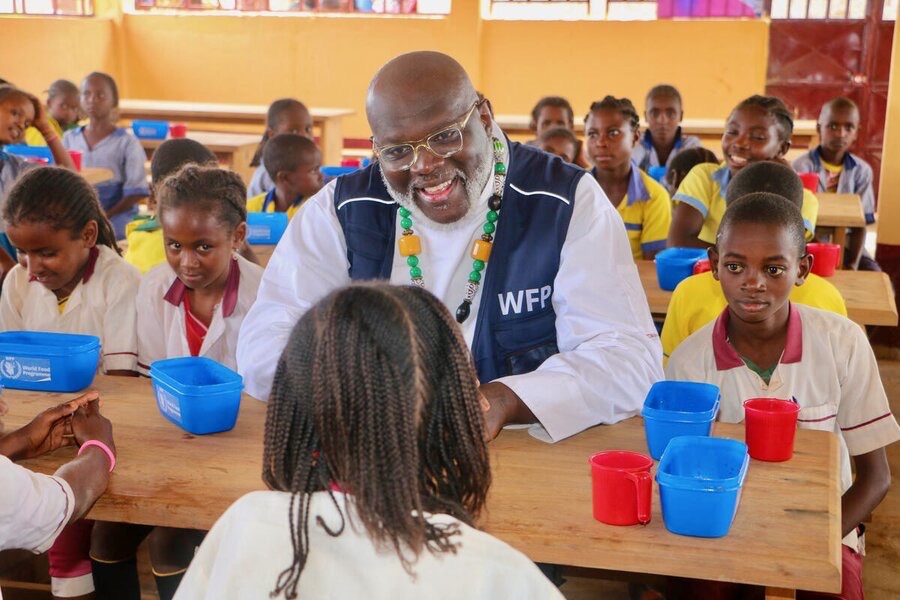
During his visit, Abegan also joined school cooks serving meals made from locally sourced manioc, groundnuts and gumbo sauce, and visited a WFP-supported fish farm where women harvested fish by hand. According to WFP Cameroon Country Director Gianluca Ferrera, the combined PULCCA interventions have proven effective in boosting incomes and food security. The programme requires US$156 million to continue in 2026 and risks being scaled down without new funding.
Abegan argues that the returns justify the investment. He says WFP’s approach places people at the centre, offering hope in moments of displacement and loss. In his view, these efforts show how food can restore dignity and save lives.
For Africa, where fertile land and human potential coexist with persistent hunger, Abegan’s work is a reminder that solutions do not always lie in imported systems. They can begin with local knowledge, shared meals and the belief that communities, when supported, can feed themselves. As young African nations continue to confront old and new crises, such grounded approaches point towards a more resilient and self-sustaining future.
Christian Abegan, WFP Chef Advocate, food security Africa, hunger in Cameroon, malnutrition West Africa, sustainable food systems Africa, Five Star Porridge, refugee nutrition Cameroon, local ingredients Africa, WFP Cameroon, Central African refugees, African food innovation, school meals Africa, resilience programmes Cameroon, World Food Programme Africa, nutrition solutions Africa, food insecurity West Central Africa, African chefs humanitarian work, traditional foods nutrition, local agriculture Africa, Cameroon hunger crisis, PULCCA programme, food aid Africa, sustainable diets Africa, women and nutrition Africa, child malnutrition Africa, climate and hunger Africa, African culinary advocacy, humanitarian food programmes, community nutrition Africa, fish farming Cameroon, school feeding programmes Africa, refugee camps Cameroon, poverty and hunger Africa, African food systems, local food resilience, nutrition security Africa, UN food programmes Africa, African agriculture development, hunger statistics Cameroon, food assistance cuts Africa, international financing food security, African solutions hunger, women cooks refugee camps, maternal nutrition Africa, child health nutrition Africa, humanitarian funding gaps Africa, sustainable agriculture Cameroon, traditional diets Africa, food sovereignty Africa, local markets Africa, African resilience stories, UN agencies Africa, development and hunger Africa, nutrition education Africa, affordable diets Africa, African food culture, humanitarian chefs Africa, food security policy Africa, rural nutrition Africa, urban food systems Africa, African youth nutrition, women-led food initiatives Africa, climate shocks hunger Africa, conflict and hunger Africa, displacement and food security, African development narratives, community-based nutrition Africa, nutrition advocacy Africa, food systems transformation Africa, African humanitarian innovation, local solutions global hunger