Qatar to Supply Egypt With Up to 24 LNG Shipments to Meet 2026 Summer Energy Demand
Get real time updates directly on you device, subscribe now.
|
Getting your Trinity Audio player ready...
|

Qatar is set to play a pivotal role in supporting Egypt’s energy security in 2026, following a new agreement that will see the Gulf state supply up to 24 liquefied natural gas (LNG) cargoes to meet Egypt’s peak summer demand.
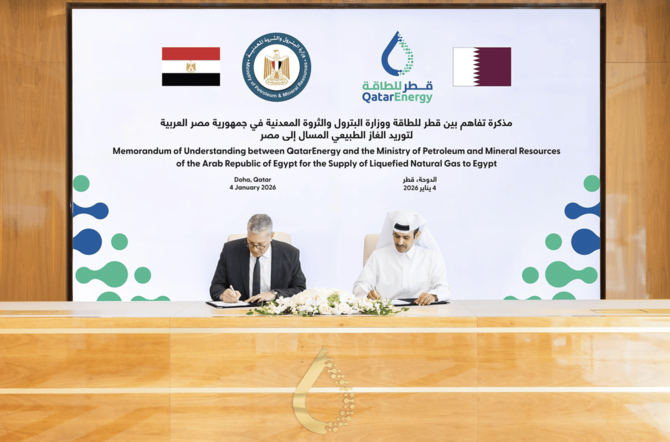
The arrangement was finalized through a delivery agreement between QatarEnergy and the Egyptian Natural Gas Holding Company (EGAS), alongside a memorandum of understanding signed with Egypt’s Ministry of Petroleum and Mineral Resources. The move strengthens bilateral energy cooperation at a time when global gas markets remain under pressure from rising demand and geopolitical uncertainty.
The agreement was signed during a formal ceremony at QatarEnergy’s headquarters in Doha by Saad Sherida Al-Kaabi, Qatar’s Minister of Energy Affairs and President and CEO of QatarEnergy, and Karim Badawi, Egypt’s Minister of Petroleum and Mineral Resources.
The deal aligns with Qatar’s broader strategy of expanding long-term LNG partnerships across Europe and Asia, including agreements with Germany, France, the Netherlands, China, and India. These arrangements have positioned Qatar as one of the most reliable pillars of global energy supply.
Speaking after the signing, Al-Kaabi said the agreement builds on recent successful cooperation between the two countries and reflects a shared commitment to energy stability.
“We are pleased to further enhance our cooperation with Egypt. This agreement builds on our recent successful collaboration, particularly in relation to LNG supply from QatarEnergy’s portfolio,” he said.
He added that the memorandum of understanding deepens bilateral relations and opens the door for additional long-term LNG supplies to support Egypt’s growing industrial and economic needs.
QatarEnergy and EGAS also agreed to explore future long-term LNG supply frameworks, reinforcing Egypt’s access to secure energy resources as domestic consumption rises during summer months.
The agreement is consistent with Qatar National Vision 2030, which prioritizes economic diversification, sustainable resource development, and the country’s role as a global energy hub.
Industry analysts note that Qatar’s expanding LNG capacity under the North Field expansion project underpins its ability to meet rising global demand. The project is expected to increase Qatar’s LNG production capacity from 77 million tonnes per year to 126 million tonnes by 2027, representing one of the largest expansions in the history of the gas industry.
For Egypt, the agreement provides critical flexibility to manage seasonal demand surges while reinforcing its position as a regional energy hub linking Africa, the Middle East, and Europe.
QatarEnergy, Egypt LNG, LNG supply Egypt, Qatar Egypt energy deal, Middle East energy, liquefied natural gas, LNG shipments 2026, Egypt summer energy demand, EGAS, Egyptian Natural Gas Holding Company, Qatar National Vision 2030, global energy supply, gas markets, North Field expansion, LNG exports, Africa energy security, Middle East gas, Egypt energy sector, Qatar gas exports, LNG cargoes, long-term LNG agreements, energy cooperation, Gulf energy, Egypt power demand, natural gas trade, energy diplomacy, gas infrastructure, summer electricity demand, LNG contracts, gas supply stability, energy diversification, Qatar gas production, LNG capacity expansion, African energy markets, energy investment, industrial growth Egypt, LNG shipping, energy agreements, Middle East Africa trade, global LNG market, gas demand growth, sustainable energy supply, Qatar LNG portfolio, Egypt petroleum ministry, energy policy, gas logistics, LNG infrastructure, bilateral trade, Gulf Africa relations, energy security Africa, natural gas cooperation, LNG deliveries, global gas hub, energy partnerships, LNG pricing, energy transition, gas exports Africa, LNG market outlook, international energy trade, gas supply chain, Egypt power sector, LNG shipping routes, energy resilience, gas production growth, LNG terminals, energy agreements Middle East, Qatar global energy role, Egypt gas imports, LNG strategy, energy stability, gas expansion projects