
DR Congo President Félix Tshisekedi Sets Clear Conditions for National Dialogue as Eastern Conflict Persists

|
Getting your Trinity Audio player ready...
|
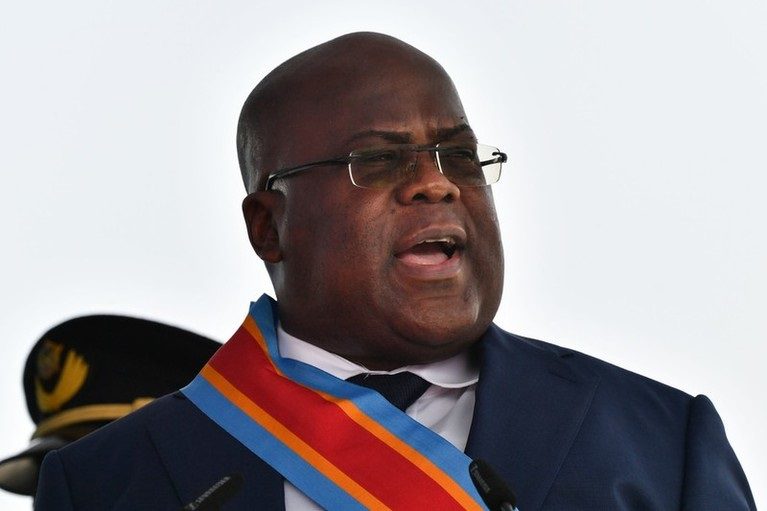
Kinshasa — President Félix Tshisekedi has reaffirmed his commitment to an inclusive national dialogue in the Democratic Republic of Congo, while drawing firm institutional red lines on how such a process would be conducted.
Speaking during a New Year’s address to the diplomatic corps in Kinshasa, Tshisekedi described national unity as a “fundamental requirement” at a moment when the country continues to face intense security pressures, particularly in the east, where fighting between government forces and Rwanda‑backed M23 rebels has persisted.
The call for an inter‑Congolese dialogue has gained renewed momentum in recent weeks, supported by sections of the political opposition and regional actors, including João Lourenço, who has promoted dialogue as a pathway toward de‑escalation. Tshisekedi confirmed that such a process remains possible — but only under specific, non‑negotiable conditions.
Dialogue, But on Institutional Terms
According to the president, any national dialogue must:
-
Take place on Congolese soil
-
Remain under formal institutional oversight
-
Not challenge the legitimacy of elected institutions
-
Not overturn existing court rulings
Tshisekedi emphasized that dialogue cannot become a parallel mechanism to re‑litigate electoral outcomes or judicial decisions. Parts of the opposition continue to contest his re‑election and criticize his handling of the security situation, particularly in the east, but the president made clear that institutional continuity and constitutional order remain paramount.
Justice and Accountability
Addressing questions of accountability, Tshisekedi stated that the justice system would “follow its normal course with rigour, to the end, and without complacency.” His remarks come against the backdrop of the high‑profile conviction of former president Joseph Kabila, who was sentenced to death in absentia by a military court in September on charges including war crimes, treason, and crimes against humanity linked to the eastern conflict. Kabila has denied all allegations.
2026 Framed as a Decisive Year
Looking ahead, Tshisekedi described 2026 as a pivotal year for the Democratic Republic of Congo. His priorities include:
-
Restoring durable security in the east
-
Re‑establishing full state authority in conflict‑affected regions
-
Accelerating governance reforms
-
Driving economic transformation
-
Consolidating national unity
For international partners and regional observers, Tshisekedi’s message signals a dual strategy: openness to political dialogue, coupled with a firm insistence on constitutional order and state authority.
As conflict dynamics in eastern Congo continue to shape regional stability across Central and East Africa, the coming months are likely to test whether dialogue — on the president’s terms — can gain sufficient traction to complement military, diplomatic, and judicial efforts already underway.
DR Congo, Democratic Republic of Congo politics, Félix Tshisekedi, Tshisekedi speech, Kinshasa address, DR Congo national dialogue, inter Congolese dialogue, M23 rebels, eastern Congo conflict, Rwanda backed M23, DRC security crisis, Congo peace process, Angola mediation Congo, João Lourenço mediation, Congolese opposition, Joseph Kabila conviction, Kabila war crimes case, Congo military court, DRC justice system, Congolese elections dispute, state authority DRC, governance reforms Congo, economic transformation DRC, national unity Congo, African diplomacy Central Africa, Great Lakes security, Congo regional stability, AU conflict resolution, African peace efforts, DRC institutional legitimacy, constitutional order Congo, post election tensions DRC, eastern DRC violence, Kinshasa government, Congo presidency, Central Africa politics, Africanews DR Congo, Congo political reform, DRC 2026 priorities, Tshisekedi leadership, Congolese state rebuilding, peace talks Congo, African mediation, security and governance Africa, conflict resolution DRC, Congo diplomatic corps, DRC reform agenda, eastern Congo rebels, Central African security, African political dialogue, DRC peace conditions, Congo institutional control, national reconciliation DRC