
Investing in Africa’s Rural Youth Is Reshaping Economies from the Ground Up
By Maxine Ansah

|
Getting your Trinity Audio player ready...
|
Africa is the youngest continent in the world. More than 60 per cent of its population is under the age of 25, yet one in four young Africans is not in employment, education or training. As population growth accelerates, millions more enter an already strained labour market each year.
This demographic reality is often framed as a risk. In truth, it is one of Africa’s greatest untapped assets. When young people are productively engaged, particularly in rural areas, the effects extend far beyond individual livelihoods. Food security improves, local economies strengthen and communities become more resilient.
The agrifood sector sits at the centre of this opportunity. With the right investments, it has the capacity to absorb large numbers of young jobseekers while modernising food systems and stimulating rural development. This is where the Agribusiness Hub Programme of the International Fund for Agricultural Development plays a decisive role.
A model built on decent rural work
Launched in 2019, the Agribusiness Hub Programme takes a multi-stakeholder approach to rural youth employment. Its focus is not short-term job placement, but the creation of decent, dignified and durable work across agribusiness value chains. By combining finance, skills development and market access, the programme aims to generate lasting economic growth.
The results are increasingly visible at community level.
Financing change on the ground
In Njoro, Kenya, agricultural advisory service Inuka Solutions works to improve social and economic outcomes for rural communities. In 2023, the Agribusiness Hub Programme partnered with Inuka to provide young people with financial support and training in entrepreneurship, communication and digital skills. Participants were then linked to wage employment opportunities or supported to become self-employed.
The impact has been significant. Inuka’s revenue has grown by 144 per cent. More than 55 students have been trained in agricultural skills, while over 100 young people have established their own enterprises. By linking farmers to markets, Inuka has also supported a shift from subsistence to commercial farming, creating additional employment across the local economy.
This success is not isolated. Over its first five years, the Agribusiness Hub Programme has created thousands of jobs across nine African countries. Evidence suggests that when youth employment is prioritised, migratory pressures decrease and rural stability improves.
The Agribusiness Hub effect in action
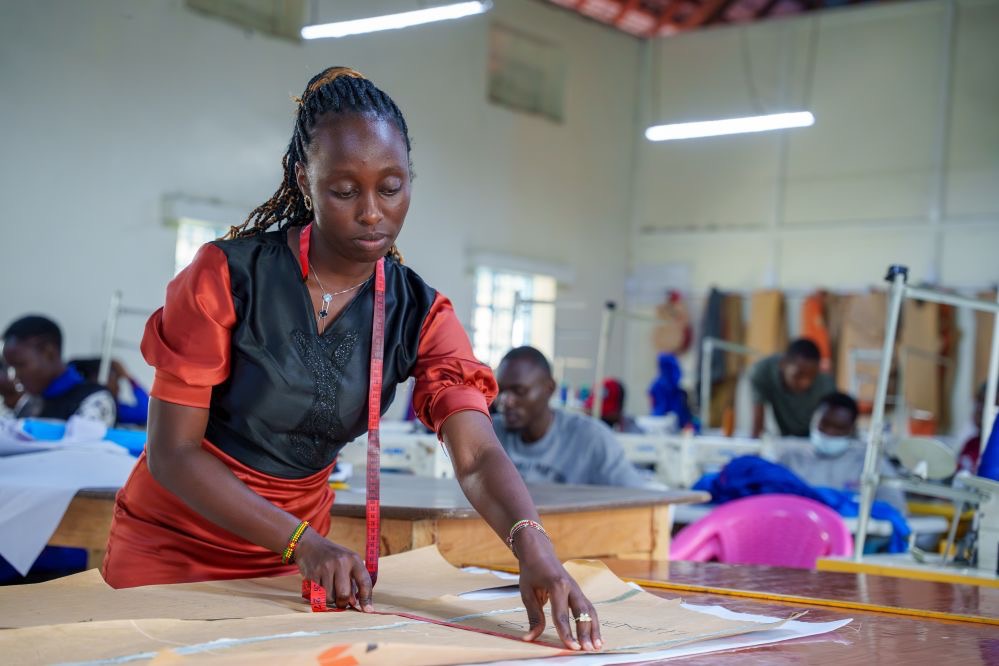
In Nakuru County, a bustling textiles centre brings together dozens of young people working at sewing machines, learning new skills and mentoring one another. The centre is run by Daraja 360, a youth empowerment organisation that blends textile production with digital freelancing opportunities to reach even the most vulnerable young people.
The Agribusiness Hub Programme partnered with Daraja 360 in 2022, supporting its expansion through stronger market linkages, digitalised operations and strategic partnerships. Since then, more than 200 youth have been trained in textile skills, with 80 per cent securing jobs or starting businesses. A further 600 young people have gained digital skills, 80 have received scholarships and over 5,000 have benefited from mentorship.
Operating alongside Daraja 360 is tech firm Lish AI Labs, which trains youth in basic digital and AI skills and connects them to freelance work through its workforce management system. In five years, the company has supported more than 5,000 young people in Kenya.
Scaling impact across the continent
The first phase of the Agribusiness Hub Programme has almost tripled its original targets, creating more than 59,000 wage and self-employment opportunities across agribusiness value chains. Participants report higher productivity, more diversified livelihoods and increased leadership roles within their communities.
As the programme enters its second phase, IFAD plans to deepen its work in existing countries while expanding into new ones, in collaboration with development partners. The aim is to scale what works and ensure that rural youth are not left behind in Africa’s economic transformation.
Africa’s rural young people are not a problem to be managed. They are an opportunity to be invested in. When smart, targeted investment reaches young people where they live and work, the ripple effects strengthen communities, food systems and economies for generations to come.
This focus will take centre stage at the 49th session of IFAD’s Governing Council, convening under the theme From Farm to Market: Investing with Young Entrepreneurs.