
Africa’s New Charge: Youth, Manufacturing, and the Future of Clean Energy
Written By Emma Anne Cullo

|
Getting your Trinity Audio player ready...
|
On August 13th, the U.S. Department of Energy announced a $500 million investment in the domestic battery supply chain. Creating a sense of urgency in African countries to accelerate their production. With about 30% of the world’s critical mineral reserves but just 3% of global energy investment flowing its way each year, Africa is at a pivotal moment.
Efforts to transform African resources into manufactured goods domestically are a new trend. The United States’ latest moves suggest a desire to keep manufacturing on home soil.
concludes Dr. Amani Abou-Zeid, African Union Energy Commissioner
The world has entered a new era of manufacturing, a strategic resurgence aimed at keeping pace with the explosive growth of artificial intelligence and the inevitable decline in global oil supplies. But this manufacturing revolution reveals a striking imbalance in who’s building what, and where.
The United States leads with over 449 GWh of battery manufacturing capacity across multiple gigafactories, from Tesla’s Nevada facility to Ford’s massive Kentucky plant. Yet, Africa has quietly built 128 GWh of capacity across the continent—with Morocco alone accounting for 110 GWh, representing 25% of total US capacity and positioning itself as a formidable competitor.
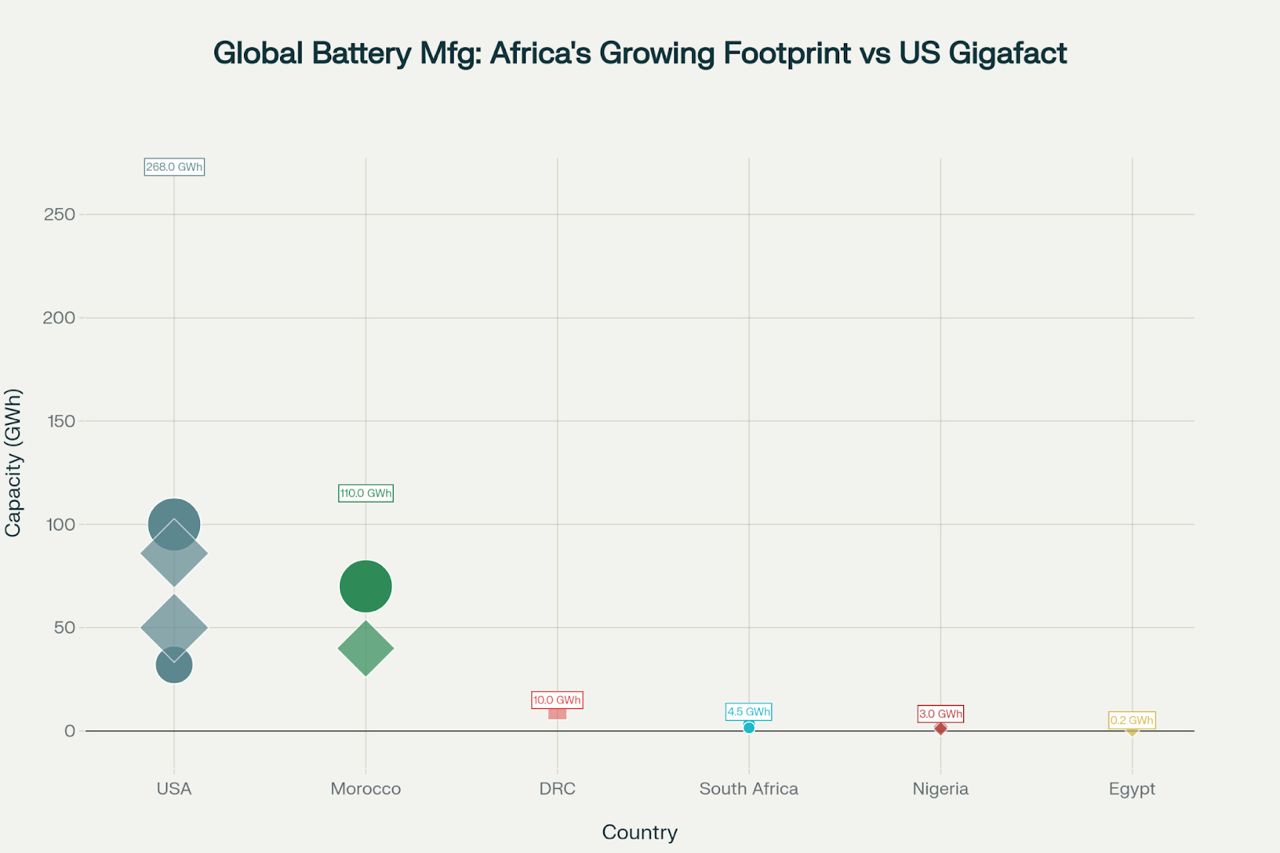
Morocco has emerged as Africa’s battery manufacturing powerhouse. The country’s first operational facility, the COBCO plant in Jorf Lasfar, produces 70 GWh annually—enough battery materials to power one million electric vehicles. The second facility, Gotion’s $6.5 billion gigafactory, will add another 40 GWh of capacity when production begins in Q3 2026, creating 17,000 jobs and solidifying Morocco’s position as a global battery hub.
explains Khalid Qalam, Director of Gotion Power Morocco, highlighting the strategic advantage of local resource integration.
Morocco’s geographic positioning offers a compelling competitive edge: located just 15 kilometers from European borders, the country can serve a market of 450 million consumers while leveraging abundant local materials for manufacturing. This stands in stark contrast to US facilities, which, despite their impressive scale, depend heavily on importing the very raw materials that Africa produces in abundance.
While the US invests heavily in domestic manufacturing, 90% of its raw materials still originate abroad, with 72% of global cobalt sourced from the Democratic Republic of Congo’s rich red earth. There is no way for the United States to move forward without navigating an international supply chain, from Africa to China’s refineries, where the value grows.
In Africa, the story is different. Khalid Qalam, the director, asserted,
At the center of the $235 billion global market are African resources, yet they are capturing only 10-20% of the final value from their mineral wealth. With continued investments and key partnerships in the manufacturing sector, Africa’s global role may be fundamentally reshaped.
Growth is moving beyond Morocco’s borders and through the rest of Africa. Clean energy has become one of the fastest-growing industries in Africa. In Nigeria, new processing plants promise to turn raw lithium into battery-ready materials—similar to South Africa’s continental battery pack manufacturing, with Freedom Won’s 3 GWh capacity. Cross-border cooperation between Zambia and the Democratic Republic of Congo are targeting 85,000 manufacturing jobs, shifting from $2-per-day mining work to $50-per-day manufacturing positions.
The new builds suggest a movement from price-taker to price-maker in global supply chains. Egypt’s $590 million battery storage project, and Kenya’s thriving e-mobility startups—from Ampersand’s to BasiGo’s — suggest that this movement is rooted in economic and sustainable change, change that has the potential to transform the livelihoods of individuals across the continent.
In stark contrast, the United States’ clean energy manufacturing drive is increasingly anchored in the quest to “win the AI race,” prioritizing massive energy expansion over renewable innovation.
“We need to build and maintain vast AI infrastructure and the energy to power it,”
the White House declared in its America’s AI Action Plan, adding bluntly, “Simply put, we need to ‘Build, Baby, Build!’”
Energy Secretary Chris Wright reinforced this shift in focus:
In America, it seems that power is being wielded more quickly; it seems to be taking a back seat.
Meanwhile, Africa’s manufacturing resurgence is infused with hope and led by its youth, a groundswell that demands not just prosperity, but also stability and self-reliance. Across the continent, change is fostered by the determination of local innovators and pragmatic collaborations with global partners, not by the uncertain tides of electoral politics. Where the U.S. approach is characterized by fluctuating priorities, Africa’s clean energy movement is increasingly rooted, inclusive, and forward-looking.
The movement is not being pushed by government decree but is unfolding through a bottom-up approach. Youth innovators and investors, such as Josh Whale, founder and CEO of Ampersand, are championing the e-mobility revolution in Rwanda, building Africa’s leading electric motorcycle company. Meanwhile, in Kenya, Jit Bhattacharya, CEO of BasiGo, is electrifying public transit with affordable e-buses and pay-as-you-drive financing.
Young political and social movements, such as The Youth Alliance for Leadership and Development in Africa (YALDA) and Afrika Youth Movement—with over 10,000 members across 40 countries—are advocating for industrial integration, local value-creation, and climate-smart economic strategies, all aimed at ensuring Africa’s growth is both sustainable and inclusive.
This movement is more than a manufacturing renaissance; it’s a reclamation. Africa is no longer content to be the world’s quarry. The manufacturing race will not just be won with gigafactories and investments, but with the determination to build systems that serve people, not just profits. In this, Africa may have found its lasting competitive edge, an edge forged by a new generation determined to turn abundance into lasting impact.