
“I Still Want to Finish School”: Namibia’s Young Mothers Struggle for Reproductive Freedom
Written By Maxine Ansah

|
Getting your Trinity Audio player ready...
|
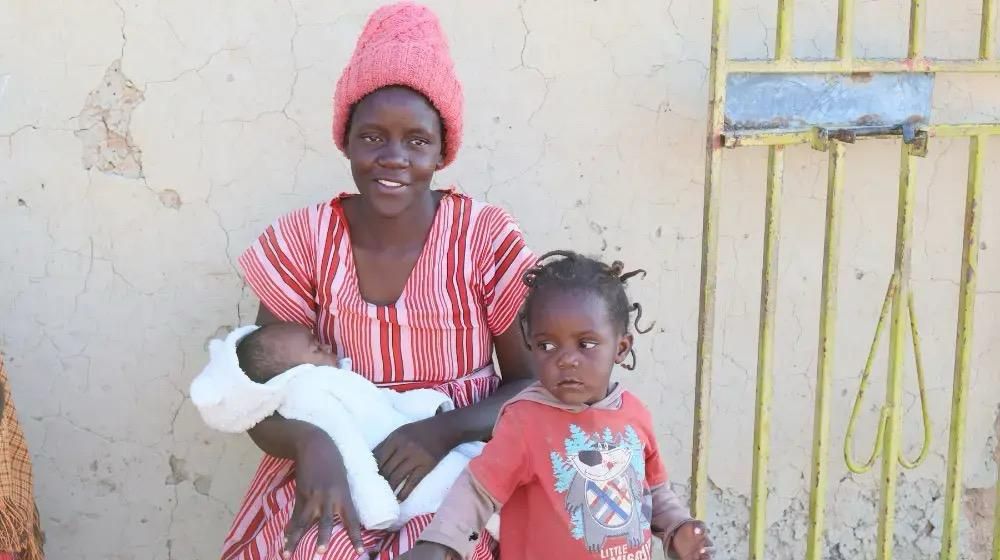
In the remote Kunene Region of north-western Namibia, the red earth stretches into the horizon and life moves at a deliberate pace. Yet for many young girls like 21-year-old Elly Tjondu, time feels suspended between hope and hardship. Seated outside her family home in Alpha village, 15 kilometres from Opuwo, Elly carefully wraps her newborn in a faded babygrow. Her dreams of finishing school have not faded, but they have been deferred once again.
“I should have been in Grade 11 this year,” she said softly. “That’s all I want, to go back and finish school.”
Elly’s story is not unique. Kunene has one of the highest adolescent pregnancy rates in Namibia, with more than one in three girls becoming pregnant before reaching adulthood. The reality behind those statistics is one of lost opportunities, interrupted education, and unequal futures.
When Elly first became pregnant at 15, she suffered a miscarriage that left emotional scars. Three years later, she gave birth to a healthy daughter. Her parents supported her to return to school while they cared for the baby. Every break, she would walk home to breastfeed before hurrying back to class. The family’s perseverance reflected both their resilience and the power of community support in keeping a young mother’s dream alive.
After her second pregnancy, Elly sought information about family planning, but access to such services proved difficult. The nearest clinic is in Opuwo, and without money for transport, she could not make the journey. “I wanted to get contraceptives after my second pregnancy,” she said. “But if you don’t have money for a taxi, you just stay at home.”
This is the quiet crisis facing thousands of girls across Namibia and beyond. When reproductive healthcare is physically and financially out of reach, young women are denied the agency to make choices about their bodies and futures.
Last year, Elly gave birth again, this time to her second child. While Namibia’s Learner Pregnancy Policy supports girls’ return to school, Elly’s situation has become more complicated. Her parents, already stretched thin, asked her to stay home to care for the baby, promising she could resume her studies in January. The household is crowded and burdened with care responsibilities. Elly’s mother, Uandende, recently gave birth herself, while one of Elly’s sisters also has a young child.
Her father, Kaukondua, works as a welder, taking small jobs whenever possible. “I try,” he said. “But work is not always there. I do what I can.” Despite the family’s economic struggles, he has not confronted the families of the boys who fathered Elly’s children. “In our Himba culture, when there is no marriage, you don’t go to the boy’s family,” he explained. “They are still children. They don’t work. What can they really do? I just focus on what I can, looking after my grandchildren.”
This cultural acceptance of unequal responsibility between boys and girls reinforces the gendered impact of adolescent pregnancy. While the boys remain in school, the girls often carry the heavier load of childcare and social stigma.
UNFPA, the United Nations sexual and reproductive health agency, has been working with the Namibian government to address these challenges. Through the training of healthcare providers and mobile outreach programmes, UNFPA is expanding youth-friendly services and promoting non-judgmental sexual and reproductive health education. Between 2020 and 2024, more than 21,000 long-acting reversible contraceptives were distributed across Namibia, with 385 implants provided in Kunene between 2024 and 2025. These initiatives aim to give girls like Elly real options and real control over their lives.
For now, Elly’s future remains uncertain, but her determination endures. “I want to go back to school. I want to work and raise my children well,” she said, glancing down at her baby. “I want them to have more opportunities than I did.”
Her words echo the unspoken hopes of many young mothers across Africa—girls caught between tradition and transformation, resilience and limitation, yearning not just for education but for the freedom to choose their own path.