
A Promise of Protection: How Senegal’s HPV+ Initiative is Empowering a Generation
Written By Maxine Ansah

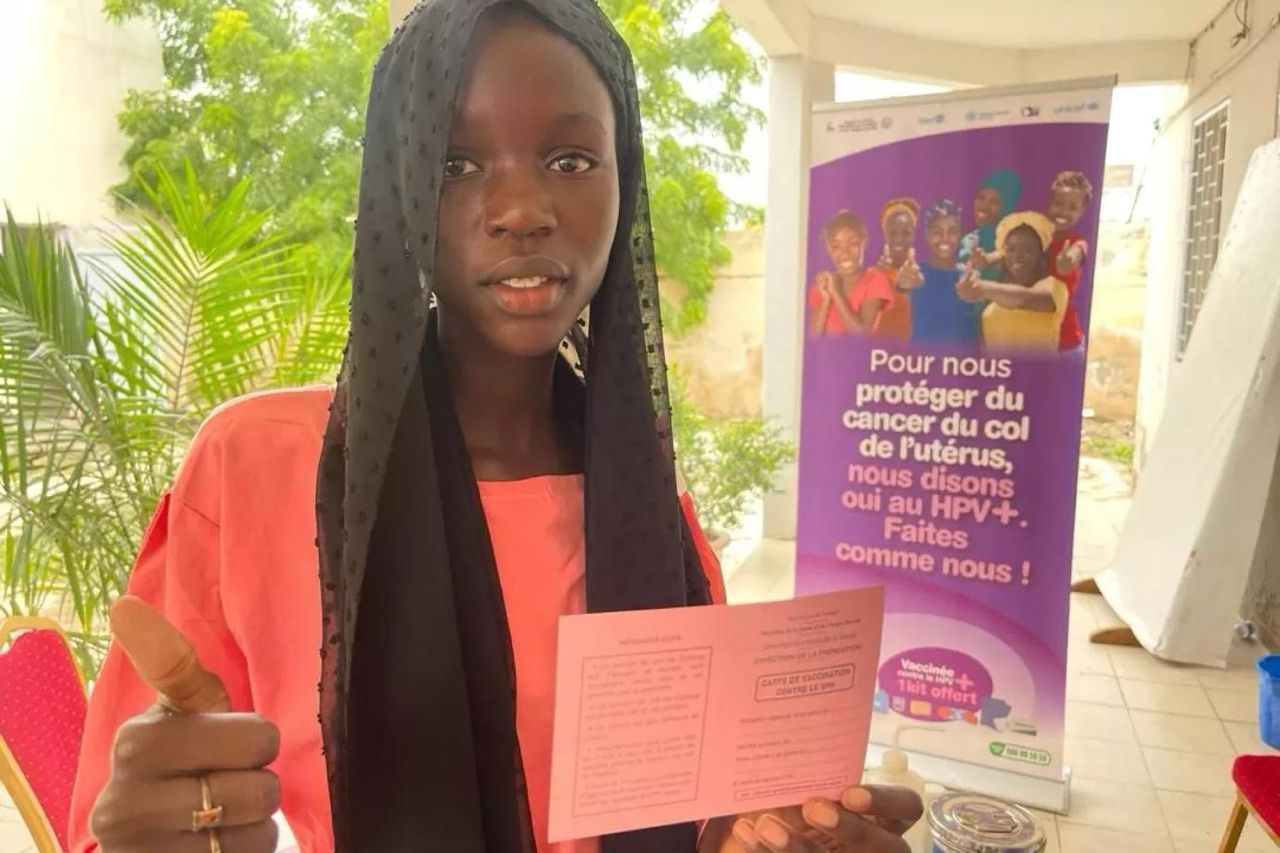
The air in Kaolack, Senegal, carries the familiar weight of change. As September draws to a close, the weather dances between sun and rain, heat and breeze. Life moves steadily on the dusty streets of this busy port city, where people have learned to adapt to the rhythm of the seasons. Yet, beneath this quiet routine, a transformation is taking place. It is not a revolution of noise or spectacle, but one that begins in classrooms and health centres, in the lives of girls like Anta.
Thirteen-year-old Anta, a fourth-grade pupil, walks with purpose along the streets of Kaolack toward the Kanda Health Centre. Her steps are light but determined. The centre is a place she knows well. It is where her grandmother, a community health worker, has devoted years to serving others, and where Anta herself is receiving her human papillomavirus (HPV) vaccine. For her, this visit is more than a health appointment. It is part of a journey toward safety, empowerment, and a dream for the future.
“Every year there is a cervical cancer screening and vaccination of girls against cervical cancer,” Anta explains with quiet confidence. “Health workers come to school to inform us and ask us to get vaccinated to protect ourselves against this disease.”
Today’s visit is a special one. Anta is among the first in Kaolack to benefit from the new HPV Plus initiative, a UNICEF-led programme that builds on the success of HPV vaccination to deliver wider health support for adolescents. HPV Plus, or HPV+, connects vaccination with essential services such as nutrition, reproductive health, HIV care, and mental health support. Its goal is simple but powerful: to ensure that girls are protected not just from disease, but empowered with knowledge, dignity, and confidence.
At the health centre, Anta receives a small pink bag. Inside are items that speak to the needs of girls her age: soap, sanitary pads, bicarbonate of soda, and a booklet about menstrual hygiene. She smiles as she examines the contents, aware that this little package represents something much larger. “I am very satisfied with this initiative,” she says. “It allows us to manage our menstrual hygiene while maintaining good health.”
For Anta, health and ambition go hand in hand. She dreams of becoming a police officer, inspired by the idea of protecting others. “At first, I was a little stressed about getting the vaccine, but now I am so relieved and happy to be protected,” she says. “It is a good thing to prevent diseases, especially cancer. As a young girl, health for me comes before everything.”
The HPV+ initiative aims to reach at least 22,000 girls aged 9 to 14 across four districts: Kaolack, Salémata, Ziguinchor, and Touba. Alongside this, 2,000 girl leaders will be trained to raise awareness among their peers, helping to increase vaccination coverage to 90 percent by the end of 2025. Through this network of young advocates, the programme hopes to bring communities closer to eliminating cervical cancer as a public health threat.
Behind the success of HPV+ lies collaboration. The initiative brings together health services, schools, local authorities, community groups, and families, ensuring that girls are not only reached with vaccines but also with accurate information and emotional support. Forums are held to give girls the space to speak about their experiences, ask questions, and shape the solutions that affect them. In these spaces, they are not treated as passive recipients of care, but as partners in building healthier futures.
Anta is already embracing that role. “I think it is very important to elect young girls to be role models to raise awareness among their peers,” she says. “I am now very comfortable talking about health because I have been vaccinated and am an example. I talk constantly with my friends, and I always suggest that they do like me and get vaccinated. I feel they are very motivated in doing it.”
The fight against cervical cancer is deeply personal for families like Anta’s. Her grandmother, Aminata, remembers a time when the HPV vaccine was not available and knowledge about the disease was scarce. “This vaccine is a promise for the future, for families and for the whole community,” Aminata says. “I spoke with my granddaughter about the benefit of the vaccine and reminded her how fortunate she is to have it available. The family supported the decision to vaccinate her wholeheartedly. As a community health worker, I encourage other families to do the same: to vaccinate their daughters and stand alongside health providers during awareness campaigns.”
Senegal faces a pressing challenge. Cervical cancer remains the most common cancer among women in the country, with an estimated 2,064 new cases each year and 1,327 deaths. For every 100 women diagnosed, more than 60 die, often due to late diagnosis or limited access to treatment. The HPV vaccine represents one of the most effective tools for changing that story, preventing infections that lead to the disease and giving new hope to generations of women and girls.
Through the HPV+ initiative, prevention begins earlier, and empowerment begins with education. The small pink bag that Anta carries is more than a symbol of care. It holds the promise of a healthier adolescence, the confidence to speak openly about health, and the belief that every girl deserves protection and opportunity.
In Kaolack, amid the shifting weather and daily routines, a quiet movement is taking root. It is led by girls like Anta, inspired by women like Aminata, and supported by communities that believe in the power of prevention. One vaccine, one voice, one future at a time.