
Frontline Girls: The Rising Power of a Generation Refusing to Wait
Written By Maxine Ansah

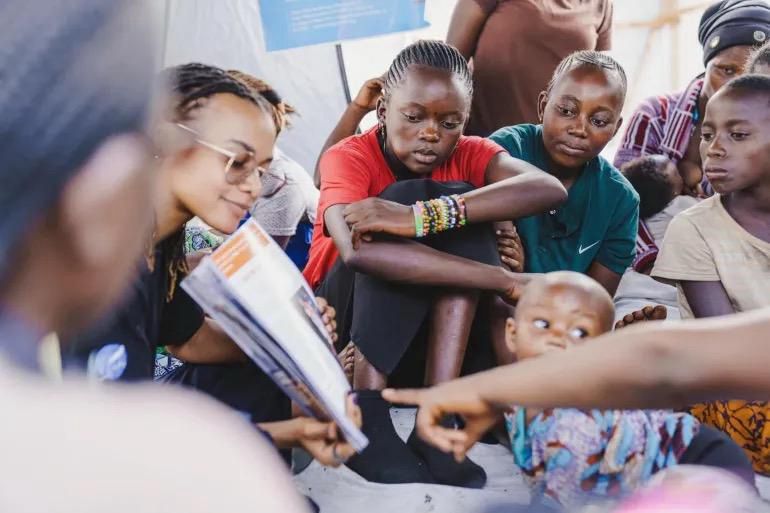
This moment in history can feel like a difficult place to be for many girls across the world. From the Congo Basin to the Caribbean, girls are navigating a reality shaped by conflict, climate change and crisis. When disaster strikes, it is they who are often hit hardest. Child marriage rates soar in fragile contexts, sexual violence increases, and the risks of teenage pregnancy and maternal mortality climb sharply.
At the same time, troubling evidence shows a rise in inequitable attitudes among young men regarding gender roles and power. Combined with the chronic underfunding of programmes that protect and empower girls, the global picture may appear bleak. Yet, amid the hardship, there is another story unfolding, one that speaks of resilience, leadership and hope.
Girls leading change in the Democratic Republic of the Congo
The Democratic Republic of the Congo (DRC) has faced decades of instability marked by violence, poverty and widespread gender-based abuse. Yet in this protracted crisis, girls and young women are not standing by. They are mobilising, creating solutions and transforming their communities from within.
Organisations like Kongo Mwinda, led by young women under 25, are ensuring that displaced girls and women regain independence and security. Through training in health, education and vocational skills, the group has reached thousands with campaigns, distributed dignity kits to displaced girls, and trained activists on rights and digital safety.
Another initiative, Congo Debout, supports survivors of violence with access to services and skills for income-generating activities. The group has worked with more than 1,500 households, reached over 1,000 people through digital campaigns, and helped hundreds of girls rebuild their lives. These are not isolated acts of courage. They reflect a growing movement of young women and girls who are reimagining what recovery and resilience look like.
Through arts, sports and technology, they are reclaiming agency and amplifying the voices of survivors. Their efforts show that girls are not merely beneficiaries of aid, but first responders, innovators and community leaders. They know what is needed and are finding ways to deliver it, often in contexts where institutional support is scarce.
POWER4Girls: Investing in girls’ leadership
Recognising this potential, UNICEF and Purposeful launched POWER4Girls, a global initiative rooted in the belief that systems can be transformed when resources and trust are placed directly in the hands of girls and young people. Announced at the United Nations earlier this year with the participation of UNICEF Goodwill Ambassador Millie Bobby Brown, POWER4Girls brings together governments, philanthropists and youth activists to drive gender equality at scale.
Purposeful, an Africa-rooted hub for girls’ organising, and UNICEF, the world’s leading agency for child rights, are partnering to deliver direct grants and mentorship to girl- and youth-led groups. The initiative builds on evidence showing that flexible, localised funding allows young leaders to design solutions suited to their own contexts.
In September, girls in Tanganyika Province in the DRC helped advise on POWER4Girls programming. During the launch event in Kabalo, both girls and boys spoke passionately about the link between peace, justice and girls’ rights. The message was clear: achieving equality is inseparable from achieving stability.
Scaling up impact and investment
The impact of these efforts is already being felt. Under its pilot phase, UNICEF reached more than 47 million people worldwide with new programming focused on adolescent girls. This includes services for gender-based violence prevention, adolescent-friendly health care, nutrition, and skills training. Community-based initiatives have also been strengthened through parenting and care programmes that promote gender equality from within the family unit.
Purposeful has channelled over $5.2 million in flexible funding to girl-led groups in more than 100 countries. These funds support leadership, advocacy and movement building, allowing young women to sustain and expand their work.
Since the global launch of POWER4Girls, over $10 million in new resources has been committed, targeting fragile settings like the DRC and Ukraine. Policy dialogues are ongoing in countries such as Egypt and the Dominican Republic, and more governments are mobilising public finance to prioritise adolescent girls in their national agendas.
A call to action
History shows that investing in girls is one of the smartest and most transformative decisions any society can make. When girls thrive, economies strengthen, health outcomes improve, and peace becomes more sustainable. Yet, despite this knowledge, funding cuts threaten to reverse progress.
Now more than ever, the world must double down on support for girls and young women, especially those on the frontlines of crisis. They are not waiting for permission to lead. From community classrooms to crisis zones, they are already showing what resilience and leadership look like.
They are not the future, they are the present. And when they rise, the world rises with them.