
Growing Futures: IFAD Pushes for More Partnerships to Boost Youth Employment in African Agriculture
By Maxine Ansah

|
Getting your Trinity Audio player ready...
|
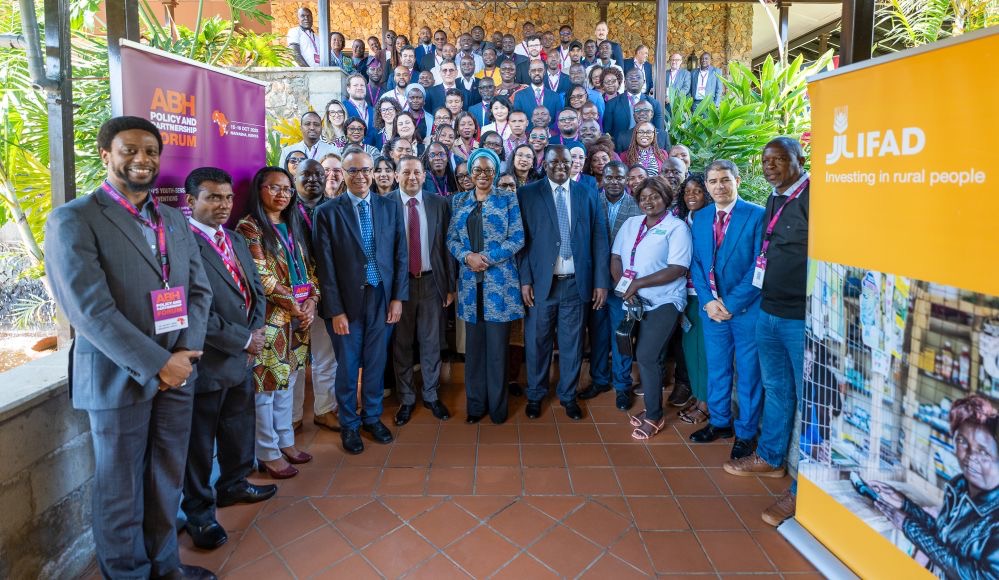
Youth leaders, policymakers, and development partners gathered to discuss the future of youth employment in African agriculture. The forum, titled “From Learning to Policy Action – Scaling Youth Employment through Systems Change,” brought together key players to build momentum behind the Agribusiness Hubs (ABH) programme, an initiative that has shown remarkable success in creating jobs for young people across nine African countries.
The event, held on 15–16 October in Naivasha, Kenya, was convened by the International Fund for Agricultural Development (IFAD) in partnership with the German Federal Ministry for Economic Cooperation and Development (BMZ), the VISA Foundation, the Government of Kenya, and other implementing partners. Together, they explored how to expand the ABH model to reach more young people and transform rural employment systems at scale.
Launched in 2020, the ABH programme takes an ecosystem-based approach by linking youth to essential resources such as skills training, entrepreneurship support, access to finance, markets, and networking platforms. Over its five-year lifespan, the initiative has created more than 60,000 decent jobs for young people, nearly three times its original target. The success of this pilot has demonstrated that, with the right support systems in place, agriculture can serve as a vibrant pathway for youth empowerment and economic growth.
Juan Carlos Mendoza Casadiegos, IFAD’s Director of Environment, Climate, Gender and Social Inclusion, emphasised the importance of collective action to sustain and expand these gains. He highlighted that while investments in youth are crucial, achieving real transformation requires systemic collaboration across multiple sectors.
“Our efforts must go beyond direct investments in young people,” he said. “Real change requires a systemic approach that brings governments, the private sector, development partners, civil society, and youth together. No single institution can transform rural employment alone.”
The ABH model has been lauded for its emphasis on partnerships and its ability to catalyse lasting change by embedding transformation within local economies. Through its multi-stakeholder approach, it has strengthened connections between governments, private sector actors, and training institutions, ensuring that the benefits of agricultural growth reach young people where they live and work.
Kenya’s Cabinet Secretary for Youth Affairs, Creative Economy and Sports, Salim Mvurya, praised the programme for its human-centred impact. “The programme has demonstrated that inclusive agribusiness models can restore dignity and hope for a generation ready to build Africa’s rural economies,” he said.
With agriculture remaining the backbone of livelihoods across the continent, the potential for youth engagement in this sector is immense. Each year, over 25 million young Africans enter the labour market, the majority finding themselves in informal, low-paying work. The ABH initiative offers a viable solution to this challenge by positioning agriculture as a dynamic and profitable sector that can generate sustainable employment and entrepreneurship opportunities.
However, participants at the Naivasha forum agreed that more needs to be done to unlock this potential. Scaling up the ABH model will require coordinated investment and innovation, particularly in access to finance, value chain development, and digital transformation. Development partners and policymakers emphasised that youth-led solutions and rural inclusion must remain at the heart of any future strategy.
As discussions concluded, there was a shared sense of optimism. The success of the ABH programme has proven that young Africans are ready to lead the charge in transforming agriculture. What remains is the collective will and commitment to ensure that these efforts are scaled, sustained, and supported by all stakeholders.
Agriculture holds the key to Africa’s economic resilience and food security. By investing in youth-driven agribusiness ecosystems, the continent can not only tackle unemployment but also drive innovation and inclusive growth from the ground up.