
South Africa and Kenya Sign Six New Agreements to Boost Trade and Regional Integration

|
Getting your Trinity Audio player ready...
|
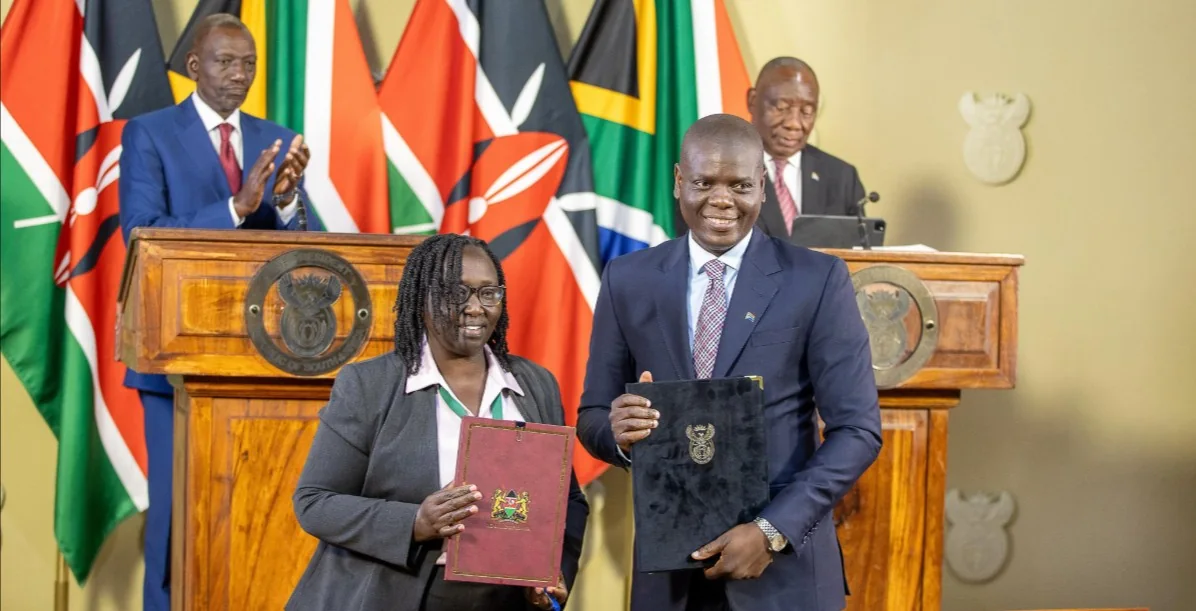
South Africa and Kenya have signed six new cooperation agreements aimed at expanding trade, improving transport connectivity and deepening economic integration between two of Africa’s largest and most influential economies.
The agreements were signed in Pretoria on June 4 during Kenyan President William Ruto’s state visit to South Africa, with both governments presenting the package as a practical step toward reducing barriers that continue to limit trade and investment across the continent.
Strengthening Economic Cooperation
The new agreements cover standardisation, technical regulations and conformity assessment, maritime transport, gender equality, technical and vocational education and training, arts and culture, and sport.
Officials believe the agreements will create a stronger framework for business cooperation while improving market access for companies operating in both countries.
One of the most significant accords focuses on standards and technical regulations. Such measures play a critical role in determining how easily products move across borders and whether businesses face costly compliance barriers when entering new markets.
Both governments said greater regulatory cooperation could help facilitate trade flows and improve competitiveness for businesses operating within Africa.
Supporting AfCFTA Ambitions
A maritime cooperation agreement signed as part of the package seeks to improve shipping links between East Africa and Southern Africa.
The agreement is expected to strengthen logistics networks while supporting implementation of the African Continental Free Trade Area, which aims to create a single market across the continent.
Improved maritime connectivity could help reduce transport costs, enhance supply chain efficiency and increase trade volumes between African economies.
The deal aligns with broader continental efforts to improve infrastructure and remove obstacles that have historically limited intra African trade.
Investing in Skills and Social Development
Beyond trade and transport, the agreements also target social and human capital development.
The gender equality partnership seeks to increase women’s participation in economic activity and leadership roles across both countries.
Meanwhile, the technical and vocational education agreement aims to equip workers with skills needed for changing labour market demands and emerging industries.
The arts and culture agreement is designed to strengthen cultural exchange while creating opportunities for collaboration between creative industries in both nations.
Sports Cooperation Expands
The sport cooperation agreement comes at a notable time for Kenya, which is preparing to co host the 2027 Africa Cup of Nations.
Officials say the partnership could support athlete development, sports administration and knowledge sharing between the two countries.
Sport continues to play an increasingly important role in diplomacy, youth development and economic activity across Africa.
A Growing Strategic Partnership
South African President Cyril Ramaphosa said the agreements provide a foundation for deeper cooperation in trade, investment, industrialisation, infrastructure and regional integration.
President William Ruto described the six accords as evidence of a partnership that continues to expand in both ambition and scope.
The latest agreements bring the total number of bilateral instruments between South Africa and Kenya to 34, highlighting the growing importance of a relationship that has become one of Africa’s most active diplomatic and economic partnerships since diplomatic ties were re established in 1994.
Building Africa’s Connected Future
The agreements reflect a broader shift toward greater African economic cooperation at a time when countries are seeking stronger regional markets and more resilient supply chains. While challenges to continental integration remain, partnerships between major economies such as South Africa and Kenya demonstrate growing momentum behind Africa’s long term development goals. As trade links deepen and cooperation expands, initiatives like these could help accelerate the vision of a more connected, competitive and prosperous Africa.