
Africa Great Green Wall Drive Turns Focus to Investment as 2030 Target Nears
By Maxine Ansah

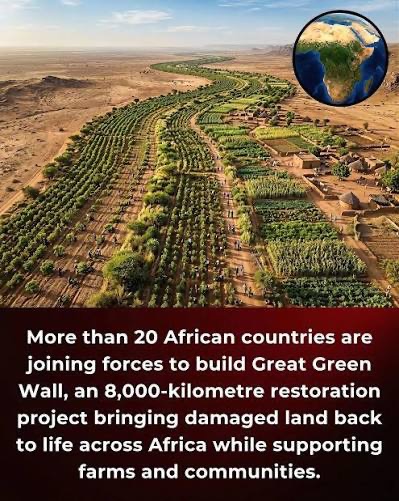
The African Union is intensifying efforts to secure investment for the Great Green Wall, one of the continent’s most ambitious environmental programmes, as governments face growing pressure to accelerate land restoration before the initiative’s 2030 target.
The African Union Commission convened a high-level investment event on Monday 24th August 2026 alongside the UN Convention to Combat Desertification’s COP17 meeting in Ulaanbaatar, Mongolia.
The gathering brought together the African Union, UNCCD, African Development Bank, Pan-African Agency of the Great Green Wall and Southern African Development Community. Its focus was not simply on discussing environmental degradation, but on identifying financing mechanisms capable of moving restoration projects towards implementation.
The Great Green Wall aims to restore 100 million hectares of degraded land across the Sahel and beyond by 2030. It is one of Africa’s flagship responses to land degradation, desertification and the growing effects of climate change.
The original concept of a wall of vegetation stretching across the continent has evolved substantially. Today, the initiative encompasses a much wider programme of land restoration, sustainable agriculture, climate resilience and livelihood creation. That broader approach recognises that degraded land is not only an environmental issue.
When agricultural land loses productivity, households can lose income, food insecurity can deepen and competition over increasingly scarce resources can intensify. Restoring landscapes therefore has consequences for rural development as well as climate policy.
The African Union’s current strategy covers the period from 2024 to 2034 and seeks to scale the initiative through stronger continental integration. But financing remains one of its central challenges. Land restoration projects require sustained investment over long periods, while governments across the Sahel are already managing tight public finances and competing development needs. The AU is therefore seeking greater participation from investors and development partners.
The African Development Bank’s involvement is significant because large-scale restoration requires financial structures capable of supporting projects that may generate environmental and social benefits long before they generate conventional financial returns. Private finance could become particularly important if restoration projects can be linked to agriculture, carbon markets, renewable energy, sustainable forestry or other economic activity.
But financing alone will not determine success. Projects also need to reach local communities. A restoration programme can only be sustainable if people living on the land have a reason to protect it and can see improvements in livelihoods, food production or economic opportunity.
The Great Green Wall also carries considerable symbolic importance for Africa.
Climate change is frequently presented to African states as a crisis created disproportionately elsewhere but experienced acutely on the continent.
The initiative represents an African-led response that attempts to turn climate vulnerability into a programme of restoration and development.
Progress has been uneven and the scale of the challenge remains substantial.
That is why the current effort to mobilise fresh investment matters.
For Africa, restoring land is ultimately about restoring possibility. A hectare recovered from degradation can mean more than vegetation. It can mean productive farmland, greater food security, jobs, stronger rural economies and communities better equipped to survive drought. The Great Green Wall is ambitious, and African institutions will need more financing, coordination and accountability if that ambition is to become reality. But the programme also demonstrates what continental institutions can attempt when environmental protection is treated not as a constraint on development, but as part of development itself.
Great Green Wall Africa, African land restoration, AU Great Green Wall, Sahel restoration, Africa desertification, African Union climate, land restoration Africa, Great Green Wall 2030, 100 million hectares Africa, climate resilience Africa, AU GGWI Strategy, Africa green investment, Sahel climate action, African landscape restoration, desertification control Africa, Africa land degradation, Great Green Wall financing, African Union environment, UNCCD COP17 Africa, AfDB Great Green Wall, PAGGW, SADC Great Green Wall, African climate finance, Africa sustainable land, Sahel livelihoods, Africa ecosystem restoration, green jobs Africa, Africa resilience, land restoration investment, Africa climate adaptation, Africa biodiversity restoration, African drylands, Sahel development, Africa environmental policy, AU climate strategy, Great Green Wall Initiative, Africa restoration economy, climate finance Sahel, African agriculture resilience, land degradation neutrality Africa, UNCCD Africa, Africa green development, restoring African landscapes, restoring hope Africa, Great Green Wall investment gap, Africa nature restoration, Sahel food security, Africa rural livelihoods, African environmental governance, climate action Africa, Africa land management, sustainable landscapes Africa, Great Green Wall partners, Africa climate summit, AU sustainable environment, Africa ecological restoration, African restoration projects, Sahel regeneration, Africa soil restoration, Africa drought resilience, African reforestation, Africa sustainable agriculture, Great Green Wall strategy 2024 2034, Africa environmental investment, African climate institutions, continental land restoration, Africa green finance, Sahel green economy, Africa ecosystem resilience, African Union land policy, Africa restoration funding, climate investment Africa, African natural resources, Africa dryland restoration, Great Green Wall progress, Africa sustainable livelihoods, land restoration jobs Africa, Africa environmental cooperation, AU ARBE, African Development Bank climate, UNCCD Great Green Wall, Africa restoration partnerships, Sahel climate finance, Africa nature-based solutions, African land resilience, Africa green transition, climate resilience Sahel, African ecosystems, Africa landscape recovery, Great Green Wall news, Africa environment news, positive Africa climate news, Africa COP17, African climate diplomacy, TVOA climate Africa, Africa sustainability news, AU Great Green Wall 2026, Africa land restoration 2026, Sahel restoration 2026, African climate action 2026