

|
Getting your Trinity Audio player ready...
|
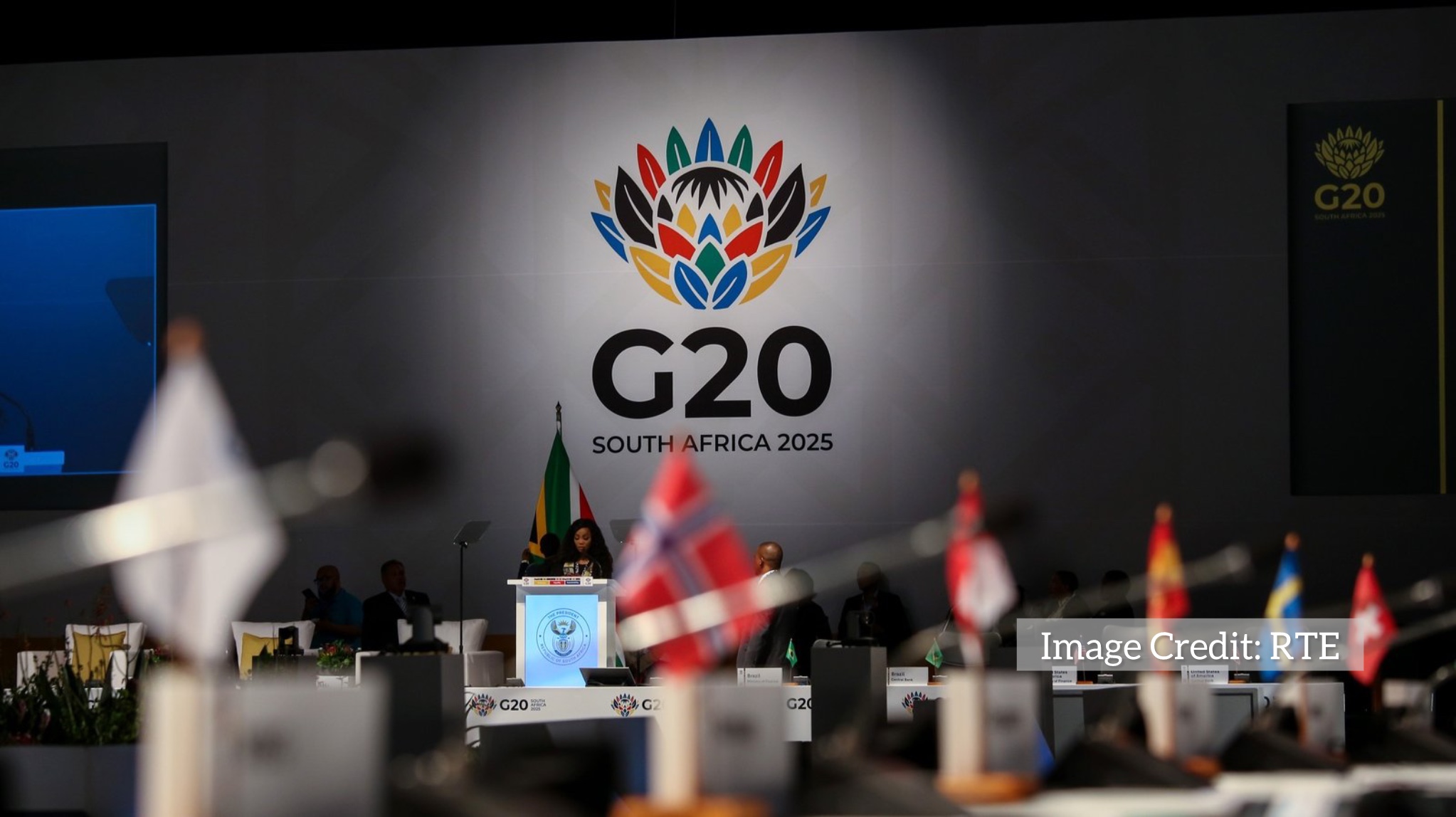
The latest G20 finance ministers’ summit, held in Durban, South Africa, has been deeply overshadowed by rising global concerns over U.S. President Donald Trump’s renewed push for steep tariffs. The gathering, intended to foster economic cooperation and address critical global issues, is now dominated by anxiety over escalating trade tensions and their potential to derail fragile economic stability.
President Trump’s recent announcement of sweeping new tariffs set to take effect on August 1, has sparked widespread concern among global economic leaders. These include a 25% import tariff on automobiles and a 10% blanket tariff on goods from BRICS nations (Brazil, Russia, India, China, and South Africa), further straining global trade relationships. The move has raised fears of a new wave of trade conflicts that could deepen the fragmentation of the global economy.
South Africa Pushes for Unity Amid Growing Divisions
Hosting the high-stakes summit under the theme “Solidarity, Equality, Sustainability,” South Africa is working hard to steer the group toward collective action. Finance Minister Enoch Godongwana opened the event by urging G20 members to recommit to multilateralism and cooperative economic policy. He stressed the importance of global solidarity in tackling not only trade protectionism, but also critical issues such as climate financing and access to affordable capital for developing nations.
“Our shared future depends on collaborative leadership,” said Godongwana. “We must rebuild trust, revitalize global institutions, and ensure that developing regions particularly Africa are not left behind.”
The host country is seeking to spotlight Africa’s priorities, including sustainable development, infrastructure financing, and climate resilience goals that risk being drowned out by escalating geopolitical and economic rivalries.
Key Absences Undermine Sense of Unity
Adding to the sense of disunity, several high-profile finance leaders did not attend the summit in person. U.S. Treasury Secretary Scott Bessent’s absence was particularly noted, with Michael Kaplan attending on his behalf. Finance ministers from India, France, and Russia were also missing, further clouding the prospects for meaningful consensus.
South African officials have attempted to downplay the impact of these absences, pointing out that all countries were still represented, albeit at different levels. However, analysts note that the lack of top-level engagement signals growing divisions and a waning commitment to coordinated action within the G20 framework.
Economic Fallout Feared from U.S. Tariffs
Trump’s assertive tariff policy is already sending ripples through the global economy. Germany’s central bank, the Bundesbank, issued a stark warning that the proposed tariffs could tip Europe’s largest economy into recession by 2025. Emerging markets, especially those in the BRICS group, are also bracing for economic shocks from reduced trade access and investor uncertainty.
The U.S. President has also reignited concerns over political interference in monetary policy, having sharply criticized the U.S. Federal Reserve for its interest rate strategy. This rhetoric has alarmed financial institutions and economists, who see central bank independence as a cornerstone of economic stability.
Can the G20 Find Common Ground?
Despite these challenges, South African officials remain cautiously optimistic that the group can reach a consensus. Efforts are underway to produce the first joint communiqué since 2023 something that would signal at least some level of alignment on global priorities.
Yet as trade tensions rise, climate commitments falter, and key members pull back from full participation, the question remains: Is the G20 still capable of delivering unified leadership in a fractured world economy?
For now, the summit serves as both a critical test of international cooperation and a sobering reflection of the geopolitical and economic divisions that continue to shape global affairs.