
Liberia’s Born Perfect Campaign Takes FGM Fight from Communities to the Legislature
By Maxine Ansah
|
Getting your Trinity Audio player ready...
|
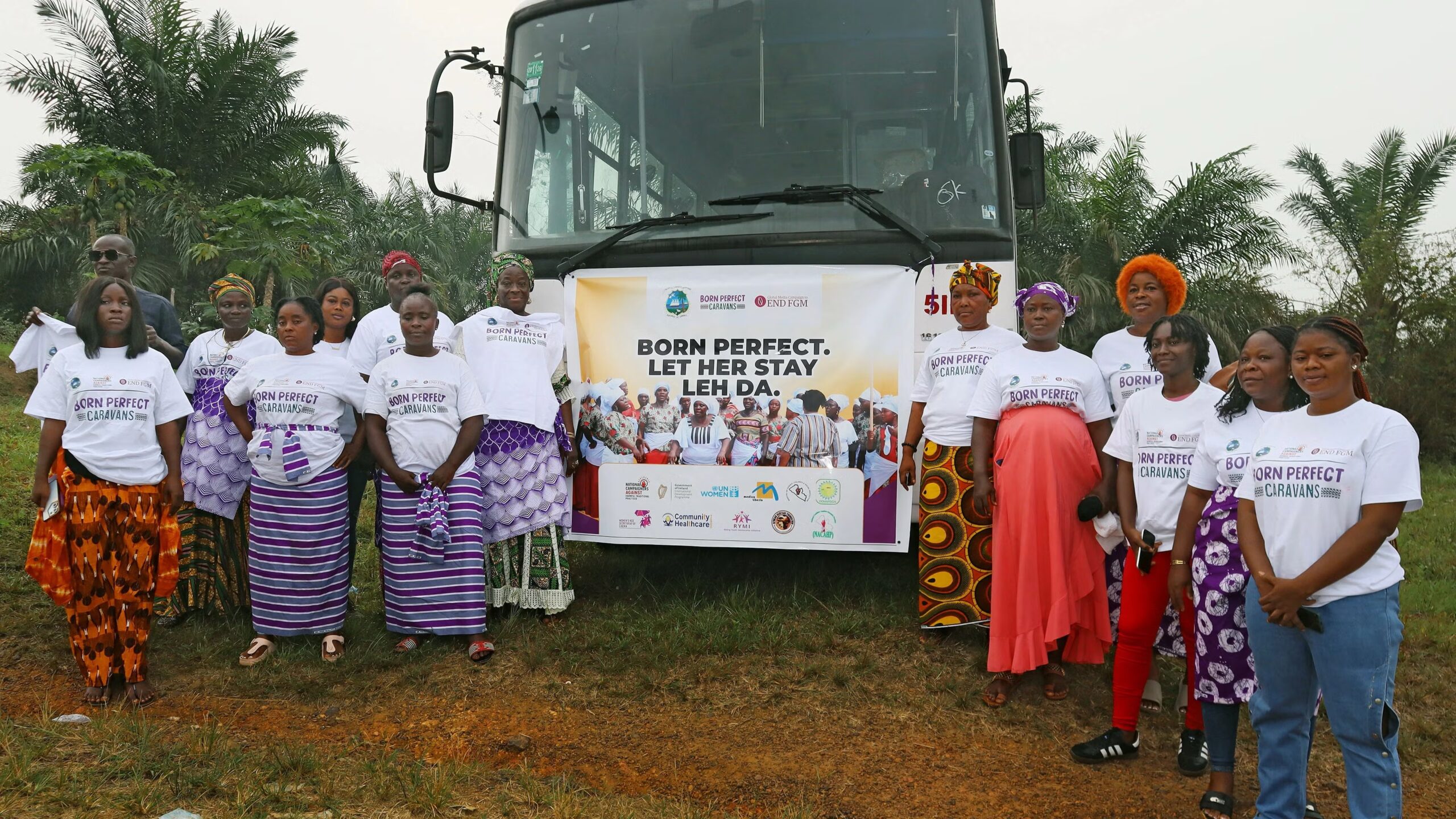
Across towns and villages in Liberia, a brightly branded bus is taking one of the country’s most difficult conversations directly to communities.
The Born Perfect Bus Tour, a community-driven campaign aimed at ending female genital mutilation (FGM), has brought survivors, traditional leaders, young people, women and men together to confront the cultural and social pressures that continue to sustain the practice.
Travelling through Totota and Palala in Bong County, with outreach extending to Margibi, Cape Mount, Bomi and Gbarpolu Counties, the initiative reached more than 3,000 people. Its approach centres on dialogue, challenging harmful norms and strengthening political commitment to ending FGM.
For some participants, the campaign marked the first time they had encountered detailed information about the dangers associated with the practice.
“Besides listening to the radio, this was the very first time in my life hearing about the dangers of FGM,” said Daniel E. Kollie, a traditional leader and clerk for the Konawolala Administrative District in Bong County.
“The harmful part of our tradition… this was not something that I had heard conversations about in my community before.”
The pilot tour, launched earlier this year, was supported by UN Women and the Embassy of Ireland in Liberia. The mobile outreach model was led by medica Liberia and the Community Healthcare Initiative, in collaboration with the Global Media Campaign to End FGM and the National Campaigners Against Harmful Traditional Practices.
Taking the FGM Conversation into Communities
Rather than relying solely on formal meetings, the Born Perfect Bus transformed markets, town halls and other community gathering spaces into places for public discussion.
Music, storytelling and comedy were incorporated into activities designed to make difficult conversations more accessible while maintaining respect, dignity and cultural sensitivity.
Survivor participation was voluntary and supported by trained psychosocial staff. Structured discussions encouraged communities to examine gender norms and traditions alongside the rights and protection of girls.
Traditional leadership was also central to the campaign.
Kollie said the participation of the Paramount Chief, the highest-ranking member of the traditional government, helped reinforce the campaign’s message about the dangers of FGM.
Before arriving in communities, campaign teams consulted traditional leaders, women’s groups, youth representatives, religious leaders and local authorities. The consultations were intended to build trust, address concerns and give communities a sense of ownership over the discussions.
Why FGM Persists in Liberia
Research and surveys by UN Women in Bong County indicate that cultural and social factors remain major influences behind the continuation of FGM.
Culture and tradition were identified by 63 per cent of respondents, while 40 per cent cited social acceptance. Marriageability was identified by 31 per cent, while religious and health-related reasons accounted for less than 7 per cent.
The findings highlight the role of perceived social consequences in sustaining the practice. Families may fear exclusion or reputational damage if their daughters do not undergo FGM, demonstrating how community expectations can influence decisions concerning girls.
The relationship between FGM and Liberia’s traditional bush schools is particularly significant.
Traditional bush schools are community-based institutions where children and adolescents receive cultural education and participate in rites of passage into adulthood. They are often organised by traditional societies, including the Sande for girls and Poro for boys, and provide instruction on cultural values and life skills. In some communities, initiation rites have included FGM.
For young survivor Janet Wokpeh, ending the practice requires both greater awareness and alternatives for young people.
“I am a survivor,” Wokpeh said. “I hope that the people present during the campaign were able to hear my story and are working to end FGM so that we can go back to school. It’s not easy.”
Her comments also reflected a recurring message from participants: communities need greater educational opportunities for young people outside bush schools.
Young People Challenge the Idea That Ending FGM Means Ending Tradition
For Moses Nahn, a youth president in the Konawolala District, the campaign also provided an opportunity to challenge fears that efforts to eliminate FGM are an attack on Liberian culture itself.
Motivated by his younger sisters and brothers, Nahn attended the campaign and later took its message back to his community.
“I said [to my community], the information you all heard that [people] want to take away our tradition is wrong. It’s only the harmful practices they want us to stop.”
Nahn called for initiatives that would provide alternatives to bush schools, including trade schools where young people could develop practical skills.
“I really want FGM to come to an end,” he said. “We have to come up with an initiative that will stop people from going to the bush school. People need to go to trade school and learn [useful skills].”
He also pointed to economic empowerment for mothers, including through farming, as another way of building community support for abandoning the practice.
Early Signs of Changing Attitudes
An impact assessment completed two months after the bus tour, in March 2026, found signs that community attitudes were beginning to change.
Discussions about FGM had increased within families, community spaces and religious centres, particularly mosques. Support was also growing for suspending FGM in bush schools, while the number of people supporting the decision to send girls, including their own daughters, to bush schools had fallen significantly.
In Gbarpolu County, traditional leaders publicly expressed support for ending FGM and said bush operations had stopped. Leaders in Bong and Cape Mount counties committed to continued dialogue and engagement.
For Kollie, the campaign should not end with the communities already reached.
“This caravan should go all over,” he said. “It needs to go [around] the country and not just stop with us.”
From Community Dialogue to Liberia’s Legislature
The Born Perfect Bus Tour ultimately travelled from community spaces to the centre of national policymaking.
Its final stop was Liberia’s National Legislature, where insights gathered during the campaign were presented to policymakers. The engagement brought together lawmakers, traditional leaders, civil society actors, development partners and campaign organisations, connecting experiences at community level with the national debate over ending FGM.
Former UN Women Liberia Country Representative Comfort Lamptey described ending FGM as a priority.
“UN Women considers supporting the Government to end FGM as one of our top priorities in Liberia. The Born Perfect Bus Tour is one way to give women the power they need to end it.”
For community member Ma Watta Kanneh, the significance of the initiative lies partly in creating conversations that previously did not happen.
“I have been part of this community for over 20 years, and I haven’t seen the FGM issue discussed this way,” she said. “For me, I see this as progress, and with more awareness, I believe it will lead to changes in the communities.”
Liberia’s experience shows that ending FGM is not simply a matter of condemning a harmful practice. It also requires communities to confront the social pressures that keep it alive, while creating educational and economic alternatives that allow traditions to evolve without sacrificing the rights and wellbeing of girls. Across Africa, where many modern states are still navigating the relationship between inherited traditions, community authority and expanding human rights protections, sustainable change is more likely when communities are part of building it. The Born Perfect Bus offers a hopeful example: culture does not have to disappear for girls to be protected, but harmful practices within culture can, and must, change.
female genital mutilation, FGM, FGM in Liberia, end FGM, Liberia FGM campaign, Born Perfect Bus Tour, Born Perfect campaign, female genital mutilation Liberia, ending FGM in Liberia, Liberia women’s rights, girls’ rights Liberia, UN Women Liberia, FGM awareness, FGM survivors, harmful traditional practices, FGM prevention, Liberia traditional practices, women in Liberia, girls in Liberia, Liberia human rights, Bong County FGM, Bong County Liberia, Gbarpolu County, Cape Mount County, Bomi County, Margibi County, Totota Liberia, Palala Liberia, FGM community campaign, community action against FGM, African women’s rights, African girls’ rights, FGM in Africa, ending FGM in Africa, harmful practices in Africa, traditional leaders and FGM, traditional leaders Liberia, Liberia bush schools, bush schools and FGM, Sande society Liberia, Poro society Liberia, Sande bush schools, girls’ education Liberia, education and FGM, FGM cultural traditions, culture and FGM, social acceptance of FGM, marriageability and FGM, FGM social pressure, FGM community dialogue, Liberia gender equality, gender equality Africa, women’s empowerment Liberia, economic empowerment women Liberia, youth and FGM, young people against FGM, FGM advocacy Liberia, FGM campaign Africa, community engagement Liberia, grassroots FGM campaign, FGM policy Liberia, Liberia National Legislature, lawmakers and FGM, political action on FGM, legislation against FGM, protecting girls from FGM, FGM human rights, female genital cutting, female genital mutilation campaign, FGM education, FGM awareness campaign Liberia, survivors of FGM Liberia, survivor voices FGM, psychosocial support FGM, community healthcare Liberia, Community Healthcare Initiative, medica Liberia, Global Media Campaign to End FGM, National Campaigners Against Harmful Traditional Practices, Embassy of Ireland Liberia, UN Women FGM campaign, African gender issues, women’s rights Africa, child protection Liberia, protecting African girls, harmful cultural practices, ending harmful traditional practices, FGM and tradition, FGM and cultural change, FGM and education, community-led FGM prevention, grassroots women’s rights Africa, Liberia gender issues, FGM impact assessment, attitudes towards FGM, stopping FGM in bush schools, alternatives to bush schools, trade schools Liberia, women farmers Liberia, community ownership FGM, Liberia campaign to end FGM